The Trinity and all of its supporting doctrines are all circular in reasoning

Really, Runningman? Which Bible are you getting that from? I've read from numerous Bible versions, including those translated by lying Trinitarians, and despite of their attempts to manipulate scripture, none have succeeded in painting Jesus as a mere mortal "right now." Please quote scripture verbatim and provide Bible book, chapter, and verse.


According to scripture, Jesus was a spirit person aka an ANGEL prior to his spirit life being transferred into the womb of Mary.

Luke 1:26

In her sixth month, the angel Gaʹbri·el was sent from God to a city of Galʹi·lee named Nazʹa·reth,

Luke 1:27

to a virgin promised in marriage to a man named Joseph of David’s house, and the name of the virgin was Mary.

Luke 1:30

So the angel said to her: “Do not be afraid, Mary, for you have found favor with God.

Luke 1:31

And look! you will become pregnant and give birth to a son, and you are to name him Jesus.

Luke 1:32

This one will be great and will be called Son of the Most High, and Jehovah God will give him the throne of David his father,

Luke 1:33

and he will rule as King over the house of Jacob forever, and there will be no end to his Kingdom.”

Luke 1:34

But Mary said to the angel: “How is this to be, since I am not having sexual relations with a man?”

Luke 1:35

In answer the angel said to her: “Holy spirit will come upon you, and power of the Most High will overshadow you. And for that reason the one who is born will be called holy, God’s Son.

Not really sure what you're seeing. I think you bolded some things you're trying to draw my attention to, but after looking at them closely, what I see is that Jesus' rule is only over the house of Jacob and that the one who will be born is called God's Son. I know you quoting from the NWT, which I don't often read, but this specific passage seems accurate. This is what I am quoting too. Please specify where you are seeing that says Jesus was an angel prior to being born.

One of the many verses I would quote to support how Jesus is only a man is below:

Acts 2 (Berean Standard Bible)
22Men of Israel, listen to this message: Jesus of Nazareth was a man certified by God to you by miracles, wonders, and signs, which God did among you through Him, as you yourselves know.

People typically called Jesus a man and walked on to their next point. Why did no one come right out and say anything differently?

Runningman:

I asked you to quote scripture that says Jesus is a man "right now," in this day and age. The scripture at Acts 2 is merely telling us he was a human in the first Century AD and has nothing to do with "right now."

The Bible indicates Jesus is the first of Jehovah's created angels.


"The Son is the image of the invisible God, the firstborn over all creation." (Colossians 1:15 -- New International Version)


"He is the image of the invisible God, the firstborn of all creation. (Colossians 1:15 -- English Standard Version)
 
Runningman:

I asked you to quote scripture that says Jesus is a man "right now," in this day and age. The scripture at Acts 2 is merely telling us he was a human in the first Century AD and has nothing to do with "right now."

The Bible indicates Jesus is the first of Jehovah's created angels.


"The Son is the image of the invisible God, the firstborn over all creation." (Colossians 1:15 -- New International Version)


"He is the image of the invisible God, the firstborn of all creation. (Colossians 1:15 -- English Standard Version)
Ah I see. Yes, Jesus was resurrected as a human and there is no narrative about him becoming anything different upon God's decision to take him to heaven. All of the writers, post-resurrection and post-ascension, continued referring to him as a man decades later. So it isn't as if the Bible says "Jesus is a man right now" but based on the broad testimony of the New Testament, he is. What do you think Jesus is right now?
 
Peterlag:

Although I agree with some of what you have posted on the matter of Christendom's pagan trinity god at this website, I disagree with some of your comments.

Tell us, where did you get your information that, to quote you: "The logos is an 'it' not a 'him'"? Your claim that "Translators have deliberately chosen to use "him" at that particular portion of scripture (as opposed to "it") can hardly be dismissed as merely a theological choice when context is paid attention to. Part of the context to John 1:3 (surrounding words, verses, and chapters) makes it abundantly clear that the individual referred to as "the Word" or "the logos" is indeed a HIM. Notice part of the context below. The portions in brackets are my additions in order to clarify matters.


"{14} And the Word [the logos] was made flesh, and dwelt among us, being full of grace and truth: and we beheld his glory, the glory as of the only-begotten of the Father. {18} and though no one hath ever seen God, or can see Him: yet the only-begotten Son, who is in the bosom of the Father, hath made Him known. (John 1:14 and 18 -- Worsley New Testament)


"For God so loved the world, that he gave his only begotten Son, that whosoever believeth in him should not perish, but have everlasting life." (John 3:16 -- King James Bible)


Now, suppose you explain to those reading this thread how the term "only-begotten son" -- indicating a male gender-- turned into "it" within the context of the very same book of John, particularly the context at John 3:16 where it says in plain language that God gave his only-begotten son? Are you suggesting that John 3:16 was supposed to have said God "gave his only-begotten IT?"
1769053029547.webp
 
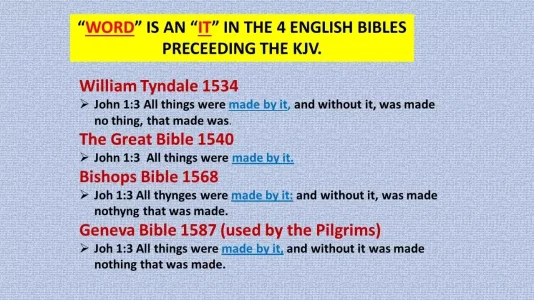
Tyndale used it” in John 1:3 because he chose the pronoun based on the English gender of the word worde rather than the masculine Greek gender of logos. In early 16th-century English, word was still treated as neuter (a holdover from Old English), so translators naturally used “it” for such nouns even when the original text used a masculine form. Thus, although logos is grammatically masculine in Greek, Tyndale’s English usage produced “it,” reflecting linguistic convention. Subsequent translations corrected this by emphasizing the masculine Greek gender.

The fact remains that the Word, who was God, tabernacled as Jesus on Earth. And because God cannot cease to be God, Jesus is God.
Almost every English version translates John 14:17 similarly to “even the Spirit of truth, whom the world cannot receive, because it neither sees him nor knows him.” Translators capitalize “Spirit” and use “he” and “him” because of their theology. The Greek word “spirit” is neuter and the text could also be translated as “the spirit of truth” and paired with “which” and “it.” The New American Bible reads “which the world cannot accept, because it neither sees nor knows it.” Capitalizing the “H” and “S” and using the English pronoun “He” is appropriate when God is being referred to as “the Holy Spirit.” However, when we see the “h” and “s” having the lowercase such as "the holy spirit" and all the pronouns referring to that spirit being impersonal such as “it” and “which” is when the subject under discussion is the gift of God’s nature.
 
Runningman:

I asked you to quote scripture that says Jesus is a man "right now," in this day and age. The scripture at Acts 2 is merely telling us he was a human in the first Century AD and has nothing to do with "right now."

The Bible indicates Jesus is the first of Jehovah's created angels.


"The Son is the image of the invisible God, the firstborn over all creation." (Colossians 1:15 -- New International Version)


"He is the image of the invisible God, the firstborn of all creation. (Colossians 1:15 -- English Standard Version)


Ah I see. Yes, Jesus was resurrected as a human and there is no narrative about him becoming anything different upon God's decision to take him to heaven. All of the writers, post-resurrection and post-ascension, continued referring to him as a man decades later. So it isn't as if the Bible says "Jesus is a man right now" but based on the broad testimony of the New Testament, he is. What do you think Jesus is right now?

Runningman:

You need to stop. You are up in here trying to correct the Trinitarians, but in reality, you're having issues yourself.

Scripture in the Christian Greek Scriptures aka the "New Testament" confirms that Jesus Christ--after his resurrection--was raised back to heavenly life. I will quote first from a Trinitarian Bible translation where it says Jesus appeared to many of his disciples for 40 days after his resurrection from the dead, and then he returned to heavenly life. Thereafter, I will quote from the New World Translation published by Jehovah's Witnesses since there are people making the fallacious claim that the New World Translation changed what the Bible originally said. Focus on the words enlarged and bolded in blue.


"{1} In my first book, O Theophilus, I wrote about all that Jesus began to do and to teach, {2} until the day He was taken up to heaven, after giving instructions through the Holy Spirit to the apostles He had chosen. {3} After His suffering, He presented Himself to them with many convincing proofs that He was alive. He appeared to them over a span of forty days and spoke about the kingdom of God." (Acts 1:1-3 -- Berean Study Bible)


NEW WORLD TRANSLATION QUOTATION IS BELOW:

Acts 1:1

The first account, O The·ophʹi·lus, I composed about all the things Jesus started to do and to teach

Acts 1:2

until the day that he was taken up, after he had given instructions through holy spirit to the apostles he had chosen.

Acts 1:3

After he had suffered, he showed himself alive to them by many convincing proofs. He was seen by them throughout 40 days, and he was speaking about the Kingdom of God.


Jesus himself said he came from heaven, so the comments by amazing grace and Peterlag, that Jesus was always human, is false. This time I will quote only from the New World Translation published by Jehovah's Witnesses. You can look it up at one of the Trinitarian Bible translations if that suits you.

John 6:35

Jesus said to them: “I am the bread of life. Whoever comes to me will not get hungry at all, and whoever exercises faith in me will never get thirsty at all.

John 6:36

But as I said to you, you have even seen me and yet do not believe.


John 6:37

All those whom the Father gives me will come to me, and I will never drive away the one who comes to me;

John 6:38

for I have come down from heaven to do, not my own will, but the will of him who sent me.

 
Peterlag:

Although I agree with some of what you have posted on the matter of Christendom's pagan trinity god at this website, I disagree with some of your comments.

Tell us, where did you get your information that, to quote you: "The logos is an 'it' not a 'him'"? Your claim that "Translators have deliberately chosen to use "him" at that particular portion of scripture (as opposed to "it") can hardly be dismissed as merely a theological choice when context is paid attention to. Part of the context to John 1:3 (surrounding words, verses, and chapters) makes it abundantly clear that the individual referred to as "the Word" or "the logos" is indeed a HIM. Notice part of the context below. The portions in brackets are my additions in order to clarify matters.


"{14} And the Word [the logos] was made flesh, and dwelt among us, being full of grace and truth: and we beheld his glory, the glory as of the only-begotten of the Father. {18} and though no one hath ever seen God, or can see Him: yet the only-begotten Son, who is in the bosom of the Father, hath made Him known. (John 1:14 and 18 -- Worsley New Testament)


"For God so loved the world, that he gave his only begotten Son, that whosoever believeth in him should not perish, but have everlasting life." (John 3:16 -- King James Bible)


Now, suppose you explain to those reading this thread how the term "only-begotten son" -- indicating a male gender-- turned into "it" within the context of the very same book of John, particularly the context at John 3:16 where it says in plain language that God gave his only-begotten son? Are you suggesting that John 3:16 was supposed to have said God "gave his only-begotten IT?"


Peterlag:

It's doesn't matter what translation of the Bible you are quoting from. Not a single version of the Bible was translated by inspiration of God. Most of them have translation errors -- some more so than others. Common sense should tell anyone that the word "it" at John 1:3 is wrong based upon the context. I've already directed you to part of the context at John 3:16 where it says:

"For God so loved the world, that he gave his only begotten Son, that whosoever believeth in him should not perish, but have everlasting life." (John 3:16 -- King James Bible)


So according to your argument, when the above verse says: "For God so loved the world, that he gave his only begotten Son,. . . ." that wasn't actually a son/male being referred to. Instead, that verse was referring to an "It."


I can see that you are just as stubborn as the Trinitarians that you are trying to correct. You're not willing to be corrected by scripture.


That said, I will leave you to your personal philosophy for now, until you post something else that's outrageous. When that happens, I will have to call you out, because you are misleading people with some of your comments.

You are anti-Trinitarian, and for that I give you credit.
 
Almost every English version translates John 14:17 similarly to “even the Spirit of truth, whom the world cannot receive, because it neither sees him nor knows him.” Translators capitalize “Spirit” and use “he” and “him” because of their theology. The Greek word “spirit” is neuter and the text could also be translated as “the spirit of truth” and paired with “which” and “it.” The New American Bible reads “which the world cannot accept, because it neither sees nor knows it.” Capitalizing the “H” and “S” and using the English pronoun “He” is appropriate when God is being referred to as “the Holy Spirit.” However, when we see the “h” and “s” having the lowercase such as "the holy spirit" and all the pronouns referring to that spirit being impersonal such as “it” and “which” is when the subject under discussion is the gift of God’s nature.
While it is true that the Greek noun πνεῦμα (pneuma, “spirit”) is grammatically neuter, Greek grammatical gender does not determine personal nature. Many personal beings in Greek take neuter nouns (e.g., παιδίον “child”), and personal beings are routinely referred to with neuter nouns without implying impersonality. To argue otherwise is to confuse grammar with ontology, a basic linguistic error.

More decisively, John himself emphasizes the Personhood of the Holy Spirit in John 14:26; 15:26; and especially 16:13–14. In those verses, Jesus refers to the Holy Spirit using the masculine demonstrative pronoun ἐκεῖνος (“he”), even though the antecedent πνεῦμα is neuter. This is not accidental or theologically imposed by translators—it is a deliberate grammatical irregularity in the Greek text. John does this because the Spirit is not merely “something,” but someone. Greek writers do not randomly break gender agreement rules; when they do, it is for emphasis. Here, the emphasis is personal identity.

Additionally, Jesus does not merely describe the Spirit as something possessed or received; He assigns the Spirit exclusively personal actions: the Spirit teaches (διδάξει), testifies (μαρτυρήσει), speaks (λαλήσει), hears (ἀκούει), guides (ὁδηγήσει), and glorifies (δοξάσει). These are not metaphors for divine energy or attributes; they are intentional, communicative, relational actions, which in Greek literature are never attributed to impersonal forces.

Your appeal to capitalization or English pronoun choice is therefore a distraction. Capitalization of words did not exist in Koine Greek manuscripts, and English capitalization is irrelevant to the underlying grammar. Likewise, citing an English translation such as the New American Bible that uses “which” or “it” proves nothing about the Greek—it only demonstrates a translation philosophy choice, not grammatical necessity. The decisive evidence lies in the original language, where John repeatedly treats the Spirit as a distinct personal agent, even overriding grammatical gender to do so.

Finally, the claim that lowercase “holy spirit” refers merely to an impersonal “gift of God’s nature” has no basis in the Greek text. Greek manuscripts do not distinguish between uppercase and lowercase theology, nor do they separate the Spirit into “personal” versus “impersonal” forms. Scripture consistently presents the Holy Spirit as God acting personally, not God distributing an abstract substance. The Spirit can be lied to (Acts 5:3–4), grieved (Ephesians 4:30), resisted (Acts 7:51), and speaks with authority (Acts 13:2)—all realities that are impossible if the Spirit were merely a thing.

In short, Greek grammar does not weaken the Personhood of the Holy Spirit—it powerfully confirms it. The argument that neuter grammar implies impersonality is textually unsupported, and contradicted by John’s own inspired words.
 
While it is true that the Greek noun πνεῦμα (pneuma, “spirit”) is grammatically neuter, Greek grammatical gender does not determine personal nature. Many personal beings in Greek take neuter nouns (e.g., παιδίον “child”), and personal beings are routinely referred to with neuter nouns without implying impersonality. To argue otherwise is to confuse grammar with ontology, a basic linguistic error.

More decisively, John himself emphasizes the Personhood of the Holy Spirit in John 14:26; 15:26; and especially 16:13–14. In those verses, Jesus refers to the Holy Spirit using the masculine demonstrative pronoun ἐκεῖνος (“he”), even though the antecedent πνεῦμα is neuter. This is not accidental or theologically imposed by translators—it is a deliberate grammatical irregularity in the Greek text. John does this because the Spirit is not merely “something,” but someone. Greek writers do not randomly break gender agreement rules; when they do, it is for emphasis. Here, the emphasis is personal identity.

Additionally, Jesus does not merely describe the Spirit as something possessed or received; He assigns the Spirit exclusively personal actions: the Spirit teaches (διδάξει), testifies (μαρτυρήσει), speaks (λαλήσει), hears (ἀκούει), guides (ὁδηγήσει), and glorifies (δοξάσει). These are not metaphors for divine energy or attributes; they are intentional, communicative, relational actions, which in Greek literature are never attributed to impersonal forces.

Your appeal to capitalization or English pronoun choice is therefore a distraction. Capitalization of words did not exist in Koine Greek manuscripts, and English capitalization is irrelevant to the underlying grammar. Likewise, citing an English translation such as the New American Bible that uses “which” or “it” proves nothing about the Greek—it only demonstrates a translation philosophy choice, not grammatical necessity. The decisive evidence lies in the original language, where John repeatedly treats the Spirit as a distinct personal agent, even overriding grammatical gender to do so.

Finally, the claim that lowercase “holy spirit” refers merely to an impersonal “gift of God’s nature” has no basis in the Greek text. Greek manuscripts do not distinguish between uppercase and lowercase theology, nor do they separate the Spirit into “personal” versus “impersonal” forms. Scripture consistently presents the Holy Spirit as God acting personally, not God distributing an abstract substance. The Spirit can be lied to (Acts 5:3–4), grieved (Ephesians 4:30), resisted (Acts 7:51), and speaks with authority (Acts 13:2)—all realities that are impossible if the Spirit were merely a thing.

In short, Greek grammar does not weaken the Personhood of the Holy Spirit—it powerfully confirms it. The argument that neuter grammar implies impersonality is textually unsupported, and contradicted by John’s own inspired words.
In this case the Greek grammar is correct because Jesus is not God.
 
Peterlag:

It's doesn't matter what translation of the Bible you are quoting from. Not a single version of the Bible was translated by inspiration of God. Most of them have translation errors -- some more so than others. Common sense should tell anyone that the word "it" at John 1:3 is wrong based upon the context. I've already directed you to part of the context at John 3:16 where it says:

"For God so loved the world, that he gave his only begotten Son, that whosoever believeth in him should not perish, but have everlasting life." (John 3:16 -- King James Bible)


So according to your argument, when the above verse says: "For God so loved the world, that he gave his only begotten Son,. . . ." that wasn't actually a son/male being referred to. Instead, that verse was referring to an "It."


I can see that you are just as stubborn as the Trinitarians that you are trying to correct. You're not willing to be corrected by scripture.


That said, I will leave you to your personal philosophy for now, until you post something else that's outrageous. When that happens, I will have to call you out, because you are misleading people with some of your comments.

You are anti-Trinitarian, and for that I give you credit.
What does John 3:16 have to do with the word "logos"?

For God so loved the world, that he gave his only begotten Son, that whosoever believeth in him should not perish, but have everlasting life.
 
I know the phrase is not there neither the description of a Triune God has nothing to do with blindness - it's because there is no Triune God.
You are a blind guide trying to distract, obscure, and hinder those who want to see. I pray that you open your eyes to the Truth before it is too late for you.

I have tried to help you see the Truth, but you refuse to open your eyes. I have done my duty to you; henceforth your soul is no longer on my conscience.
 
Runningman:

I asked you to quote scripture that says Jesus is a man "right now," in this day and age. The scripture at Acts 2 is merely telling us he was a human in the first Century AD and has nothing to do with "right now."

The Bible indicates Jesus is the first of Jehovah's created angels.


"The Son is the image of the invisible God, the firstborn over all creation." (Colossians 1:15 -- New International Version)


"He is the image of the invisible God, the firstborn of all creation. (Colossians 1:15 -- English Standard Version)
So are you Jehovah Witness ? They like you believe Jesus is a created angel
 
You are a blind guide trying to distract, obscure, and hinder those who want to see. I pray that you open your eyes to the Truth before it is too late for you.

I have tried to help you see the Truth, but you refuse to open your eyes. I have done my duty to you; henceforth your soul is no longer on my conscience.
I'm not trying to distract, obscure nor hinder those who want to see.......I have only shown from scripture that Jesus as the human Son of God, the human Messiah, the human King of the Jews is fully distinguished from His Father, who is God, the only true God, who alone is the true God.

I hope and pray that others will search the scriptures apart from the creeds and also find the truth.
Just know that according to scripture......the belief in a Triune God is not necessary for salvation.
Salvation is based upon belief in the Son of God -- our Lord Jesus Christ and truly our fellowship is with the Father and with his Son Jesus Christ.

Grace to you and peace from God our Father and the Lord Jesus Christ. Blessed be the God and Father of our Lord Jesus Christ, who has blessed us in Christ with every spiritual blessing in the heavenly places, even as he chose us in him before the foundation of the world, that we should be holy and blameless before him.......I do not cease to give thanks for you, remembering you in my prayers, that the God of our Lord Jesus Christ, the Father of glory, may give you the Spirit of wisdom and of revelation in the knowledge of him, having the eyes of your hearts enlightened, that you may know what is the hope to which he has called you, what are the riches of his glorious inheritance in the saints, and what is the immeasurable greatness of his power toward us who believe, according to the working of his great might that he worked in Christ when he raised him from the dead and seated him at his right hand..........[Eph. 1:2-4; 16-20]
 
You are a blind guide trying to distract, obscure, and hinder those who want to see. I pray that you open your eyes to the Truth before it is too late for you.

I have tried to help you see the Truth, but you refuse to open your eyes. I have done my duty to you; henceforth your soul is no longer on my conscience.
I wish I knew why a Trinity concept is so important to the Trinitarians that they argue day and night to defend it. A concept that is not even real. All I ever get from them when I ask is because the Bible teaches it. And then I show them that all of their verses that they quote are twisted like for example Thomas. And they come right back like if I never posted a thing and say Thomas said Jesus is God.
 
I'm not trying to distract, obscure nor hinder those who want to see.......I have only shown from scripture that Jesus as the human Son of God, the human Messiah, the human King of the Jews is fully distinguished from His Father, who is God, the only true God, who alone is the true God.
Jesus was indeed a human. But that doesn't stop Him from being God as well. As I said, I pray that your eyes are opened to that truth.
Just know that according to scripture......the belief in a Triune God is not necessary for salvation.
Salvation is based upon belief in the Son of God
Salvation is based upon belief in who Jesus really is. If you believe that He is just a man, then you do not really believe that what He said is true. You believe He is a liar, and if He is a liar then He cannot be your savior.

Peace.
 
I wish I knew why a Trinity concept is so important to the Trinitarians that they argue day and night to defend it. A concept that is not even real. All I ever get from them when I ask is because the Bible teaches it. And then I show them that all of their verses that they quote are twisted like for example Thomas. And they come right back like if I never posted a thing and say Thomas said Jesus is God.
You have yet to show that what Thomas said is being mistaken from what He intended. All you have given is your opinions, and they hold no weight whatsoever.
 
Jesus was indeed a human. But that doesn't stop Him from being God as well. As I said, I pray that your eyes are opened to that truth.

Salvation is based upon belief in who Jesus really is. If you believe that He is just a man, then you do not really believe that what He said is true. You believe He is a liar, and if He is a liar then He cannot be your savior.

Peace.
And you just can't drop it can you?

He said to them, “But who do you say that I am?” Simon Peter replied, “You are the Christ, the Son of the living God.” And Jesus answered him, “Blessed are you, Simon Bar-Jonah! For flesh and blood has not revealed this to you, but my Father who is in heaven. [Matthew 16:15-17]
For GOD so loved the world that HE GAVE HIS ONLY BEGOTTEN SON that whoever believes in him should not PERISH but have eternal life.....[John 3:16]
And the jailer called for lights and rushed in, and trembling with fear he fell down before Paul and Silas. Then he brought them out and said, “Sirs, what must I do to be saved?” And they said, “Believe in the Lord Jesus, and you will be saved, you and your household.” [Acts 16:29-31] ........
But God, being rich in mercy, because of the great love with which he loved us, even when we were dead in our trespasses, made us alive together with Christ—by grace you have been saved— and raised us up with him and seated us with him in the heavenly places in Christ Jesus, so that in the coming ages he might show the immeasurable riches of his grace in kindness toward us in Christ Jesus. For by grace you have been saved through faith. And this is not your own doing; it is the gift of God, not a result of works, so that no one may boast. For we are his workmanship, created in Christ Jesus for good works, which God prepared beforehand, that we should walk in them. [Eph. 2:4-10] ............ AND MANY MORE!!
🙏
 
And you just can't drop it can you?

He said to them, “But who do you say that I am?” Simon Peter replied, “You are the Christ, the Son of the living God.” And Jesus answered him, “Blessed are you, Simon Bar-Jonah! For flesh and blood has not revealed this to you, but my Father who is in heaven. [Matthew 16:15-17]
For GOD so loved the world that HE GAVE HIS ONLY BEGOTTEN SON that whoever believes in him should not PERISH but have eternal life.....[John 3:16]
And the jailer called for lights and rushed in, and trembling with fear he fell down before Paul and Silas. Then he brought them out and said, “Sirs, what must I do to be saved?” And they said, “Believe in the Lord Jesus, and you will be saved, you and your household.” [Acts 16:29-31] ........
But God, being rich in mercy, because of the great love with which he loved us, even when we were dead in our trespasses, made us alive together with Christ—by grace you have been saved— and raised us up with him and seated us with him in the heavenly places in Christ Jesus, so that in the coming ages he might show the immeasurable riches of his grace in kindness toward us in Christ Jesus. For by grace you have been saved through faith. And this is not your own doing; it is the gift of God, not a result of works, so that no one may boast. For we are his workmanship, created in Christ Jesus for good works, which God prepared beforehand, that we should walk in them. [Eph. 2:4-10] ............ AND MANY MORE!!
🙏
Sweetheart, you seem to think that "son" means descendant. Jesus is NOT God's descendant. Jesus was in Heaven with God before Creation. He is equal with God, and did not consider equality with God something to be held onto, but emptied Himself. He lowered Himself so that He became lesser than the Father and became a man. All of the verses you focus on only tell us that He was indeed a man. But He was not JUST a man. He was also God in the flesh.

I am done trying to get you to see this Truth. I pray that you open your eyes and your heart, and accept who Jesus really is. But until then, I have no desire to continue to through God's pearls fin your path. But when you are ready to listen to Truth, come back and I can instruct you.
 
Peter said, "For where two or three have gathered together in My name, I am there in their midst.

Oh wait, that was Jesus who said that. Matthew 18:20 So at any given moment, anywhere and everywhere on this globe, there are most likely hundreds, maybe thousands of people who have gathered together in Jesus' name - and in each and every one of them, at the same time, Jesus is there in their midst. Obviously, He is there in His Spirit, not physically, unless He chooses to show Himself physically.

Could any other man do that? Let's take Peter, can he be everywhere on earth at the same time? Obviously not, even if he was with us in his spirit (and we know that he is not), he could not be in more than one place at a time. The spirit of a man is not omnipresent, whether the man is alive or has died and gone to heaven. Only God is omnipresent.

Remember David mentioned that. "Where can I go from Your Spirit?" Or where can I flee from Your presence? If I ascend to heaven, You are there; If I make my bed in Sheol, behold, You are there. If I take the wings of the dawn, if I dwell in the remotest part of the sea, even there Your hand will lead me, and Your right hand will lay hold of me." Psalm 139:7-10

The bottom line? Jesus is omnipresent, an attribute that only God has. Jesus must be God!

These things are not rocket science. Even a Jehovah's Witness should be able to understand this.
 
Last edited:
Wrong

John 1:14 - "And the Word became flesh, and dwelt among us" - Yes.
So the Word in your opinion is flesh only? That's still a thing. Flesh doesn't incarnate, flesh is a creation. You're going to see that no matter the angle you choose you're going to run into issues like this until you get Biblical.
No, He was not flesh in the OT, He was God and with God (the Father). Everywhere in the OT where God speaks is Jesus, and the Father, and the Holy Spirit speaking.
God is also not flesh at any point in the Old Testament or New Testament. We have clear examples of God speaking, whether as a disembodied voice, or through messengers, but never as a human. We can surely find the Father in the Old Testament, as He is explicitly referenced several times, but why do you suppose there is never one reference to anyone under any known name of Jesus saying or doing anything until after he was born? Could it be because he is a human?
One more time for the slowest in class: The Word is God (John 1:1). The Word became flesh/a man (John 1:14), and we know the man the Word became as Jesus. The Word created everything that was made: Jesus created everything that was made.
1 John 1:1-3 refers to the Word as a thing (a that, which, this, that, it) and that the Word is eternal life, a thing that was revealed by or manifested in Jesus. Jesus isn't the Word, rather the Word is something Jesus has.

Technically the Word is not the Creator. Pay careful attention to the pronoun-antecedent agreement of John 1:2,3. Do you see the God the Word was with is the Him who created all? Who do you suppose the God the Word was with is?
John did not call the Word a "thing".
Non-personal pronouns like this, that, which, this, it etc do refer to things. You cannot change how vocabulary and grammar functions in all languages, religions, and cultures throughout all of civilization just to serve your religion.
There is no contradiction.
There's is none when the Bible is properly understood, but in your philosophy there are many contradictions.
"Work around this"? So you are admitting that you are attempting to "work around" (manipulate) the Truth to fit your preconceptions? Thank you for admitting that.
Working around the contradictions that trinitarian translators have introduced into Scripture, not working around the truth. Truth and your philosophy about what you want the Bible to say do no coexist harmoniously.
Not sure what you are talking about. John is not the speaker (at least not identified as the speaker) in Acts 4:23-31 (that is attributed to the companions to whom they reported (Acts 4:24)).
Acts 4:23,24 - John and Peter prayed to the Sovereign Lord and Creator
Acts 4:25 - Referred to David as God's servant
Acts 4:27 - Referred to Jesus as God's servant

The narrative in this passage speaks of Jesus being a servant through which God worked, a miracle worker and prophet like so many others in the Bible, not as God Himself. John didn't believe Jesus is God. He represented Jesus along the same lines as king David.
Bless your little heart!!

Yes, He is. And He is ALSO fully God.
No where does the Bible say Jesus is fully God. You couldn't discuss your beliefs using only the witness, testimony, and vocabulary of the Bible I presume. It's always going to be verses with your non-Biblical commentary attached to it, for now.
Wrong. Heb 8:13

Isa 9:6-7
"For a Child will be born to us, a Son will be given to us;
And the government will rest on His shoulders;
And His name will be called Wonderful Counselor, Mighty God,
Eternal Father, Prince of Peace.
7 There will be no end to the increase of His government or of peace
On the throne of David and over his kingdom,
To establish it and to uphold it with justice and righteousness
From then on and forevermore.
The zeal of the Lord of armies will accomplish this."

This is Jesus. Son of God equals Mighty God equals Eternal Father equals the Word equals Jesus.
This verse doesn't say it's Jesus nor does anyone reference this verse in relation to Jesus anywhere in the Bible. Care to take another swing?

Wait a minute. Just above, you said that the Word (which is Jesus) was a thing. Now Jesus is a "He". Hmm. Get your story straight here. 1 John 1:1-3 - "What was from the beginning, what we have heard, what we have seen with our eyes, what we have looked at and touched with our hands, concerning the Word of Life 2 and the life was revealed, and we have seen and testify and proclaim to you the eternal life, which was with the Father and was revealed to us 3 what we have seen and heard we proclaim to you also, so that you too may have fellowship with us; and indeed our fellowship is with the Father, and with His Son Jesus Christ."
Notice that Jesus here is called the "Word of Life", and the Life was revealed, the Life was with the Father (denoting preexistence and deity).
Jesus is not the Word. Jesus is a man, the Word is eternal life, something Jesus has. The fellowship isn't with the Word (eternal life) but rather with God and Jesus.

1 John 1
2And this is the life that was revealed; we have seen it and testified to it, and we proclaim to you the eternal life that was with the Father and was revealed to us.
3We proclaim to you what we have seen and heard, so that you also may have fellowship with us. And this fellowship of ours is with the Father and with His Son, Jesus Christ.

It is indeed a parallel, but in John 1:1-3 we are given additional details that we don't get from Nehemiah or Genesis: Jesus was with God and Jesus was God at Creation.

"John to the seven churches that are in Asia: Grace to you and peace from Him who is, and who was, and who is to come, and from the seven spirits who are before His throne, 5 and from Jesus Christ, the faithful witness, the firstborn of the dead, and the ruler of the kings of the earth. To Him who loves us and released us from our sins by His blood— 6 and He made us into a kingdom, priests to His God and Father—to Him be the glory and the dominion forever and ever. Amen. 7 Behold, He is coming with the clouds, and every eye will see Him, even those who pierced Him; and all the tribes of the earth will mourn over Him. So it is to be. Amen.
8 “I am the Alpha and the Omega,” says the Lord God, “who is and who was and who is to come, the Almighty.”"

Who is speaking in verse 8? It is Jesus who is speaking. For He is the one who released us from our sin by His blood. He is the One who made us into a Kingdom of priests. He is the One coming in the clouds whom very eye will see. He is the Lord God.
Jesus isn't speaking in verse 8. In verse 4 we see there is "Him who is, and who was, and who is to come" and in verse 5 "and from Jesus Christ" who is said to have a God and Father. Then verse 8 "Him who is, and who was, and who is to come" is said to be the Lord God, the Almighty, so not Jesus. Jesus isn't his own God, ever.
The red letters are meaningless; they are man's convention to make it clearer who the translator thinks is speaking. But they are not part of the original writings. What matters it what the original Scripture says.
So you admit that the Bible can be translated and published subjectively. That's good to know. Being critical of the Biblical text isn't the same thing as being dismissive or non-believing, but it is wise to vet what people who translated the Bible claim it's supposed to say. No one is going to do it for us, we must take the matter into our own hands and put in the time and study.
It is irrelevant that they don't share some titles. What is relevant is that they share the titles "Mighty God", "Eternal Father", "Alpha and Omega", and several others. It is also significant that Jesus is the very image of the Eternal God (Col 1:15).
You can't prove that Isaiah 9:6 is about Jesus or that the translation you provided is the accurate one. For starters, we know that Jesus was never called "Mighty God", "Eternal Father" in the entire Bible.
As a man, He grew. As God He already knew everything. Remember, He emptied Himself when He became a man, so He had room to be refilled.
It doesn't say "he emptied himself of being God" you are adding that to the text.
What a shallow response.
Ditto.
 
Last edited:
So the Word in your opinion is flesh only?
No, the Word is NOT flesh ONLY. The Word was spirit that took on flesh.
That's still a thing. Flesh doesn't incarnate,
Do you have any idea what "incarnate" means? Obviously not.
God is also not flesh at any point in the Old Testament or New Testament.
The Father is not. But the Son is.
We have clear examples of God speaking, whether as a disembodied voice, or through messengers, but never as a human. We can surely find the Father in the Old Testament, as He is explicitly referenced several times, but why do you suppose there is never one reference to anyone under any known name of Jesus saying or doing anything until after he was born? Could it be because he is a human?
Sure He is human. That is demonstrated many times in the NT Scripture. But He was there in the OT too. He was there are Creation, for all that was created was created by/through Him. He was there in the burning bush, for He is the I AM that spoke to Moses.
1 John 1:1-3 refers to the Word as a thing (a that, which, this, that, it)
You don't understand English either. "That which I say about runningman, I declare to you." Are you just a thing? No, you are a person.
Technically the Word is not the Creator. Pay careful attention to the pronoun-antecedent agreement of John 1:2,3. Do you see the God the Word was with is the Him who created all? Who do you suppose the God the Word was with is?
The Word was with God, and the Word was God. The Word was both with (meaning a separate being) and was (meaning equal to) the Father.
Working around the contradictions that trinitarian translators have introduced into Scripture, not working around the truth.
There is no contradiction (except in your mind). The Word/Logos (which is indeed a "thing") took on flesh (John 1:14) and became a man. This is a very crude analogy, but if you remember in Bicentennial Man, when the robot became a free, "living", self-aware being, it became a "he" in the eyes of it's/his owner. The Word was never bound/enslaved. The Word was always living. The Word was always self-aware. The Word was essential to the process of creation. That means that the Word (even though the word Logos/Word does indicate a "thing") can be referred to as a "HE" because in this case it is a proper noun, it refers to a specific "thing" that happens to also be a male person, Jesus.
Acts 4:23,24 - John and Peter prayed to the Sovereign Lord and Creator
Acts 4:25 - Referred to David as God's servant
Acts 4:27 - Referred to Jesus as God's servant

The narrative in this passage speaks of Jesus being a servant through which God worked, a miracle worker and prophet like so many others in the Bible, not as God Himself. John didn't believe Jesus is God. He represented Jesus along the same lines as king David.
John is the writer who most specifically demonstrates the humanity AND deity of Jesus. Just because in one place he highlights the humanity of Jesus doesn't in any way take away from the places he emphasizes His deity.
No where does the Bible say Jesus is fully God.
John 1:1
You couldn't discuss your beliefs using only the witness, testimony, and vocabulary of the Bible I presume. It's always going to be verses with your non-Biblical commentary attached to it, for now.
Sure I can, and have.
This verse doesn't say it's Jesus nor does anyone reference this verse in relation to Jesus anywhere in the Bible. Care to take another swing?
Luke 1:32-33: Describes Jesus as the ruler who will "reign over the house of Jacob forever, and of his kingdom there will be no end," directly echoing Isaiah 9:7's promise of endless government and peace on David's throne.
Matt 2: While not quoting Isaiah 9:6, the narratives of Jesus' birth and the arrival of the Magi (who sought the "King of the Jews") point to the fulfillment of the Messiah's arrival described in Isaiah.
Eph 2:14: Calls Jesus "our peace, who has made us both one and has broken down in his flesh the dividing wall of hostility," connecting to Isaiah's "Prince of Peace" and His reconciling work.
Yes, Isa 9:6-7 does refer to Jesus. He is the King who is descended from David who established an everlasting Kingdom and is the Prince of Peace. The other titles attributed to Him by Isaiah therefore do apply to Jesus.
Jesus is not the Word. Jesus is a man,
Yes, Jesus is the Word. That is what John 1:14 tells us. The Word became/took on/put on flesh and dwelt among men; we know this man as Jesus of Nazareth.
the Word is eternal life, something Jesus has.
The Word is eternal life (thank you for admitting that). And the Word is Jesus (John 1:14). That means that Jesus IS eternal life.
The fellowship isn't with the Word (eternal life) but rather with God and Jesus.

1 John 1
2And this is the life that was revealed; we have seen it and testified to it, and we proclaim to you the eternal life that was with the Father and was revealed to us.
3We proclaim to you what we have seen and heard, so that you also may have fellowship with us. And this fellowship of ours is with the Father and with His Son, Jesus Christ.
The Life that was with the Father and has been revealed to us. What was revealed to us? The Word that became flesh. Who is the Word that became flesh? Jesus.
Jesus isn't speaking in verse 8.
Again, your opinion.
In verse 4 we see there is "Him who is, and who was, and who is to come" and in verse 5 "and from Jesus Christ" who is said to have a God and Father. Then verse 8 "Him who is, and who was, and who is to come" is said to be the Lord God, the Almighty, so not Jesus. Jesus isn't his own God, ever.
Again, your opinions. Not what Scripture says.
You can't prove that Isaiah 9:6 is about Jesus or that the translation you provided is the accurate one. For starters, we know that Jesus was never called "Mighty God", "Eternal Father" in the entire Bible.
Again, your blindness and disbelief.
It doesn't say "he emptied himself of being God" you are adding that to the text.
I never said He emptied Himself of being God. That is one thing of which He did not empty Himself. He emptied Himself of the use of His power and authority. He emptied Himself of His glory. He emptied Himself of His knowledge. He emptied Himself of His honor. But He did not cease to be God. The angels are lesser than God, and man is lesser than the angels. So when the Word that was God became a man, of course He became lesser than God (the Father). But He didn't cease to be deity.
 
Back
Top Bottom