Wrong
John 1:14 - "And the Word became flesh, and dwelt among us" - Yes.
So the Word in your opinion is flesh only? That's still a thing. Flesh doesn't incarnate, flesh is a creation. You're going to see that no matter the angle you choose you're going to run into issues like this until you get Biblical.
No, He was not flesh in the OT, He was God and with God (the Father). Everywhere in the OT where God speaks is Jesus, and the Father, and the Holy Spirit speaking.
God is also not flesh at any point in the Old Testament or New Testament. We have clear examples of God speaking, whether as a disembodied voice, or through messengers, but never as a human. We can surely find the Father in the Old Testament, as He is explicitly referenced several times, but why do you suppose there is never one reference to anyone under any known name of Jesus saying or doing anything until after he was born? Could it be because he is a human?
One more time for the slowest in class: The Word is God (John 1:1). The Word became flesh/a man (John 1:14), and we know the man the Word became as Jesus. The Word created everything that was made: Jesus created everything that was made.
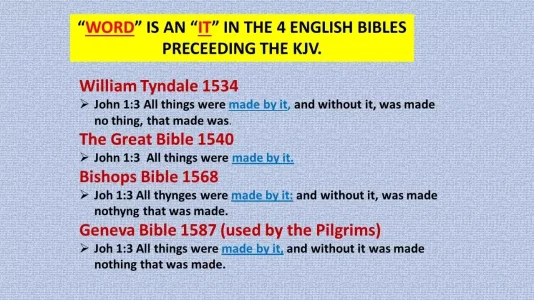
1 John 1:1-3 refers to the Word as a thing (a that, which, this, that, it) and that the Word is eternal life, a thing that was revealed by or manifested in Jesus. Jesus isn't the Word, rather the Word is something Jesus has.
Technically the Word is not the Creator. Pay careful attention to the pronoun-antecedent agreement of John 1:2,3. Do you see the God the Word was with is the Him who created all? Who do you suppose the God the Word was with is?
John did not call the Word a "thing".
Non-personal pronouns like
this, that, which, this, it etc do refer to
things. You cannot change how vocabulary and grammar functions in all languages, religions, and cultures throughout all of civilization just to serve your religion.
There is no contradiction.
There's is none when the Bible is properly understood, but in your philosophy there are many contradictions.
"Work around this"? So you are admitting that you are attempting to "work around" (manipulate) the Truth to fit your preconceptions? Thank you for admitting that.
Working around the contradictions that trinitarian translators have introduced into Scripture, not working around the truth. Truth and your philosophy about what you want the Bible to say do no coexist harmoniously.
Not sure what you are talking about. John is not the speaker (at least not identified as the speaker) in Acts 4:23-31 (that is attributed to the companions to whom they reported (Acts 4:24)).
Acts 4:23,24 - John and Peter prayed to the Sovereign Lord and Creator
Acts 4:25 - Referred to David as God's servant
Acts 4:27 - Referred to Jesus as God's servant
The narrative in this passage speaks of Jesus being a servant through which God worked, a miracle worker and prophet like so many others in the Bible, not as God Himself. John didn't believe Jesus is God. He represented Jesus along the same lines as king David.
Bless your little heart!!
Yes, He is. And He is ALSO fully God.
No where does the Bible say Jesus is fully God. You couldn't discuss your beliefs using only the witness, testimony, and vocabulary of the Bible I presume. It's always going to be verses with your non-Biblical commentary attached to it, for now.
Wrong. Heb 8:13
Isa 9:6-7
"For a Child will be born to us, a Son will be given to us;
And the government will rest on His shoulders;
And His name will be called Wonderful Counselor, Mighty God,
Eternal Father, Prince of Peace.
7 There will be no end to the increase of His government or of peace
On the throne of David and over his kingdom,
To establish it and to uphold it with justice and righteousness
From then on and forevermore.
The zeal of the Lord of armies will accomplish this."
This is Jesus. Son of God equals Mighty God equals Eternal Father equals the Word equals Jesus.
This verse doesn't say it's Jesus nor does anyone reference this verse in relation to Jesus anywhere in the Bible. Care to take another swing?
Wait a minute. Just above, you said that the Word (which is Jesus) was a thing. Now Jesus is a "He". Hmm. Get your story straight here. 1 John 1:1-3 - "What was from the beginning, what we have heard, what we have seen with our eyes, what we have looked at and touched with our hands, concerning the Word of Life 2 and the life was revealed, and we have seen and testify and proclaim to you the eternal life, which was with the Father and was revealed to us 3 what we have seen and heard we proclaim to you also, so that you too may have fellowship with us; and indeed our fellowship is with the Father, and with His Son Jesus Christ."
Notice that Jesus here is called the "Word of Life", and the Life was revealed, the Life was with the Father (denoting preexistence and deity).
Jesus is not the Word. Jesus is a man, the Word is eternal life, something Jesus has. The fellowship isn't with the Word (eternal life) but rather with God and Jesus.
1 John 1
2And
this is the life that was revealed; we have seen
it and testified to
it, and we proclaim to
you the eternal life that was with the Father and was revealed to us.
3We proclaim to you
what we have seen and heard, so that you also may have fellowship with us. And this fellowship of ours is with the Father and with His Son, Jesus Christ.
It is indeed a parallel, but in John 1:1-3 we are given additional details that we don't get from Nehemiah or Genesis: Jesus was with God and Jesus was God at Creation.
"John to the seven churches that are in Asia: Grace to you and peace from Him who is, and who was, and who is to come, and from the seven spirits who are before His throne, 5 and from Jesus Christ, the faithful witness, the firstborn of the dead, and the ruler of the kings of the earth. To Him who loves us and released us from our sins by His blood— 6 and He made us into a kingdom, priests to His God and Father—to Him be the glory and the dominion forever and ever. Amen. 7 Behold, He is coming with the clouds, and every eye will see Him, even those who pierced Him; and all the tribes of the earth will mourn over Him. So it is to be. Amen.
8 “I am the Alpha and the Omega,” says the Lord God, “who is and who was and who is to come, the Almighty.”"
Who is speaking in verse 8? It is Jesus who is speaking. For He is the one who released us from our sin by His blood. He is the One who made us into a Kingdom of priests. He is the One coming in the clouds whom very eye will see. He is the Lord God.
Jesus isn't speaking in verse 8. In verse 4 we see there is "
Him who is, and who was, and who is to come" and in verse 5 "and from Jesus Christ" who is said to have a God and Father. Then verse 8 "Him who is, and who was, and who is to come" is said to be the Lord God, the Almighty, so not Jesus. Jesus isn't his own God, ever.
The red letters are meaningless; they are man's convention to make it clearer who the translator thinks is speaking. But they are not part of the original writings. What matters it what the original Scripture says.
So you admit that the Bible can be translated and published subjectively. That's good to know. Being critical of the Biblical text isn't the same thing as being dismissive or non-believing, but it is wise to vet what people who translated the Bible claim it's supposed to say. No one is going to do it for us, we must take the matter into our own hands and put in the time and study.
It is irrelevant that they don't share some titles. What is relevant is that they share the titles "Mighty God", "Eternal Father", "Alpha and Omega", and several others. It is also significant that Jesus is the very image of the Eternal God (Col 1:15).
You can't prove that Isaiah 9:6 is about Jesus or that the translation you provided is the accurate one. For starters, we know that Jesus was never called "Mighty God", "Eternal Father" in the entire Bible.
As a man, He grew. As God He already knew everything. Remember, He emptied Himself when He became a man, so He had room to be refilled.
It doesn't say "he emptied himself of being God" you are adding that to the text.
Ditto.