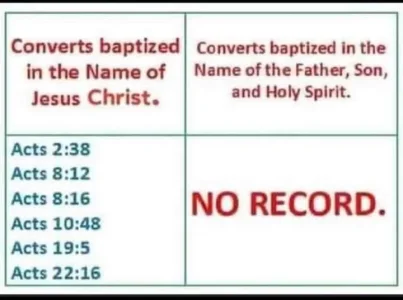
The Trinity and all of its supporting doctrines are all circular in reasoning

1 John 4:3 does indeed say...

And every spirit that confesseth not that Jesus Christ is come in the flesh is not of God:
[That would be the Trinitarians.]

1 John 4:3 does not say...
And every spirit that confesseth not that God is come in the flesh is not of God:
Projecting its Unitarians.
 
Nobody carried out such a request that Trinitarians say came from Jesus.
What request are you talking about?
1 John 4:3 does indeed say...

And every spirit that confesseth not that Jesus Christ is come in the flesh is not of God:
[That would be the Trinitarians.]
In what way have I ever said or insinuated that Jesus did not come in the flesh? Hmmm???
1 John 4:3 does not say...
And every spirit that confesseth not that God is come in the flesh is not of God:
That is exactly what 1 John 4:3 says. Jesus IS God. You cannot get around that fact with your twisting of Scripture.
 
Readers Bible 101- the spirit of antichrist denies God has come in the flesh as per Scripture.

John 1:1- the Word was God
John 1:14 the Words( who was God ) became flesh
1 Timothy 3:16- And without controversy great is the mystery of godliness: God was manifested in the flesh, Justified in the Spirit, Seen by angels, Preached among the Gentiles, Believed on in the world, Received up in glory. cf Philippians 2:1-11.

The number one test to distinguish truth for error and the Spirit of God from that of the spirit of antichrist is the confession of our divine Lord Jesus Christ. Every spirit that confesses Jesus Christ has come in the flesh is from God. There is one thing the spirit of antichrist will deny and that is they will deny He is God in the flesh- that He is fully God and fully man. They will deny God in human flesh. They will always deny the Incarnation which was permanent. When a person affirms that Jesus Christ is God in flesh that equates to divine truth. Every spirit that confesses meaning to continually confess or agrees with saying the same thing as John declares in his writings is from God. This is the person who is taught by the Spirit of God according to John. The first test that you want to have for any teacher is their Christology, check out what they say about Christ. This becomes a litmus test that is very easy to spot among the false teachers in the N.T. times which we can apply today. If you have somebody who denies the deity of Christ you have a clear indication their teaching comes from the spirit of antichrist.

If we go back to the beginning of 1 John, we read that which we he beheld, and actually touched concerning the Word of life. That is a term expressing the very deity of Christ. Christ emanates from God as His living Word. He was with the Father in the beginning in 1:2. Jesus was One with the Father sharing the same essence with the Father in heaven with Him before the foundation of the world. John says He was manifested to us. John's language then starts out with the fact that Jesus Christ emanates from God as the very living Word of God. Jesus is the living Word of God,the One John says that was from the beginning that we heard, we saw and we touched. Jesus the Word of life was the eternal One who was with the Father prior to His Incarnation and was then manifested to us in the flesh that we could see and hear and touch according to John. Therefore, we can clearly see Jesus is the very Word of God Incarnate. He is the eternal life who became flesh. The Word who was with God, the Word who was God, was the One who John says was manifested to us. This is how we can tell the spirit of truth from the spirit of antichrist. Can you confess Jesus is God Incarnate?

1 John 4:2
By this you know the Spirit of God: every spirit that confesses that Jesus Christ has come in the flesh is from God;

2 John 7
For many deceivers have gone out into the world, those who do not acknowledge Jesus Christ as coming in the flesh. This is the deceiver and the antichrist.

Erchomenon the present participle in 2 John 7

Alford
- the present tense is timeless(pg 274 RNTC on 2 John)

Brooke- the Incarnation is not only an event in history, it is an abiding truth(pg 274 RNTC on 2 John)

Stott- the two natures manhood and Godhood were united already at His birth, never to be divided. In 1 John 4:2 and here in 2 John 7 emphasizes this permanent union of the natures in the One Person ( TNTC pages 209-210) He who denies the Incarnation is not just a deceiver and an antichrist but “the deceiver and the antichrist”. There is in this heresy a double affront: it opposes Christ and deceives men.(stott TNCT page 210)

Marshall- the use of the present and perfect tenses becomes significant if the point is that Jesus Christ had come and still existed “in flesh”. For him(John) it was axiomatic that there had been a true Incarnation, that the word became flesh and remained flesh. It is a point that receives much stress in 1 John 2:18-28, 4:1-6, 5:5-8. (NICNT pages 70-71)

Smalley- the present tense emphasizes the permanent union of the human and Divine natures in Jesus. Gods self disclosure in Jesus took place at a particular moment in history , but it has continuing effects in the present and into the future(Word Biblical Commentary page 317)

Nicoll- the continuous manifestation of the Incarnate Christ(Expositors Greek Testament Volume 5 page 202)

Akin- Much has been made of the fact that John uses the present tense in this Christological confession. Literally the verse reads, “Jesus Christ coming in flesh.” “Coming” is a present active participle. This stands out in remarkable contrast to the affirmation of 1 John 4:2, where the text states that “Jesus Christ has [emphasis mine] come in the flesh.” There the perfect active participle is used. The key, it seems, is to discover what John is affirming. Here in 2 John the emphasis falls on the abiding reality of the incarnation. First John 4:2 teaches that the Christ, the Father’s Son (v. 3), has come in the flesh. Second John affirms that the wedding of deity and humanity has an abiding reality (cf. 1 Tim 2:5). The ontological and essential nature of the incarnation that would receive eloquent expression one thousand years later in the writing of St. Anselm (1033–1109) in his classic Cur Deus Homo is already present in seed form in the tiny and neglected letter of 2 John.

Lenski- In 1 John 4:2 we have ἐν σαρκὶ ἐληλυθότα, the perfect participle, “as having come in flesh” (incarnate, John 1:14); here we have ἐρχόμενον ἐν σαρκί, “as coming in flesh,” although the participle is present in form it is really timeless.of Christ as "still being manifested." See the note at 1 John 3:5. In 1 John 4:2 we have the manifestation treated as a past fact by the perfect tense, ‎eleeluthota ‎"has come

Robertson- That Jesus Christ cometh in the flesh Ieesoun ‎‎Christon ‎‎erchomenon ‎‎en ‎‎sarki‎. "Jesus Christ coming in the flesh." Present middle participle of ‎erchomai treating the Incarnation as a continuing fact which the Docetic Gnostics flatly denied. In 1 John 4:2 we have ‎eleeluthota ‎(perfect active participle) in this same construction with ‎homologeoo‎, because there the reference is to the definite historical fact of the Incarnation.

hope this helps !!!
 
continued:

Colossians 2:9
King James Bible
For in him dwelleth all the fulness of the Godhead bodily

Now read the Greek below on the present ongoing meaning of DWELLS . The bodily dwelling of Deity is permanent not temporary. The Incarnation was PERMANENT.

κατοικεῖ (katoikei)
Verb - Present Indicative Active - 3rd Person Singular
Strong's Greek 2730: To dwell in, settle in, be established in (permanently), inhabit. From kata and oikeo; to house permanently, i.e. Reside.

8.2 σωματικός, ή, όν; σωματικῶςa: (derivatives of σῶμαa ‘body,’ 8.1) pertaining to a physical body—‘bodily, physical, bodily form.’[1] Louw Nida

Expositor's Greek Testament
Colossians 2:9. in Him and in Him alone.—κατοικεῖ: “permanently dwells”. The reference is to the Exalted State, not only on account of the present, but of the context and Paul’s Christology generally.—πᾶν τὸ πλήρωμα τῆς θεότητος: “all the fulness of the Godhead”. πᾶν is emphatic, the whole fulness dwells in Christ.

Body
sōmatikṓs (an adverb, derived from 4984 /sōmatikós which is an adjective derived from 4983 /sṓma, "body") – bodily(used only in Col 2:9)Loew & Nida Greek Lexicon

Never once in the NT is soma ever used of something nonphysical or immaterial .

Paul is talking in Col chapters 2-3 about the glorified resurrected Christ now seated at the right hand of God not the earthly Christ pre resurrection. This is a slam dunk that He is in a human glorified resurrection body and that He continues to have all the fullness of Deity dwelling bodily in the present.

Bodily (σωματικῶς) In bodily fashion or bodily-wise. The verse contains two distinct assertions: 1. That the fullness of the Godhead eternally dwells in Christ. The present tense κατοικεῖ dwelleth, is used like ἐστιν is (the image), Colossians 1:15, to denote an eternal and essential characteristic of Christ's being. The indwelling of the divine fullness in Him is characteristic of Him as Christ, from all ages and to all ages. Hence the fullness of the Godhead dwelt in Him before His incarnation, when He was "in the form of God" (Philippians 2:6). The Word in the beginning, was with God and was God (John 1:1). It dwelt in Him during His incarnation. It was the Word that became flesh and dwelt among us, full of grace and truth, and His glory which was beheld was the glory as of the Only begotten of the Father (John 1:14; compare 1 John 1:1-3). The fullness of the Godhead dwells in His glorified humanity in heaven.

2. The fullness of the Godhead dwells in Him in a bodily way, clothed the body. This means that it dwells in Him as one having a human body. This could not be true of His preincarnate state, when He was "in the form of God," for the human body was taken on by Him in the fullness of time, when "He became in the likeness of men" (Philippians 2:7), when the Word became flesh. The fullness of the Godhead dwelt in His person from His birth to His ascension. He carried His human body with Him into heaven, and in His glorified body now and ever dwells the fullness of the Godhead. Vincent Greek Word Studies

(2:9) Commenting on the contents of this verse, Lightfoot says; “The apostle justifies the foregoing charge that the doctrine was not according to Christ: ‘In Christ dwells the whole plērōma (πληρωμα) (fulness, plenitude), the entire fulness of the Godhead, whereas they represent it to you as dispersed among several spiritual agencies. Christ is the fountain-head of all spiritual life, whereas they teach you to seek it in communion with inferior creatures.’ ”

Dwelleth” is katoikei (κατοικει). Oikeō (Ὀικεω) means “to be at home.” Kata (Κατα), prefixed, means “down,” thus showing permanence. The compound verb was used of the permanent residents of a town as compared with the transient community. The verb is in the present tense, showing durative action. The translation reads: “Because in Him there is continuously and permanently at home all the fulness of the Godhead in bodily fashion.”

Dwelleth imports more than a transient stay for a few minutes, or a little while, even abiding in him constantly and for ever, as dwelling most usually notes, 2 Corinthians 6:16. That which doth thus perpetually abide in his person, as denominated after the human nature, is all the fulness of the Godhead, viz. that rich and incomprehensible abundance of perfections, whereof the supreme and adorable nature is full; so that indeed there is not at all any perfection or excellency in the Divine nature but is found abiding in him. And after no common or ordinary way, but by a hypostatical or personal union of the Godhead with the manhood in Christ; which is not by way of mixture, confusion, conversion, or any other mutation;


bodily, to exclude that inhabitation which is only by extrinsical denomination. It being an adverb, doth denote the manner as well as the subject; wherefore when he speaks of the temple of his body, John 2:21, that doth not fully reach the apostle’s meaning here: but it must be expounded personally, since in the Greek that which signifies with us a body, and so our English word body, is put for a person, Romans 12:1 2 Corinthians 5:10 Revelation 18:13: somebody or nobody, i.e. some person or no person. There is a presence of the Godhead general, by essence and power; particular, in the prophets and apostles working miracles: gracious, in all sanctified ones; glorious, in heaven, in light which no man can approach unto, 1 Timothy 6:16; relative, in the church visible and ordinances, typically under the law, and symbolically in the sacraments: but all these dwellings, or being present in the creature, fall short of that in the text, viz. bodily, connoting the personal habitation of the Deity in, and union of it with, the humanity of Christ, so close, and strait, and intimate, that the Godhead inhabiting and the manhood inhabited make but one and the same person, even as the reasonable soul and body in man make but one man. The way of the presence of the Deity with the humanity of Christ is above all those manners of the presence of God with angels and men. The Godhead dwells in him personally, in them in regard of assistance and energy: Godhead notes the truth of it; Christ was not only partaker of the Divine nature, 2 Peter 1:4, but the very Godhead dwells in him: it is not only the Divinity (as the Socinians, following the Vulgar Latin in this, would have it) but the Deity, the very nature and essence of God. Now it is observable, though in God himself Divinity and Deity be indeed the same, Romans 1:20, and may differ only from the manner of our conception and contemplation; yet here, when the enemies to Christ’s Deity might by their cavilling make more use of the word Divinity, (as when the soul of man is said to be a divine thing), to insinuate as if it here noted only the Divine will exclusive to the other attributes, (which exclusion the term all doth significantly prevent), the apostle puts in Deity or Godhead. Then lest Christ might (as by the Arians) be deemed a secondary God, or (as some since) a made god, inferior to the Father, he saith the fulness of the Godhead, which speaks him perfect God, coequal with the Father: further, connoting a numerical sameness of essence between the Godhead of the Father and the Son, all the fulness of the Godhead dwelleth in him. There is not one fulness of the Father and another of the Son, but one and the same singular Godhead in both, John 10:30. The fulness of the manhood in Adam and Eve were not numerically the same, but the Godhead of the Father and the Son is: yet is not the manhood of Christ co-extended and commensurate with the Godhead (as some Lutherans conceit); but where the manhood is, or Christ as man is, or hath his existence, there the fulness of the Godhead dwells bodily: so that this fulness is extended as the manhood only in which it is, and not as far as the Deity in which this derivative fulness is not as in its seat, though it be all originally from it, but inherently or subjectively in Christ. Matthew Poole

Conclusion: no one in the history of mankind has ever had all the fulness of Deity in them except Christ alone who is God manifest in the flesh. just as the Father and the Holy Spirit have all the fulness of Deity, so to does the Incarnate Son- Forever God in the flesh !

What a Marvelous Triune God we serve !

hope this helps !!!
 
What request are you talking about?

In what way have I ever said or insinuated that Jesus did not come in the flesh? Hmmm???

That is exactly what 1 John 4:3 says. Jesus IS God. You cannot get around that fact with your twisting of Scripture.
Me twist Scripture? That's impossible. Again, the verse says Jesus Christ came in the flesh. Not God came in the flesh. Now where's the twist?

1 John 4:3 does indeed say...

And every spirit that confesseth not that Jesus Christ is come in the flesh is not of God:
[That would be the Trinitarians.]

1 John 4:3 does not say...
And every spirit that confesseth not that God is come in the flesh is not of God:

See page 1917...


1773235247558.webp
 
Last edited:
Me twist Scripture? That's impossible.
So you are God? You are perfect and infallible? I didn't realize; I am humbled to be in your august presence (dripping sarcasm).
Again, the verse says Jesus Christ came in the flesh. Not God came in the flesh. Now where's the twist?
Yes, it says Jesus Christ came in the flesh. And John 1 says that Jesus Christ is the Word, and the Word is God: Jesus Christ is God.
1 John 4:3 does indeed say...

And every spirit that confesseth not that Jesus Christ is come in the flesh is not of God:
[That would be the Trinitarians.]

1 John 4:3 does not say...
And every spirit that confesseth not that God is come in the flesh is not of God:

See page 1917...


View attachment 2880
The name of Jesus Christ is synonymous with "the Father, Son, and Holy Spirit". The Father and the Son are one. If you have seen the Son, then you have seen the Father. The Holy Spirit is the Spirit of God. If you act in the name of the Son, then you are acting in the name of God. If you act in the name of the Father, then you are acting in the name of God. They are all the same God.
 
Jesus is Theos. The New Testament Greek word for God, Theos, is the corresponding parallel to the Old Testament Hebrew term Elohim. A well-known example of Christ being addressed as God (Theos) is found in the story of “doubting Thomas” in John 20. In this passage, Thomas witnesses the resurrected Christ and worshipfully responds: “My Lord and my God [Theos]” (John 20:28).

Jesus is called Theos throughout the rest of the New Testament. For example, when a jailer asked Paul and Silas how to be saved, they responded: “Believe on the Lord Jesus, and you will be saved, you and your household” (Acts 16:31). After the jailer believed and became saved, he “rejoiced, having believed in God [Theos] with all his household” (verse 34). Believing in Christ and believing in God are seen as identical acts.

Jesus possesses attributes that belong only to God.

Jesus is eternal. John 1:1 affirms: “In the beginning was the Word, and the Word was with God, and the Word was God.” The word was in this verse is an imperfect tense, indicating continuous, ongoing existence. When the timespace universe came into being, Christ already existed (Hebrews 1:8–11).

Jesus is self-existent. As the Creator of all things (John 1:3; Colossians 1:16; Hebrews 1:2), Christ himself must be uncreated. Colossians 1:17 tells us that Christ is “before all things, and in Him all things consist.”

Jesus is everywhere-present. Christ promised His disciples, “Where two or three are gathered together in My name, I am there in the midst of them” (Matthew 18:20). Since people all over the world gather in Christ’s name, the only way He could be present with them all is if He is truly omnipresent (see Matthew 28:20; Ephesians 1:23, 4:10; Colossians 3:11).

Jesus is all-knowing. Jesus knew where the fish were in the water (Luke 5:4, 6; John 21:6–11), and He knew just which fish contained the coin (Matthew 17:27). He knew the future (John 11:11, 18:4), specific details that would be encountered (Matthew 21:2–4), and knew from a distance that Lazarus had died (John 11:14). He also knows the Father as the Father knows Him (Matthew 11:27; John 7:29, 8:55, 10:15, 17:25).

Jesus is all-powerful. Christ created the entire universe (John 1:3; Colossians 1:16; Hebrews 1:2) and sustains the universe by His own power (Colossians 1:17; Hebrews 1:3). During His earthly ministry, He exercised power over nature (Luke 8:25), physical diseases (Mark 1:29–31), demonic spirits (Mark 1:32–34), and even death (John 11:1–44).

Jesus is sovereign. Christ presently sits at the right hand of God the Father, “angels and authorities and powers having been made subject to Him” (1 Peter 3:22). When Christ comes again in glory, He will be adorned with a majestic robe, and on the thigh section of the robe will be the words, “KING OF KINGS AND LORD OF LORDS” (Revelation 19:16).

Jesus is sinless. Jesus challenged Jewish leaders: “Which of you convicts Me of sin?” (John 8:46). The apostle Paul referred to Jesus as “Him who knew no sin” (2 Corinthians 5:21). Jesus is one who “loved righteousness and hated lawlessness” (Hebrews 1:9), was “without sin” (Hebrews 4:15), and was “holy, harmless, [and] undefiled” (Hebrews 7:26).

Jesus always spoke in His own divine authority. He never said, “Thus saith the Lord” as did the prophets; He always said, “Verily, verily, I say unto you. . . .” He never retracted anything He said, never guessed or spoke with uncertainty, never made revisions, never contradicted himself, and never apologized for what He said. He even asserted, “Heaven and earth will pass away, but My words will by no means pass away” (Mark 13:31), hence elevating His words directly to the realm of heaven.

Jesus’ deity is also proved by His miracles. His miracles are often called “signs” in the New Testament. Signs always signify something—in this case, that Jesus is the divine Messiah.

Some of Jesus’ more notable miracles include turning water into wine (John 2:7–8); walking on the sea (Matthew 14:25; Mark 6:48; John 6:19); calming a stormy sea (Matthew 8:26; Mark 4:39; Luke 8:24); feeding 5,000 men and their families (Matthew 14:19; Mark 6:41; Luke 9:16; John 6:11); raising Lazarus from the dead (John 11:43–44); and causing the disciples to catch a great number of fish (Luke 5:5–6).

Jesus was worshiped on many occasions in the New Testament. He accepted worship from Thomas (John 20:28), the angels (Hebrews 1:6), some wise men (Matthew 2:11), a leper (Matthew 8:2), a ruler (Matthew 9:18), a blind man (John 9:38), an anonymous woman (Matthew 15:25), Mary Magdalene (Matthew 28:9), and the disciples (Matthew 28:17).

Scripture is emphatic that only God can be worshiped (Exodus 34:14; Deuteronomy 6:13; Matthew 4:10). In view of this, the fact that both humans and angels worshiped Jesus on numerous occasions shows He is God.

A comparison of the Old and New Testaments provides powerful testimony to Jesus’s identity as God. For example, a study of the Old Testament indicates that it is only God who saves. In Isaiah 43:11, God asserts: “I, even I, am the Lord, and besides Me there is no savior.” This verse indicates that (1) a claim to be Savior is, in itself, a claim to deity; and (2) there is only one Savior—the Lord God. It is thus highly revealing of Christ’s divine nature that the New Testament refers to Jesus as “our great God and Savior” (Titus 2:13).

Likewise, God asserted in Isaiah 44:24: “I am the Lord, who makes all things, who stretches out the heavens all alone, who spreads abroad the earth by Myself” (emphasis added). The fact that God alone “makes all things” (Isaiah 44:24)—and the accompanying fact that Christ is claimed to be the Creator of “all things” (John 1:3; Colossians 1:16; Hebrews 1:2)—proves that Christ is truly God.

Many theologians believe that appearances of the “angel of the Lord” (or, more literally, “angel of Yahweh”) in Old Testament times were preincarnate appearances of Jesus Christ. (The word preincarnate means “before becoming a human being.”) There are a number of evidences for this view:

  1. The angel of Yahweh appeared to Moses in the burning bush and claimed to be God (Exodus 3:6).
  2. Yet, the angel of Yahweh was sent into the world by Yahweh (Judges 13:8–9), just as Jesus was sent into the world in New Testament times by the Father (John 3:17).
  3. The angel of Yahweh prayed to Yahweh on behalf of the people of God (Zechariah 1:12), just as Jesus prays to the Father for the people of God today (Hebrews 7:25; 1 John 2:1–2).
  4. It would seem that appearances of this “angel” could not be the Father or the Holy Spirit. After all, the Father is One “whom no one has seen or can see” (1 Timothy 6:16, NIV; see also John 1:18, 5:37). Moreover, the Holy Spirit cannot be physically seen (John 14:17). That leaves only Jesus.
  5. The angel of Yahweh and Jesus engaged in amazingly similar ministries—such as delivering the enslaved (Exodus 3; Galatians 1:4; 1 Thessalonians 1:10; 2 Timothy 4:18; Hebrews 2:14–15) and comforting the downcast (Genesis 16:7–13; 1 Kings 19:4–8; Matthew 14:14, 15:32–39).
These evidences suggest that appearances of the angel of Yahweh in Old Testament times were preincarnate appearances of Christ. Assuming this is correct, the word “angel” is used of Christ in these verses in accordance with its Hebrew root, which means “messenger, one who is sent, envoy.” Christ, as the angel of Yahweh, was acting on behalf of the Father, just as He did in New Testament times.rhodes

hope this helps !!!
 
So you are God? You are perfect and infallible? I didn't realize; I am humbled to be in your august presence (dripping sarcasm).

Yes, it says Jesus Christ came in the flesh. And John 1 says that Jesus Christ is the Word, and the Word is God: Jesus Christ is God.

The name of Jesus Christ is synonymous with "the Father, Son, and Holy Spirit". The Father and the Son are one. If you have seen the Son, then you have seen the Father. The Holy Spirit is the Spirit of God. If you act in the name of the Son, then you are acting in the name of God. If you act in the name of the Father, then you are acting in the name of God. They are all the same God.
John 1 does not say Jesus Christ is the Word. It says the logos became flesh.

The word "logos" (Word) denotes (I) "the expression of thought" as embodying a conception or idea. λόγος "logos" is something said (including the thought). So the word "logos" means an expression of thought. It makes perfect sense if we use this understanding everywhere the word "logos" is used. So in John 1:1 the Word is not Jesus, but rather it became flesh, which is God's expression of thought or plan that became flesh with the coming of Jesus Christ.
 
John 1 does not say Jesus Christ is the Word. It says the logos became flesh.
And the Logos that became flesh is the man for whom John the Baptist came as the forerunner, Jesus Christ (John 1:15, 29-30).
The word "logos" (Word) denotes (I) "the expression of thought" as embodying a conception or idea. λόγος "logos" is something said (including the thought). So the word "logos" means an expression of thought. It makes perfect sense if we use this understanding everywhere the word "logos" is used. So in John 1:1 the Word is not Jesus, but rather it became flesh, which is God's expression of thought or plan that became flesh with the coming of Jesus Christ.
None of that matters; all you are doing is trying to confuse the issue with irrelevant meaningless arguments. The logos is God (John 1:1). The Logos became flesh (as you admit above)(John 1:14). The flesh that the Logos became is Jesus (John 1:15, 29-30). That means that Jesus IS God.
 
And the Logos that became flesh is the man for whom John the Baptist came as the forerunner, Jesus Christ (John 1:15, 29-30).

None of that matters; all you are doing is trying to confuse the issue with irrelevant meaningless arguments. The logos is God (John 1:1). The Logos became flesh (as you admit above)(John 1:14). The flesh that the Logos became is Jesus (John 1:15, 29-30). That means that Jesus IS God.
Yes and we know John was born 6 months before Jesus yet John 2 times in the 1st chapter of Johns gospel declares that Jesus existed before him. This is another declaration of the Sons Deity.
 
And the Logos that became flesh is the man for whom John the Baptist came as the forerunner, Jesus Christ (John 1:15, 29-30).

None of that matters; all you are doing is trying to confuse the issue with irrelevant meaningless arguments. The logos is God (John 1:1). The Logos became flesh (as you admit above)(John 1:14). The flesh that the Logos became is Jesus (John 1:15, 29-30). That means that Jesus IS God.
The logos is not God and words are not living creatures. Jesus Christ is not a lexical definition of logos. The verse does not say "In the beginning was Jesus." The "Word" is not synonymous with Jesus, or even the "Messiah." The word logos in John 1:1 refers to God's creative self-expression... His reason, purpose and plans, especially as they are brought into action. It refers to God's self-expression or communication of Himself. This has come to pass through His creation and especially the heavens. It has come through the spoken word of the prophets and through Scripture. Most notably it has come into being through His Son. The logos is the expression of God and is His communication of Himself just as a "word" is an outward expression of a person's thoughts. This outward expression of God has now occurred through His Son and thus it's perfectly understandable why Jesus is called the "Word." Jesus is an outward expression of God's reason, wisdom, purpose and plan. For the same reason we call revelation "a word from God" and the Bible "the Word of God."
 
The logos is not God
John 1:1 says differently.
and words are not living creatures.
Then your understanding of what the Logos is, is wrong!
Jesus Christ is not a lexical definition of logos. The verse does not say "In the beginning was Jesus." The "Word" is not synonymous with Jesus, or even the "Messiah."
That is where your erroneous logic brings you, but it is a wrong conclusion. The Logos was God and was with God when the Beginning occurred (which means that the Logos is God). And then the Logos took on flesh and became a man (Jesus). The word logos does not mean Jesus, but the Logos of God does mean Jesus, because that is who the Logos of God became.
The word logos in John 1:1 refers to God's creative self-expression... His reason, purpose and plans, especially as they are brought into action. It refers to God's self-expression or communication of Himself. This has come to pass through His creation and especially the heavens. It has come through the spoken word of the prophets and through Scripture. Most notably it has come into being through His Son. The logos is the expression of God and is His communication of Himself just as a "word" is an outward expression of a person's thoughts. This outward expression of God has now occurred through His Son and thus it's perfectly understandable why Jesus is called the "Word." Jesus is an outward expression of God's reason, wisdom, purpose and plan. For the same reason we call revelation "a word from God" and the Bible "the Word of God."
All of this is a twisted, corruption of the Truth so that you can explain away the deity of Jesus. You are working overtime trying to change what Scripture says. John 1:1 says explicitly that the Logos of God was God. There can be no getting around this Truth with human logic, fancy words, or loose interpretations of other passages.

The Logos of God is God. The Logos of God took on flesh and became a man. The man that the Logos became is Jesus Christ.

JESUS CHRIST IS GOD!!!!!
 
John 1:1 says differently.

Then your understanding of what the Logos is, is wrong!

That is where your erroneous logic brings you, but it is a wrong conclusion. The Logos was God and was with God when the Beginning occurred (which means that the Logos is God). And then the Logos took on flesh and became a man (Jesus). The word logos does not mean Jesus, but the Logos of God does mean Jesus, because that is who the Logos of God became.

All of this is a twisted, corruption of the Truth so that you can explain away the deity of Jesus. You are working overtime trying to change what Scripture says. John 1:1 says explicitly that the Logos of God was God. There can be no getting around this Truth with human logic, fancy words, or loose interpretations of other passages.

The Logos of God is God. The Logos of God took on flesh and became a man. The man that the Logos became is Jesus Christ.

JESUS CHRIST IS GOD!!!!!
My thoughts are with me and my thoughts have been with me from my beginning. Now I would have to be a fool if I thought my thoughts were another me or someone else.
 
My thoughts are with me and my thoughts have been with me from my beginning. Now I would have to be a fool if I thought my thoughts were another me or someone else.
Your thoughts have not been with you from your beginning. You had no thoughts when you were conceived. You didn't even have thoughts (reasoning) when you were born. All of your "thoughts" were developed as you learned, experienced, grew....

But your spirit has been with you since you were conceived. And you soul has been with you since you were conceived. And they ARE you. But they are not your body. Will your spirit still live if it is separated from your body? Sure it will.

The Logos is a spirit (because the Logos is God and God is a Spirit) that took on a physical body that we know as Jesus.
 
Last edited:
Back
Top Bottom