
Thomas... My Lord and my God

You crack me up on this site. You don't say, well... I disagree. Or I do not understand how you can come to the concept that you do. Or I believe you are wrong. You instead say you have proven me wrong. Like only you can be right and it's not possible that I can. And the hilarious part here is that I believe I'm the one who is correct.
Do you think about what you read?

Christ is presented in scripture as a creator. Multiple verses state he created the world

The creator in John 1:1 was involved in all creation; nothing was created apart from him thus the creator in John 1 is Jesus Christ.

Or you can just read the text

John 1:1–18 (NASB 95) — 1 In the beginning was the Word, and the Word was with God, and the Word was God. 2 He was in the beginning with God. 3 All things came into being through Him, and apart from Him nothing came into being that has come into being. 4 In Him was life, and the life was the Light of men. 5 The Light shines in the darkness, and the darkness did not comprehend it. 6 There came a man sent from God, whose name was John. 7 He came as a witness, to testify about the Light, so that all might believe through him. 8 He was not the Light, but he came to testify about the Light. 9 There was the true Light which, coming into the world, enlightens every man. 10 He was in the world, and the world was made through Him, and the world did not know Him. 11 He came to His own, and those who were His own did not receive Him. 12 But as many as received Him, to them He gave the right to become children of God, even to those who believe in His name, 13 who were born, not of blood nor of the will of the flesh nor of the will of man, but of God. 14 And the Word became flesh, and dwelt among us, and we saw His glory, glory as of the only begotten from the Father, full of grace and truth. 15 John testified about Him and cried out, saying, “This was He of whom I said, ‘He who comes after me has a higher rank than I, for He existed before me.’ ” 16 For of His fullness we have all received, and grace upon grace. 17 For the Law was given through Moses; grace and truth were realized through Jesus Christ. 18 No one has seen God at any time; the only begotten God who is in the bosom of the Father, He has explained Him.

The word was light and became flesh. John testified as to this light as Jesus Christ

His glory was seen as the only begotten of the Father, and he pre-existed becoming flesh.

The word was full of grace and truth - grace and truth realized through Jesus Christ

Thus the word is clearly identified as Jesus Christ

or you can just read

Revelation 19:11–13 (NASB 95) — 11 And I saw heaven opened, and behold, a white horse, and He who sat on it is called Faithful and True, and in righteousness He judges and wages war. 12 His eyes are a flame of fire, and on His head are many diadems; and He has a name written on Him which no one knows except Himself. 13 He is clothed with a robe dipped in blood, and His name is called The Word of God.

But your view is clearly contrary to much of scripture, which you try to cover up by calling hilarious what you cannot rebut.
 
You crack me up on this site. You don't say, well... I disagree. Or I do not understand how you can come to the concept that you do. Or I believe you are wrong. You instead say you have proven me wrong. Like only you can be right and it's not possible that I can. And the hilarious part here is that I believe I'm the one who is correct.
You repeat yourself while failing to deal with the issues.

Sorry what I posted disproves your claims

You are simply denying scripture and ignoring the point

BTW all things were made by him and that eliminates the possibility of him being a thing.

John 1:3 (NASB 95) — 3 All things came into being through Him, and apart from Him nothing came into being that has come into being.

Seeing he Jesus, created the world and the world came into existence which apart from the above creator cannot be

Attension here Christ is proven to be a he who created all things.

as I stated

Therefore he Jesus must be the creator of all things


And He is the radiance of the glory of God the exact representation of his nature

Heb 1:1–3God, after He spoke long ago to the fathers in the prophets in many portions and in many ways, in these last days has spoken to us in His Son, whom He appointed heir of all things, through whom also He made the world. And He is the radiance of His glory and the exact representation of His nature, and upholds all things by the word of His power. When He had made purification of sins, He sat down at the right hand of the Majesty on high,

Through whom (personal reality) he made the world

Importantly, can a non personal thing represent the nature of God?

You fail to answer

Can an it be The image of God?

Colossians 1:15–17 (NASB 95) — 15 He is the image of the invisible God, the firstborn of all creation. 16 For by Him all things were created, both in the heavens and on earth, visible and invisible, whether thrones or dominions or rulers or authorities—all things have been created through Him and for Him. 17 He is before all things, and in Him all things hold together.

And it was by him, not it all things were created.

2 Cor 4:4in whose case the god of this world has blinded the minds of the unbelieving so that they might not see the light of the gospel of the glory of Christ, who is the image of God.

Is God a non personal thing?

Is a non personal thing an image of God?

Is God himself a mere thing?

You provide no answer

Philippians 2:6 (NASB 95) — 6 who, although He existed in the form of God, did not regard equality with God a thing to be grasped,

He Christ existed in the form of a thing or in the form of God according to scripture?

Can a non personal thing exist in the form of God?

Such is an incredible impossibility

And so you avoid a reply

The result is Your claim of his existence as a thing is clearly unbiblical if you actually examine scripture.

And additionally, we see He created all things.

And you stand in error regarding both points being addressed.
 
Either God or an Angel. Depending on who's Bible you read.
The most accurate word-for-word translations say it was God, for He said He was the God of Abraham, Isaac, and Jacob. This was the first time, but certainly not the last time, that God spoke directly to Moses.

Then when asked what His name is, He said, "I AM WHO I AM”; and He said, “This is what you shall say to the sons of Israel: I AM has sent me to you."

Now, since it was God who was speaking to Moses out of the bush, and He said to refer to Him as "I AM" (without any kind of modifier, meaning that He exists in and of Himself, unlike all created things which exist only because He sustains them (Heb 1:3)), when Jesus said that He was "I AM" (again without any kind of modifier)(a phrase that does not fit grammatically with the rest of His sentence in Greek or English) it is clear that He was claiming to be God; claiming to have existed before His incarnation, claiming to preexist Abraham and to be greater than Abraham.
 
The most accurate word-for-word translations say it was God, for He said He was the God of Abraham, Isaac, and Jacob. This was the first time, but certainly not the last time, that God spoke directly to Moses.

Then when asked what His name is, He said, "I AM WHO I AM”; and He said, “This is what you shall say to the sons of Israel: I AM has sent me to you."

Now, since it was God who was speaking to Moses out of the bush, and He said to refer to Him as "I AM" (without any kind of modifier, meaning that He exists in and of Himself, unlike all created things which exist only because He sustains them (Heb 1:3)), when Jesus said that He was "I AM" (again without any kind of modifier)(a phrase that does not fit grammatically with the rest of His sentence in Greek or English) it is clear that He was claiming to be God; claiming to have existed before His incarnation, claiming to preexist Abraham and to be greater than Abraham.
I don't know if we can assume 100 percent that it was not an angel since they do speak on His behalf and like a secretary they would speak in the first person as the boss. They write the letters and sign his name etc. And here's my take on the "I am"...

Jesus said "ego eimi" .... God didn't. The Greek word in Exodus 3:14 is not the same word Jesus used in John 8:58. Jesus said “ego eimi” in John 8:58. Not “ego eimi ho eimi” which means "I am the One who is" as Exodus 3:14 is written in the Septuagint. The two statements are very different. The Greek phrase in John does mean "I am" which was a common phrase in the New Testament and isn't the name of anyone. The disciples were trying to find out who would deny the Christ at the last supper. They said literally "Not I am, Lord" Matthew 26:22, 25. No one would say the disciples were trying to deny they were God because they were using the phrase "not I am." The word "I am" was a common way of designating oneself and it did not mean you were claiming to be God. The statement Jesus made in John 8:58 concerning "I am" would have to be equivalent with God's "I am" statement in Exodus 3:14 in order for the Trinitarian argument to make Jesus God. And it is not. The argument is made that because Jesus was "before" Abraham that Jesus must be God. Jesus figuratively existed in Abraham's time. He did not actually physically exist as a person, but rather he existed in the mind of God as God's plan for the redemption of man.

The trinitarian has only 3 to pick from...

1.) Use a verse from a bad translation.
2.) Use a verse that is taken out of context.
3.) Not understand how the words were used in the culture they were written in.

And basically that's all trinitarians have. And I mean 100 percent of what they have. They have nothing else.
 
You repeat yourself while failing to deal with the issues.

Sorry what I posted disproves your claims

You are simply denying scripture and ignoring the point

BTW all things were made by him and that eliminates the possibility of him being a thing.

John 1:3 (NASB 95) — 3 All things came into being through Him, and apart from Him nothing came into being that has come into being.

Seeing he Jesus, created the world and the world came into existence which apart from the above creator cannot be

Attension here Christ is proven to be a he who created all things.

as I stated

Therefore he Jesus must be the creator of all things


And He is the radiance of the glory of God the exact representation of his nature

Heb 1:1–3God, after He spoke long ago to the fathers in the prophets in many portions and in many ways, in these last days has spoken to us in His Son, whom He appointed heir of all things, through whom also He made the world. And He is the radiance of His glory and the exact representation of His nature, and upholds all things by the word of His power. When He had made purification of sins, He sat down at the right hand of the Majesty on high,

Through whom (personal reality) he made the world

Importantly, can a non personal thing represent the nature of God?

You fail to answer

Can an it be The image of God?

Colossians 1:15–17 (NASB 95) — 15 He is the image of the invisible God, the firstborn of all creation. 16 For by Him all things were created, both in the heavens and on earth, visible and invisible, whether thrones or dominions or rulers or authorities—all things have been created through Him and for Him. 17 He is before all things, and in Him all things hold together.

And it was by him, not it all things were created.

2 Cor 4:4in whose case the god of this world has blinded the minds of the unbelieving so that they might not see the light of the gospel of the glory of Christ, who is the image of God.

Is God a non personal thing?

Is a non personal thing an image of God?

Is God himself a mere thing?

You provide no answer

Philippians 2:6 (NASB 95) — 6 who, although He existed in the form of God, did not regard equality with God a thing to be grasped,

He Christ existed in the form of a thing or in the form of God according to scripture?

Can a non personal thing exist in the form of God?

Such is an incredible impossibility

And so you avoid a reply

The result is Your claim of his existence as a thing is clearly unbiblical if you actually examine scripture.

And additionally, we see He created all things.

And you stand in error regarding both points being addressed.
I repeat myself because you do. I give the same response because you continue to repeat yourself posting the same verses one right after the other. If you continue to post John 1:3 every single day. Then I will continue to respond with the following every single day... And how that becomes me not staying on topic is beyond me.

John 1:3 “Everything came to be through it.” The logos is an “it” not a “him.”

Translators have deliberately chosen to use “him” because they wanted to emphasize that the Word was the male person we know as Jesus. This was a theological choice, not a linguistic one.

"Do not forsake wisdom, and she will protect you; love her, and she will watch over you” (Proverbs 4:6).

Is the Wisdom in Proverbs 4:6 a distinct divine person?

The "Word" is not literally a person for the same reason that "Wisdom" is not literally a person. Both are to be taken metaphorically.

Jesus is the personification of the Word because He speaks the words of God. To listen to Jesus equals listening to the Word of God.

People often say I'm wrong when I post this because they say I looked it up in an Interlinear or Concordance and it shows the word is a "him" and not an "it." Those reference books show how the Bible translates a word and not what the Greek actually means. The pronoun is an "it" when it refers to an inanimate noun like the "Word" because Greek has grammatical gender and the "Word" in John 1 is a thing so the Greek says it's an "it."

Here's a partial list of how "logos" is translated in the New Testament...

cause, communication, sayings, saying, word, words, account, talk, question, treatise, intent, tidings, speaker, matter, mouth, work, utterance, preaching, speech, concerning, show, do, doctrine, reason, with, and thing.

The trinitarian has only 3 to pick from...

1.) Use a verse from a bad translation.
2.) Use a verse that is taken out of context.
3.) Not understand how the words were used in the culture they were written in.

And basically that's all trinitarians have. And I mean 100 percent of what they have. They have nothing else.
 
I don't know if we can assume 100 percent that it was not an angel since they do speak on His behalf and like a secretary they would speak in the first person as the boss. They write the letters and sign his name etc. And here's my take on the "I am"...

Jesus said "ego eimi" .... God didn't. The Greek word in Exodus 3:14 is not the same word Jesus used in John 8:58. Jesus said “ego eimi” in John 8:58. Not “ego eimi ho eimi” which means "I am the One who is" as Exodus 3:14 is written in the Septuagint. The two statements are very different. The Greek phrase in John does mean "I am" which was a common phrase in the New Testament and isn't the name of anyone. The disciples were trying to find out who would deny the Christ at the last supper. They said literally "Not I am, Lord" Matthew 26:22, 25. No one would say the disciples were trying to deny they were God because they were using the phrase "not I am." The word "I am" was a common way of designating oneself and it did not mean you were claiming to be God. The statement Jesus made in John 8:58 concerning "I am" would have to be equivalent with God's "I am" statement in Exodus 3:14 in order for the Trinitarian argument to make Jesus God. And it is not. The argument is made that because Jesus was "before" Abraham that Jesus must be God. Jesus figuratively existed in Abraham's time. He did not actually physically exist as a person, but rather he existed in the mind of God as God's plan for the redemption of man.

The trinitarian has only 3 to pick from...

1.) Use a verse from a bad translation.
2.) Use a verse that is taken out of context.
3.) Not understand how the words were used in the culture they were written in.

And basically that's all trinitarians have. And I mean 100 percent of what they have. They have nothing else.

Ah, there is plenty more.

I've mentioned this before but all you "resident Unitarians" ignore it.

Joh 18:6 As soon then as he had said unto them, I am he, they went backward, and fell to the ground.

Did that ever happened with an angel?
 
Do you think about what you read?

Christ is presented in scripture as a creator. Multiple verses state he created the world

The creator in John 1:1 was involved in all creation; nothing was created apart from him thus the creator in John 1 is Jesus Christ.

Or you can just read the text

John 1:1–18 (NASB 95) — 1 In the beginning was the Word, and the Word was with God, and the Word was God. 2 He was in the beginning with God. 3 All things came into being through Him, and apart from Him nothing came into being that has come into being. 4 In Him was life, and the life was the Light of men. 5 The Light shines in the darkness, and the darkness did not comprehend it. 6 There came a man sent from God, whose name was John. 7 He came as a witness, to testify about the Light, so that all might believe through him. 8 He was not the Light, but he came to testify about the Light. 9 There was the true Light which, coming into the world, enlightens every man. 10 He was in the world, and the world was made through Him, and the world did not know Him. 11 He came to His own, and those who were His own did not receive Him. 12 But as many as received Him, to them He gave the right to become children of God, even to those who believe in His name, 13 who were born, not of blood nor of the will of the flesh nor of the will of man, but of God. 14 And the Word became flesh, and dwelt among us, and we saw His glory, glory as of the only begotten from the Father, full of grace and truth. 15 John testified about Him and cried out, saying, “This was He of whom I said, ‘He who comes after me has a higher rank than I, for He existed before me.’ ” 16 For of His fullness we have all received, and grace upon grace. 17 For the Law was given through Moses; grace and truth were realized through Jesus Christ. 18 No one has seen God at any time; the only begotten God who is in the bosom of the Father, He has explained Him.

The word was light and became flesh. John testified as to this light as Jesus Christ

His glory was seen as the only begotten of the Father, and he pre-existed becoming flesh.

The word was full of grace and truth - grace and truth realized through Jesus Christ

Thus the word is clearly identified as Jesus Christ

or you can just read

Revelation 19:11–13 (NASB 95) — 11 And I saw heaven opened, and behold, a white horse, and He who sat on it is called Faithful and True, and in righteousness He judges and wages war. 12 His eyes are a flame of fire, and on His head are many diadems; and He has a name written on Him which no one knows except Himself. 13 He is clothed with a robe dipped in blood, and His name is called The Word of God.

But your view is clearly contrary to much of scripture, which you try to cover up by calling hilarious what you cannot rebut.
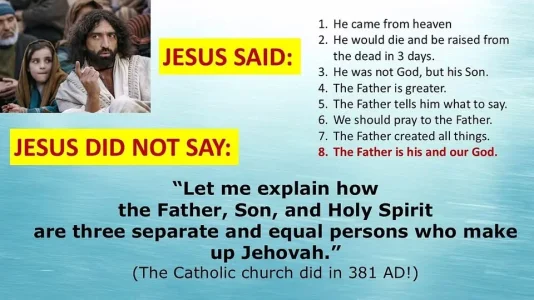
You talk about me repeating myself and yet you repeat the same verse twice in the same hour. And here's the same response...

John 1:3 “Everything came to be through it.” The logos is an “it” not a “him.”

Translators have deliberately chosen to use “him” because they wanted to emphasize that the Word was the male person we know as Jesus. This was a theological choice, not a linguistic one.

"Do not forsake wisdom, and she will protect you; love her, and she will watch over you” (Proverbs 4:6).

Is the Wisdom in Proverbs 4:6 a distinct divine person?

The "Word" is not literally a person for the same reason that "Wisdom" is not literally a person. Both are to be taken metaphorically.

Jesus is the personification of the Word because He speaks the words of God. To listen to Jesus equals listening to the Word of God.

People often say I'm wrong when I post this because they say I looked it up in an Interlinear or Concordance and it shows the word is a "him" and not an "it." Those reference books show how the Bible translates a word and not what the Greek actually means. The pronoun is an "it" when it refers to an inanimate noun like the "Word" because Greek has grammatical gender and the "Word" in John 1 is a thing so the Greek says it's an "it."

Here's a partial list of how "logos" is translated in the New Testament...

cause, communication, sayings, saying, word, words, account, talk, question, treatise, intent, tidings, speaker, matter, mouth, work, utterance, preaching, speech, concerning, show, do, doctrine, reason, with, and thing.

The trinitarian has only 3 to pick from...

1.) Use a verse from a bad translation.
2.) Use a verse that is taken out of context.
3.) Not understand how the words were used in the culture they were written in.

And basically that's all trinitarians have. And I mean 100 percent of what they have. They have nothing else.
 
So, a group of people fall on the ground and that makes Jesus God. Right.

Just making the point that you said there wasn't anything else. You said that. This means there is "something else".

So stop saying there "isn't anything else".

I asked about an angel. Your argument revolves around a claim that an angel represents "something". I asked about this happening previously with angels.

I can say right here.... "It doesn't say that". That felt good. It really did.

Now, that your argument is self defeating. I can tell you one thing we can say for certain.

You can't make anyone fall to the ground when you say "I AM HE".
 
I don't know if we can assume 100 percent that it was not an angel since they do speak on His behalf and like a secretary they would speak in the first person as the boss. They write the letters and sign his name etc. And here's my take on the "I am"...

Jesus said "ego eimi" .... God didn't. The Greek word in Exodus 3:14 is not the same word Jesus used in John 8:58. Jesus said “ego eimi” in John 8:58. Not “ego eimi ho eimi” which means "I am the One who is" as Exodus 3:14 is written in the Septuagint. The two statements are very different. The Greek phrase in John does mean "I am" which was a common phrase in the New Testament and isn't the name of anyone. The disciples were trying to find out who would deny the Christ at the last supper. They said literally "Not I am, Lord" Matthew 26:22, 25. No one would say the disciples were trying to deny they were God because they were using the phrase "not I am." The word "I am" was a common way of designating oneself and it did not mean you were claiming to be God. The statement Jesus made in John 8:58 concerning "I am" would have to be equivalent with God's "I am" statement in Exodus 3:14 in order for the Trinitarian argument to make Jesus God. And it is not. The argument is made that because Jesus was "before" Abraham that Jesus must be God. Jesus figuratively existed in Abraham's time. He did not actually physically exist as a person, but rather he existed in the mind of God as God's plan for the redemption of man.
The OT was written in Hebrew, not Greek. So the Septuagint is not the original Scripture. Any translation runs the risk of having errors due to there not being the same meaning of words from one language to the other. However:
In the Septuagint Exo 3:14, God told Moses, "This is what you shall say to the sons of Israel: I AM has sent me to you." "I AM" = ego eimi.
In John 8:58, John says, "before Abraham was born, I am." "I AM" = ego eimi.
Exactly the same phrase.
The trinitarian has only 3 to pick from...

1.) Use a verse from a bad translation.
2.) Use a verse that is taken out of context.
3.) Not understand how the words were used in the culture they were written in.

And basically that's all trinitarians have. And I mean 100 percent of what they have. They have nothing else.
Again with the meaningless statement posted at the end of your comments to make it look like you have proven a point, make your post longer (and thereby more important?), and/or to show that you are more righteous than anyone else. These last 5 lines of your post (that you put in an increasingly large percentage of your posts) is totally erroneous, without support, and meaningless.
 
I don't know if we can assume 100 percent that it was not an angel since they do speak on His behalf and like a secretary they would speak in the first person as the boss. They write the letters and sign his name etc. And here's my take on the "I am"...

Jesus said "ego eimi" .... God didn't. The Greek word in Exodus 3:14 is not the same word Jesus used in John 8:58. Jesus said “ego eimi” in John 8:58. Not “ego eimi ho eimi” which means "I am the One who is" as Exodus 3:14 is written in the Septuagint. The two statements are very different. The Greek phrase in John does mean "I am" which was a common phrase in the New Testament and isn't the name of anyone. The disciples were trying to find out who would deny the Christ at the last supper. They said literally "Not I am, Lord" Matthew 26:22, 25. No one would say the disciples were trying to deny they were God because they were using the phrase "not I am." The word "I am" was a common way of designating oneself and it did not mean you were claiming to be God. The statement Jesus made in John 8:58 concerning "I am" would have to be equivalent with God's "I am" statement in Exodus 3:14 in order for the Trinitarian argument to make Jesus God. And it is not. The argument is made that because Jesus was "before" Abraham that Jesus must be God. Jesus figuratively existed in Abraham's time. He did not actually physically exist as a person, but rather he existed in the mind of God as God's plan for the redemption of man.

The trinitarian has only 3 to pick from...

1.) Use a verse from a bad translation.
2.) Use a verse that is taken out of context.
3.) Not understand how the words were used in the culture they were written in.

And basically that's all trinitarians have. And I mean 100 percent of what they have. They have nothing else.
🥱🥱🥱

@Peterlag keeps repeating the same old worn-out misinformation that has been debunked many times over by many people. For example, I debunked this misinformation of his by saying the following:
There is a 4th option. Refer also to Deut 32:39; Isaiah 41:4, 43:10, 43:13, 46:4, 48:12, and 51:12.

For every single time "ἐγώ εἰμι" appears in an absolute sense in the LXX, it is God Himself declaring His divine identity. There are no places where an angel, a prophet, or a human says it in an absolute sense. Only YHWH uses it without a predicate as a divine self-revelation.

All these Isaiah verses support Jesus' claim of being the "I AM" in John 8:58. Unitarianism just crashed and burned.

As for the blind man's usage of ἐγώ εἰμι", it is used in an idiomatic way, not in an absolute (divine self-revelation) way. It is not surrounded by theological claims (eternity, salvation) and it does not echo the Isaiah (LXX) divine formula.
 
Yes, that shows that unitarianism is a Judaizing Sect.

There were those who rejected God long before Judaism ever existed. Longer than this world, as we know it now, ever existed.

No matter the name or the distinction, anyone who rejects the Character of Jesus Christ must deal with the wrath of God.

Heb 10:28 He that despised Moses' law died without mercy under two or three witnesses:
Heb 10:29 Of how much sorer punishment, suppose ye, shall he be thought worthy, who hath trodden under foot the Son of God, and hath counted the blood of the covenant, wherewith he was sanctified, an unholy thing, and hath done despite unto the Spirit of grace?
Heb 10:30 For we know him that hath said, Vengeance belongeth unto me, I will recompense, saith the Lord. And again, The Lord shall judge his people.
Heb 10:31 It is a fearful thing to fall into the hands of the living God.

A very fearful thing to say what they say about Jesus Christ and pretend it doesn't matter.

Matthew describes these very people.

Notice how they fall "into his hands". The "Lord's hands". Jesus Christ.

Mat 7:21 Not every one that saith unto me, Lord, Lord, shall enter into the kingdom of heaven; but he that doeth the will of my Father which is in heaven.
Mat 7:22 Many will say to me in that day, Lord, Lord, have we not prophesied in thy name? and in thy name have cast out devils? and in thy name done many wonderful works?
Mat 7:23 And then will I profess unto them, I never knew you: depart from me, ye that work iniquity.

He did not know them because they never knew HIM.
 
Last edited:
There were those who rejected God long before Judaism ever existed. Longer than this world, as we know it now, ever existed.

No matter the name or the distinction, anyone who rejects the Character of Jesus Christ must deal with the wrath of God.

Heb 10:28 He that despised Moses' law died without mercy under two or three witnesses:
Heb 10:29 Of how much sorer punishment, suppose ye, shall he be thought worthy, who hath trodden under foot the Son of God, and hath counted the blood of the covenant, wherewith he was sanctified, an unholy thing, and hath done despite unto the Spirit of grace?
Heb 10:30 For we know him that hath said, Vengeance belongeth unto me, I will recompense, saith the Lord. And again, The Lord shall judge his people.
Heb 10:31 It is a fearful thing to fall into the hands of the living God.

A very fearful thing to say what they say about Jesus Christ and pretend it doesn't matter.

Matthew describes these very people.

Notice how they fall "into his hands". The "Lord's hands". Jesus Christ.

Mat 7:21 Not every one that saith unto me, Lord, Lord, shall enter into the kingdom of heaven; but he that doeth the will of my Father which is in heaven.
Mat 7:22 Many will say to me in that day, Lord, Lord, have we not prophesied in thy name? and in thy name have cast out devils? and in thy name done many wonderful works?
Mat 7:23 And then will I profess unto them, I never knew you: depart from me, ye that work iniquity.

He did know them because they never knew HIM.
There are lots of facets to this for sure. They are all interwoven/ intertwined together.
 
The OT was written in Hebrew, not Greek. So the Septuagint is not the original Scripture. Any translation runs the risk of having errors due to there not being the same meaning of words from one language to the other. However:
In the Septuagint Exo 3:14, God told Moses, "This is what you shall say to the sons of Israel: I AM has sent me to you." "I AM" = ego eimi.
In John 8:58, John says, "before Abraham was born, I am." "I AM" = ego eimi.
Exactly the same phrase.

Again with the meaningless statement posted at the end of your comments to make it look like you have proven a point, make your post longer (and thereby more important?), and/or to show that you are more righteous than anyone else. These last 5 lines of your post (that you put in an increasingly large percentage of your posts) is totally erroneous, without support, and meaningless.
Now this is very interesting. My translation that I posted has “ego eimi ho eimi” that you say is wrong based on nothing. And that your translation that you posted is correct based on nothing.
 
Back
Top Bottom