Thomas... My Lord and my God

Have you told that to Jesus? Can we correct Him in the Bible you are writing?

Jesus said... " “Go therefore and make disciples of all the nations, baptizing them in the name of the Father and the Son and the Holy Spirit,"

He did not even use His own name..... Wow... How perceptive you are.!!! Not.
You're quoting a verse that's probably not even a real verse and you're doing it to try to prove that the word "Father" is not a name... a title.

Every English teacher knows the word "Father" is a name. Not a person. And you're trying to say Jesus did not know that.
 
Last edited:
Perhaps Trinitarians understand the definition of "God" as some kind of a substance or essence. Word definitions sometimes need adjustment when false doctrines are at stake.

Hint: Father is not a God. It's a title, a name.
I may be seeing how Peterlag's confusion develops.
He possibly treats Father out of context. That is a name for God and shows his creative role over all creation.

The Father also is father of Jesus, at minimal in the incarnation of Jesus.

In that sense Peterlag misses that a son has the essence of his father and mother. That does not mean there is some general essence of a god or that God is an essence. That is backwards like saying a man is an essence. That concept does not work in biblical sense where man is not an essence but has the essence of people -- thinking like, acting like, and having a body like that.
The essence of God is uniquely of who God is -- his thinking, power, omniscience, omnipresence, etc. God is not a type of essence. God is who he is and that is known in part by humanity. What is known is God along with the real aspects of him and with the recognized attributes. Despite the omnipresence, there can be the absence of that. We see with Elijah where God was not present in the wind.

1 King 19
11 The Lord said, “Go out and stand on the mountain in the presence of the Lord, for the Lord is about to pass by.”
Then a great and powerful wind tore the mountains apart and shattered the rocks before the Lord, but the Lord was not in the wind. After the wind there was an earthquake, but the Lord was not in the earthquake.

His presence, for example, can also be absent, despite being known for omnipresence. God remains God. We only know the ways God appears among people. This does not mean Jesus has had essence of God created in him. John 1 shows Jesus is God's essence so as to convey Jesus, although human, begins in heaven. This is not the beginning in existence as deity but just to highlight the status before incarnation.

This can be a bit beyond Peterlag's comprehension and of many people's. This however is just a detailed expression of what scripture shows. The concept of scripture can be held true even though it is hard to understand naturally.
/
 
You're quoting a verse that's probably not even a real verse and you're doing it to try to prove that the word "Father" is not a name... a title.
Matthew 28:19 is in every Greek manuscript of Matthew. There is no textual alternative.

Every English teacher knows the word "Father" is a name. Not a person. And you're trying to say Jesus did not know that.

“Name” in Scripture means authority and identity, not a spoken label. Otherwise “ to call on the name of the Lord” would make no sense.

If “Father” is just a name and not a person, then explain how the Father sends, loves, and glorifies the So orhow the Son prays to the Father.

Titles don’t do that. Persons do.

Jesus’ wording is deliberate, not confused, though you seem to be having trouble understanding him.
 
Matthew 28:19 is in every Greek manuscript of Matthew. There is no textual alternative.


“Name” in Scripture means authority and identity, not a spoken label. Otherwise “ to call on the name of the Lord” would make no sense.

If “Father” is just a name and not a person, then explain how the Father sends, loves, and glorifies the So orhow the Son prays to the Father.

Titles don’t do that. Persons do.

Jesus’ wording is deliberate, not confused, though you seem to be having trouble understanding him.
Am I a father, uncle, son, brother, or am I a human being?

Who gives blood at the Red Cross?

1.) The human
2. The father
3.) The uncle
4. The son

Is it considered human blood? Or father blood?
 
Am I a father, uncle, son, brother, or am I a human being?

Who gives blood at the Red Cross?

1.) The human
2. The father
3.) The uncle
4. The son

Is it considered human blood? Or father blood?
Again I see Peterlag's confusion. He cannot distinguish between a specific person as father. When I say "Dad, I thank you for all your help" then that is a person and functions as a name. When we say heavenly Father, that is specifically the God of Israel and functions as a name. Jesus also has the name Son of God but it also is his uniqueness in that naming and it is a relative status as well -- that he is, in essence, the son of God.
 
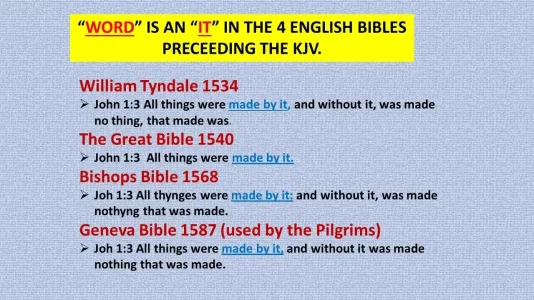
The spirit is an it...

View attachment 2676
And rejected ever since

DARBY All things received being through him, and without him not one thing received being which has received being.
ASV All things were made through him; and without him was not anything made that hath been made.
AMP All things were made and came into existence through Him; and without Him was not even one thing made that has come into being.
BBE All things came into existence through him, and without him nothing was.
CSB All things were created through him, and apart from him not one thing was created that has been created.
CEB Everything came into being through the Word, and without the Word nothing came into being. What came into being
CJB All things came to be through him, and without him nothing made had being.
CEV And with this Word, God created all things. Nothing was made without the Word. Everything that was created
D-R All things were made by him: and without him was made nothing that was made.
EOB: NTAll things came into being through him, and without him, nothing came into being that has come into being.
ESV All things were made through him, and without him was not any thing made that was made.
GW Everything came into existence through him. Not one thing that exists was made without him.
GNB Through him God made all things; not one thing in all creation was made without him.
HCSB All things were created through Him, and apart from Him not one thing was created that has been created.
HBCONTCV All things were made by him; and without him was not any thing made that was made.
HB:ERV Everything was made through him, and nothing was made without him.
EHV Through him everything was made, and without him not one thing was made that has been made.
KJV All things were made by him; and without him was not any thing made that was made.
ISV Through him all things were made, and apart from him nothing was made that has been made.
KJV 1900All things were made by him; and without him was not any thing made that was made.
KJV (WS)All things were made by him; and without him was not any thing made that was made.
LEBAll things came into being through him, and apart from him not one thing came into being that has come into being.
MNT all things were made by him; and without him was not any thing made.
MSG Everything was created through him; nothing—not one thing!— came into being without him.
MEV All things were created through Him, and without Him nothing was created that was created.
MLB:BV Through Him everything came into being and without Him nothing that exists came into being.
MNT through him all existence came into being, no existence came into being apart from him.
NET All things were created by him, and apart from him not one thing was created that has been created.
NABRE All things came to be through him, and without him nothing came to be. What came to be
NASB All things came into being by Him, and apart from Him nothing came into being that has come into being.
NASB95 All things came into being through Him, and apart from Him nothing came into being that has come into being.
NCV All things were made by him, and nothing was made without him.
NEB and through him all things came to be; no single thing was created without him. All that came to be
NIrV All things were made through him. Nothing that has been made was made without him.
NIV84 Through him all things were made; without him nothing was made that has been made.
NIV Through him all things were made; without him nothing was made that has been made.
NJB Through him all things came into being, not one thing came into being except through him.
NKJV All things were made through Him, and without Him nothing was made that was made.
NLT God created everything through him, and nothing was created except through him.
NRSV All things came into being through him, and without him not one thing came into being. What has come into being
Phillips [1–3]All creation took place through him, and none took place without him..
NTMS:ITEETRGT All things came into being through Him, and apart from Him nothing that exists came into being.
NT:TOG All things were made by him, and without him not one thing was made that now exists.
TPTAnd through his creative inspiration this Living Expression made all things, for nothing has existence apart from him!
REB and through him all things came to be; without him no created thing came into being.
RSV all things were made through him, and without him was not anything made that was made.
SCNTE All things became through him, and without him did not anything become: that which became
SNTTEP very thing was by his hand; and without him, was not any thing whatever that existed.
TNIV Through him all things were made; without him nothing was made that has been made.
YLT all things through him did happen, and without him happened not even one thing that hath happened.

BTW those same versions you posted

(Bishops) John 1:10 He was in the worlde, and the worlde was made by hym, and the worlde knewe hym not.
(Williams) Joh 1:10 He was in the world, and the world by him was made: and the world knew him not.
(Great bible) John 1:10 He was in the worlde, and the worlde was made by him: & the worlde knewe him not.
(Geneva) Joh 1:10 He was in the world, and the worlde was made by him: and the worlde knewe him not.

(Bishops) Rev 19:13 And he was clothed with a vesture dipt in blood, and his name is called the worde of God.
(Geneva) Rev 19:13 And he was clothed with a garment dipt in blood, and his name is called The worde of God.
(Williams) Rev 19:13 He wore a garment dipped in blood, and His name was the Word of God.

 
The spirit is an it...

View attachment 2676
This is about One with God who became Jesus not about the Spirit. So one big error has been corrected.

Another issue that can occur at times with a language is that the pronouns match the gender of the noun given. But these are masculine yet neglected in that sense.

Third, the translators who say "it" miss the gender of the Greek autos in verse 3. It would seem the translators favored the English idea that logos is an it and thus focused on their favored concept of these early verses. This does not mean they do not assign the logos metalyptically to Jesus.
 
And rejected ever since

DARBY All things received being through him, and without him not one thing received being which has received being.
ASV All things were made through him; and without him was not anything made that hath been made.
AMP All things were made and came into existence through Him; and without Him was not even one thing made that has come into being.
BBE All things came into existence through him, and without him nothing was.
CSB All things were created through him, and apart from him not one thing was created that has been created.
CEB Everything came into being through the Word, and without the Word nothing came into being. What came into being
CJB All things came to be through him, and without him nothing made had being.
CEV And with this Word, God created all things. Nothing was made without the Word. Everything that was created
D-R All things were made by him: and without him was made nothing that was made.
EOB: NTAll things came into being through him, and without him, nothing came into being that has come into being.
ESV All things were made through him, and without him was not any thing made that was made.
GW Everything came into existence through him. Not one thing that exists was made without him.
GNB Through him God made all things; not one thing in all creation was made without him.
HCSB All things were created through Him, and apart from Him not one thing was created that has been created.
HBCONTCV All things were made by him; and without him was not any thing made that was made.
HB:ERV Everything was made through him, and nothing was made without him.
EHV Through him everything was made, and without him not one thing was made that has been made.
KJV All things were made by him; and without him was not any thing made that was made.
ISV Through him all things were made, and apart from him nothing was made that has been made.
KJV 1900All things were made by him; and without him was not any thing made that was made.
KJV (WS)All things were made by him; and without him was not any thing made that was made.
LEBAll things came into being through him, and apart from him not one thing came into being that has come into being.
MNT all things were made by him; and without him was not any thing made.
MSG Everything was created through him; nothing—not one thing!— came into being without him.
MEV All things were created through Him, and without Him nothing was created that was created.
MLB:BV Through Him everything came into being and without Him nothing that exists came into being.
MNT through him all existence came into being, no existence came into being apart from him.
NET All things were created by him, and apart from him not one thing was created that has been created.
NABRE All things came to be through him, and without him nothing came to be. What came to be
NASB All things came into being by Him, and apart from Him nothing came into being that has come into being.
NASB95 All things came into being through Him, and apart from Him nothing came into being that has come into being.
NCV All things were made by him, and nothing was made without him.
NEB and through him all things came to be; no single thing was created without him. All that came to be
NIrV All things were made through him. Nothing that has been made was made without him.
NIV84 Through him all things were made; without him nothing was made that has been made.
NIV Through him all things were made; without him nothing was made that has been made.
NJB Through him all things came into being, not one thing came into being except through him.
NKJV All things were made through Him, and without Him nothing was made that was made.
NLT God created everything through him, and nothing was created except through him.
NRSV All things came into being through him, and without him not one thing came into being. What has come into being
Phillips [1–3]All creation took place through him, and none took place without him..
NTMS:ITEETRGT All things came into being through Him, and apart from Him nothing that exists came into being.
NT:TOG All things were made by him, and without him not one thing was made that now exists.
TPTAnd through his creative inspiration this Living Expression made all things, for nothing has existence apart from him!
REB and through him all things came to be; without him no created thing came into being.
RSV all things were made through him, and without him was not anything made that was made.
SCNTE All things became through him, and without him did not anything become: that which became
SNTTEP very thing was by his hand; and without him, was not any thing whatever that existed.
TNIV Through him all things were made; without him nothing was made that has been made.
YLT all things through him did happen, and without him happened not even one thing that hath happened.

BTW those same versions you posted

(Bishops) John 1:10 He was in the worlde, and the worlde was made by hym, and the worlde knewe hym not.
(Williams) Joh 1:10 He was in the world, and the world by him was made: and the world knew him not.
(Great bible) John 1:10 He was in the worlde, and the worlde was made by him: & the worlde knewe him not.
(Geneva) Joh 1:10 He was in the world, and the worlde was made by him: and the worlde knewe him not.

(Bishops) Rev 19:13 And he was clothed with a vesture dipt in blood, and his name is called the worde of God.
(Geneva) Rev 19:13 And he was clothed with a garment dipt in blood, and his name is called The worde of God.
(Williams) Rev 19:13 He wore a garment dipped in blood, and His name was the Word of God.
John 1:10 is referring to God. Not the spirit which is an it. Or the logos which is also an it.
 
The spirit is an it...

View attachment 2676
Tyndale used it” in John 1:3 because he chose the pronoun based on the English gender of the word worde rather than the masculine Greek gender of logos. In early 16th-century English, word was still treated as neuter (a holdover from Old English), so translators naturally used “it” for such nouns even when the original text used a masculine form. Thus, although logos is grammatically masculine in Greek, Tyndale’s English usage produced “it,” reflecting linguistic convention. Subsequent translations corrected this by emphasizing the masculine Greek gender.

The fact remains that the Word, who was God, tabernacled as Jesus on Earth. And because God cannot cease to be God, Jesus is God.
 
John 1:10 is referring to God. Not the spirit which is an it. Or the logos which is also an it.
Try reading and believing scripture

John 1:4–18 (NASB 95) — 4 In Him was life, and the life was the Light of men. 5 The Light shines in the darkness, and the darkness did not comprehend it. 6 There came a man sent from God, whose name was John. 7 He came as a witness, to testify about the Light, so that all might believe through him. 8 He was not the Light, but he came to testify about the Light. 9 There was the true Light which, coming into the world, enlightens every man. 10 He was in the world, and the world was made through Him, and the world did not know Him. 11 He came to His own, and those who were His own did not receive Him. 12 But as many as received Him, to them He gave the right to become children of God, even to those who believe in His name, 13 who were born, not of blood nor of the will of the flesh nor of the will of man, but of God. 14 And the Word became flesh, and dwelt among us, and we saw His glory, glory as of the only begotten from the Father, full of grace and truth. 15 John testified about Him and cried out, saying, “This was He of whom I said, ‘He who comes after me has a higher rank than I, for He existed before me.’ ” 16 For of His fullness we have all received, and grace upon grace. 17 For the Law was given through Moses; grace and truth were realized through Jesus Christ. 18 No one has seen God at any time; the only begotten God who is in the bosom of the Father, He has explained Him.

The clear reference is Christ
 
This is about One with God who became Jesus not about the Spirit. So one big error has been corrected.

Another issue that can occur at times with a language is that the pronouns match the gender of the noun given. But these are masculine yet neglected in that sense.

Third, the translators who say "it" miss the gender of the Greek autos in verse 3. It would seem the translators favored the English idea that logos is an it and thus focused on their favored concept of these early verses. This does not mean they do not assign the logos metalyptically to Jesus.
Also

And the word was

In the beginning was the Word, and the Word was with God, and the Word was God

God

Morph: Noun, Nominative, Singular, Masculine


New American Standard Bible, 1995 Edition: Paragraph Version (La Habra, CA: The Lockman Foundation, 1995), Jn 1:1.
 
The following is from another guy which now makes three different guys weighing in on the word "logos."

The word "logos" (Word) denotes (I) "the expression of thought" as embodying a conception or idea. λόγος "logos" is something said (including the thought). So the word "logos" means an expression of thought. It makes perfect sense if we use this understanding everywhere the word "logos" is used. So in John 1:1 the Word is not Jesus, but rather it became flesh, which is God's expression of thought or plan that became flesh with the coming of Jesus Christ.
That is a simplistic view of who/what the Logos is, but it is a start. It is clear from the language used that the Logos is not just an "expression of thought", but is a real person, someone with power, self-awareness, reasoning ability, etc. And this real person (a Spiritual being in Heaven with God, in the form of God, and who is God, came to Earth and took on a human form. The fact that the Logos "became flesh" in the form of Jesus makes the Logos Jesus even before He became flesh. He never ceased to be who He always was.
 
The spirit is an it...
Interesting and telling.

I can give you 6 reasons why those of old were wrong, making you wrong also.

Are you unaware that the The Holy Spirit is parallel to other persons


Sorry, but I have forgotten if you actually have a church affiliation. No matter as I assume uyou at one time did and as such you surly are aware that nost of the church’s missions are to make disciples by baptizing them “in the name [singular] of the Father and of the Son and of the Holy Spirit” (Matt 28:19–20).

This means The Holy Spirit is a person parallel to the persons of the Father and the Son (see also 1 Cor 12:4–6; 2 Cor 13:14; Eph 4:4–6; 1 Pet 1:2). Further, when Jesus says, “I will ask the Father, and he will give you another Helper” (John 14:16), he means that the Holy Spirit is “another” in the sense of another companion of the same kind (Greek, allos), not a different kind (Greek, heteros).

Jesus says of the Spirit, “He will glorify me, for he will take what is mine and declare it to you” (John 16:14). The Holy Spirit is a person parallel to the persons of Jesus and his disciples.

Now if Jesus calls him a he..... are you claiming to be above Jesus? Should I pray and bow top you? Forget it....

Even the Jerusalem council concluded “It has seemed good to the Holy Spirit and to us” (Acts 15:28). The Holy Spirit is a person parallel to persons in the Jerusalem council.

And here is another thing..,The Holy Spirit has characteristics of a person!!!!!!!!!!!!!!!!!!!!!!!!!!!!!!!!!!!!

What? you dont believe this?


The Holy Spirit has intellect. He is “the Spirit of wisdom and understanding, the Spirit of counsel … the Spirit of knowledge” (Isa 11:2; cf. Rom 8:27; 1 Cor 2:11).

The Holy Spirit has a will. He sovereignly distributes gifts to each member of the body of Christ—he “apportions to each one individually as he wills” (1 Cor 12:11). He decides to regenerate spiritually dead humans (John 3:7–8; Titus 3:5).

The Holy Spirit has emotions. Paul commands, “Do not grieve the Holy Spirit of God” (Eph 4:30; see Isa 63:10).

How many its can you tell us of that acts in the way a person acts? Fact....The Holy Spirit acts in ways that persons act.

The Holy Spirit loves. Paul appeals to his brothers “by the love of the Spirit” (Rom 15:30).

The Holy Spirit speaks. “While Peter was pondering the vision, the Spirit said to him, “Behold, three men are looking for you” (Acts 10:19–20; see 1 Tim 4:1).

The Holy Spirit commands. “The Holy Spirit said, ‘Set apart for me Barnabas and Saul for the work to which I have called them’” (Acts 13:2; see 8:29).

The Holy Spirit teaches. “The Holy Spirit will teach you in that very hour what you ought to say” (Luke 12:12; cf. Neh 9:20).

The Holy Spirit bears witness. “The Spirit himself bears witness with our spirit that we are children of God” (Rom 8:16).

The Holy Spirit directs. “They went through the region of Phrygia and Galatia, having been forbidden by the Holy Spirit to speak the word in Asia. And when they had come up to Mysia, they attempted to go into Bithynia, but the Spirit of Jesus did not allow them” (Acts 16:6–7; see 10:20; 15:28; 20:28; Rom 8:14).

The Holy Spirit intercedes. “The Spirit himself intercedes for us with groanings too deep for words. … The Spirit intercedes for the saints according to the will of God” (Rom 8:26–27).

The Holy Spirit convicts. “He will convict the world concerning sin and righteousness and judgment” (John 16:8).

The Holy Spirit can be sinned against as a person.

First fact on this. People can lie to the Holy Spirit. Peter asked, “Ananias, why has Satan filled your heart to lie to the Holy Spirit and to keep back for yourself part of the proceeds of the land?” (Acts 5:3).

Second fact on this. People can resist the Holy Spirit. Stephen preached, “You stiff-necked people, uncircumcised in heart and ears, you always resist the Holy Spirit” (Acts 7:51; see 5:9).

Third fact on this. People can grieve the Holy Spirit. Paul commands, “Do not grieve the Holy Spirit of God” (Eph 4:30).

Fourth fact on this. People can insult the Holy Spirit. “How much worse punishment, do you think, will be deserved by the one who … has outraged [insulted]... the Spirit of grace?” (Heb 10:29).

Final fact an most important fact on this... People can blaspheme the Holy Spirit. Jesus warned about the unpardonable sin: “The blasphemy against the Spirit will not be forgiven” (Matt 12:31). And includes denying the Holy Spirit or attributing the works of the Spirit to evil.

Does this... "denying the Holy Spirit"... ring any bells with you?


This is very important and I am not sure you will understand. The Holy Spirit is distinct from his power.

The Holy Spirit is a person and not merely a powerful force; (OR AN IT) the Spirit and power are not identical. “Jesus returned in the power of the Spirit to Galilee” (Luke 4:14) meaning “filled with the Holy Spirit’s power” .

“God anointed Jesus of Nazareth with the Holy Spirit and with power” (Acts 10:38). A purpose of Paul’s prayer for the Romans is “that by the power of the Holy Spirit you may abound in hope” (Rom 15:13). Paul explains to the Corinthians, “My speech and my message were not in plausible words of wisdom, but in demonstration of the Spirit and of power” (1 Cor 2:4).

One last thing, not the leaast important fact by any means. One of the Holy Spirit’s titles, “Paraclete,” is fitting for a person.

One of the Holy Spirit’s titles, “Paraclete,” means “one who appears in another’s behalf, mediator, intercessor, helper.”
Do you or can you understand this about the person of the Holy Spirit?

Translations of the Greek word ( look them up for yourself if you are in doubt because this is long enough) here in John 14:16, 26; 15:26; and 16:7 include Helper (NASB, ESV), Advocate (LSB, NIV, NET, NLT), Counselor (CSB), and Comforter (KJV).

Helper, Advocate. Counselor and Comforter... titles that are fitting for a person.

Final fact.

The Holy Spirit is a person. Christians should avoid the potential ...even unwitting .....disrespect of calling him an “it.”

If your Holy Book errors in this way, GET ANOTHER
 
That is a simplistic view of who/what the Logos is, but it is a start. It is clear from the language used that the Logos is not just an "expression of thought", but is a real person, someone with power, self-awareness, reasoning ability, etc. And this real person (a Spiritual being in Heaven with God, in the form of God, and who is God, came to Earth and took on a human form. The fact that the Logos "became flesh" in the form of Jesus makes the Logos Jesus even before He became flesh. He never ceased to be who He always was.
Yes as the biblical narrative and testimony is the Son was together with the Father before the universe came into existence. Both Father and Son are Eternal. Its clear from scripture that the Word/Logos is Personal not impersonal. Thats Johns entire point in the Prologue as he makes the parallel between Genesis 1 and his opening in his gospel account of the beginning in Genesis 1.

And we see the Apostles affirm the above in their writings too.
 
Back
Top Bottom