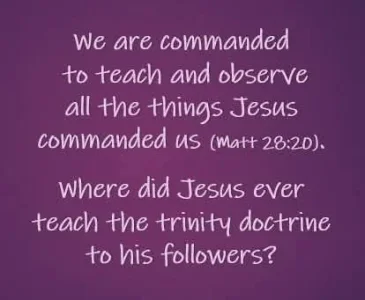
Yeah, that's what I want to know. Where did anyone teach the trinity? Trinitarians say morning, noon, and night that Jesus was called God. But what I'm looking for is a teaching on the trinity doctrine. A teaching... a whole paragraph or chapter. Such an important and a huge subject to Christianity that is necessary for salvation like many teach should have been taught by someone somewhere.
View attachment 2697
The Trinity is not taught as a single, self-contained chapter because the Bible is not written as a systematic theology textbook. The doctrine of the Trinity is a
synthesized teaching, drawn from many passages where Father, Son, and Spirit are spoken of together, share divine attributes, and yet are personally distinct.
@Peterlag , You’re right that there is no chapter titled
“The Doctrine of the Trinity.” But that standard would also eliminate many essential Christian doctrines. There is no single chapter teaching the hypostatic union, the canon of Scripture, original sin, or substitutionary atonement either.
Thew fact is the Trinity is not a later invention.....it IS the church’s name for the total biblical data.
The Scriptures simultaneously teach.....
Deut 6:4 There is one God
John 1:1; John 20:28; Acts 5:3–4 The Father is God, the Son is God, and the Spirit is God
John 14–17 The Father, Son, and Spirit are personally distinct. Here we see these verses encapsulate Jesus' final teachings, focusing on the promise of the Holy Spirit, the importance of knowing God, and the assurance of peace. These chapters are foundational for understanding the Christian faith and the believer's relationship with God.
No single paragraph resolves all of that and how could it? So the doctrine emerges from the whole witness of Scripture rather than one proof-text. The question isn’t “Where is the Trinity taught in one chapter?”
The real question is, “What doctrine best accounts for
everything Scripture says about God, Christ, and the Spirit without denying any of it?”
There is no single chapter titled
“The Trinity,” but the doctrine was already being articulated
well before Nicaea, long before the Middle Ages.
Ignatius of Antioch (c. AD 107) calls Jesus
God while distinguishing Him from the Father:
Justin Martyr (c. AD 150) affirms monotheism while describing Christian worship as triadic:
“We worship and adore
the Father,
the Son, and
the prophetic Spirit” (
First Apology 6)
The Son is the pre-existent divine Logos (
First Apology 46;
Dialogue with Trypho 61)
Tertullian (c. AD 200) coins
Trinitas to explain existing belief, not invent it:
“One substance in three persons” (
Against Praxeas 12)
“The Father is God, the Son is God, the Spirit is God… yet one God” (
Against Praxeas 2)
Non-Trinitarian views (modalism, adoptionism, subordinationism) did appear early ,but were rejected because they failed to account for the full biblical data:
Modalism denied real personal distinctions (contradicted John 14–17).
Adoptionism denied Christ’s pre-existence (contradicted John 1:1–3).
Subordinationism compromised monotheism and divine worship.
You have got to come to terms with the fact that The Trinity
was not invented later; it prevailed because it best accounted for
all of Scripture... one God, the deity of Christ and the Spirit, and their real personal distinctions.
So when you are looking for " a teaching on the trinity doctrine."... you need to open your bible to where it says "In the beginning God created the heaven and the earth and read to The grace of our Lord Jesus Christ
be [m]with you all. Amen.
And you will have what you want....
And while you are reading this and scratching your head always remember Salvation in Scripture is consistently and always tied to
faith in Christ, not to mastering a later theological formulation.
The New Testament calls people to repent and believe in
Jesus as Lord and Messiah (John 3:16; Rom 10:9–13; Acts 16:31).
The Trinity is a
doctrinal framework the church developed to explain who Jesus is in light of all of Scripture,
not an entry-level creed required to be saved. One can be saved by trusting the Son without yet understanding how the Father, Son, and Spirit relate in technical terms ... just as the earliest believers were.
BUT.....
BUT
Rejecting the Trinity
after understanding it is a different issue than never having been taught it.
And you
have been taught. Saying “I don’t understand it” at this point is really saying “I don’t accept it,” which is a different claim altogether.