The Trinity lacks any Biblical support

It appears the trinitarians have no teaching anywhere on the trinity doctrine since they continue to tell me Jesus was called God.

But no teaching on the doctrine of the trinity. It seems it would have been clearly stated in the Bible and in the earliest Christian creeds if the doctrine of the Trinity was genuine and central to Christian belief and especially if belief in it was necessary for salvation as many Trinitarians teach.

God gave the Scriptures to the Jewish people, and the Jewish religion and worship that comes from that revelation does not contain any reference to or teachings about a triune God. Surely the Jewish people were qualified to read and understand it, but they never saw the doctrine of the Trinity, but rather just the opposite as all throughout their history they fiercely defended the fact that there was only one God.
 

It appears the trinitarians have no teaching anywhere on the trinity doctrine since they continue to tell me Jesus was called God.

But no teaching on the doctrine of the trinity. It seems it would have been clearly stated in the Bible and in the earliest Christian creeds if the doctrine of the Trinity was genuine and central to Christian belief and especially if belief in it was necessary for salvation as many Trinitarians teach.

God gave the Scriptures to the Jewish people, and the Jewish religion and worship that comes from that revelation does not contain any reference to or teachings about a triune God. Surely the Jewish people were qualified to read and understand it, but they never saw the doctrine of the Trinity, but rather just the opposite as all throughout their history they fiercely defended the fact that there was only one God.
should we go over John 1 for you again. We do not need to cover the trinity but only the deity of Christ in his pre-existence. Still, the Jews were aware of some passages showing at least two of Yahweh together in the OT. See the Two Powers of Heaven, even though it sort of is a technical proof rather than easy reading.
I do not quite say it is required to know the deity of Christ. However, the persistent denial of Christ may be an indication of someone on the wrong path.
 
Since God is Spirit. I see no need to mention Him twice.
Is it the Father living in you?

Is it the Father that was explained to Nicodemus?
 
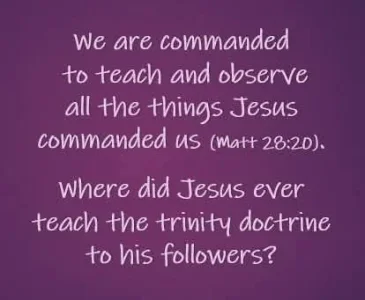
Yeah, that's what I want to know. Where did anyone teach the trinity? Trinitarians say morning, noon, and night that Jesus was called God. But what I'm looking for is a teaching on the trinity doctrine. A teaching... a whole paragraph or chapter. Such an important and a huge subject to Christianity that is necessary for salvation like many teach should have been taught by someone somewhere.

1766977920544.webp
 
Yeah, that's what I want to know. Where did anyone teach the trinity? Trinitarians say morning, noon, and night that Jesus was called God. But what I'm looking for is a teaching on the trinity doctrine. A teaching... a whole paragraph or chapter. Such an important and a huge subject to Christianity that is necessary for salvation like many teach should have been taught by someone somewhere.

View attachment 2697
Really? Did Jesus have to reveal more than just him being deity? We start with what Jesus shares and then recognize he is not a separate god. If a person does not know Jesus, it is hard to be justified by him.
 
Yeah, that's what I want to know. Where did anyone teach the trinity? Trinitarians say morning, noon, and night that Jesus was called God. But what I'm looking for is a teaching on the trinity doctrine. A teaching... a whole paragraph or chapter. Such an important and a huge subject to Christianity that is necessary for salvation like many teach should have been taught by someone somewhere.

View attachment 2697

The Trinity is not taught as a single, self-contained chapter because the Bible is not written as a systematic theology textbook. The doctrine of the Trinity is a synthesized teaching, drawn from many passages where Father, Son, and Spirit are spoken of together, share divine attributes, and yet are personally distinct.

@Peterlag , You’re right that there is no chapter titled “The Doctrine of the Trinity.” But that standard would also eliminate many essential Christian doctrines. There is no single chapter teaching the hypostatic union, the canon of Scripture, original sin, or substitutionary atonement either.

Thew fact is the Trinity is not a later invention.....it IS the church’s name for the total biblical data.

The Scriptures simultaneously teach.....

Deut 6:4 There is one God

John 1:1; John 20:28; Acts 5:3–4 The Father is God, the Son is God, and the Spirit is God

John 14–17 The Father, Son, and Spirit are personally distinct. Here we see these verses encapsulate Jesus' final teachings, focusing on the promise of the Holy Spirit, the importance of knowing God, and the assurance of peace. These chapters are foundational for understanding the Christian faith and the believer's relationship with God.

No single paragraph resolves all of that and how could it? So the doctrine emerges from the whole witness of Scripture rather than one proof-text. The question isn’t “Where is the Trinity taught in one chapter?”
The real question is, “What doctrine best accounts for everything Scripture says about God, Christ, and the Spirit without denying any of it?”

There is no single chapter titled “The Trinity,” but the doctrine was already being articulated well before Nicaea, long before the Middle Ages.


Ignatius of Antioch (c. AD 107) calls Jesus God while distinguishing Him from the Father:

Justin Martyr (c. AD 150) affirms monotheism while describing Christian worship as triadic:

“We worship and adore the Father, the Son, and the prophetic Spirit” (First Apology 6)
The Son is the pre-existent divine Logos (First Apology 46; Dialogue with Trypho 61)

Tertullian (c. AD 200) coins Trinitas to explain existing belief, not invent it:

“One substance in three persons” (Against Praxeas 12)
“The Father is God, the Son is God, the Spirit is God… yet one God” (Against Praxeas 2)

Non-Trinitarian views (modalism, adoptionism, subordinationism) did appear early ,but were rejected because they failed to account for the full biblical data:

Modalism denied real personal distinctions (contradicted John 14–17).

Adoptionism denied Christ’s pre-existence (contradicted John 1:1–3).

Subordinationism compromised monotheism and divine worship.

You have got to come to terms with the fact that The Trinity was not invented later; it prevailed because it best accounted for all of Scripture... one God, the deity of Christ and the Spirit, and their real personal distinctions.

So when you are looking for " a teaching on the trinity doctrine."... you need to open your bible to where it says "In the beginning God created the heaven and the earth and read to The grace of our Lord Jesus Christ be [m]with you all. Amen.
And you will have what you want....

And while you are reading this and scratching your head always remember Salvation in Scripture is consistently and always tied to faith in Christ, not to mastering a later theological formulation.

The New Testament calls people to repent and believe in Jesus as Lord and Messiah (John 3:16; Rom 10:9–13; Acts 16:31).

The Trinity is a doctrinal framework the church developed to explain who Jesus is in light of all of Scripture, not an entry-level creed required to be saved. One can be saved by trusting the Son without yet understanding how the Father, Son, and Spirit relate in technical terms ... just as the earliest believers were.

BUT..... BUT

Rejecting the Trinity after understanding it is a different issue than never having been taught it.

And you have been taught. Saying “I don’t understand it” at this point is really saying “I don’t accept it,” which is a different claim altogether.




 
Concerning 1 John 5:7-8 where it has the words "In heaven, the Father, the Word, and the Holy Ghost, and these three are one. And there are three that bear witness in earth" are words that are not found in any Greek Manuscript before the 15th or 16th century and in no ancient Version. - E. W. Bullinger., A Critical Lexicon and Concordance to the English and Greek New Testament: (London: Samuel Bagster & Sons, 1975), p. 11 of Appendix A.
False and even if you considered it to be true and scripture you like every other Unitarian would still deny the Trinity and Deity of Christ. The text whether biblical or not would never change your mind and heart concerning Jesus identify as God.

That’s the bottom line.

Ancient Latin Witnesses That Contain the Comma
• Old Latin mss. r (Codex Monacensis, 6th c.) and q produce the expanded reading.

• Priscillian (c. 380 A.D.) cites it verbatim in Liber Apologeticus 1.4.

• The 5th-century Council of Carthage (A.D. 484) appealed to it when bishops defended Trinitarian doctrine before the Vandal king Huneric.

• Codex Fuldensis (A.D. 546)—a Vulgate ms. prepared under Victor of Capua—notes the Comma in the margin.

While no Greek patristic source before the 4th century quotes the clause verbatim, several bear witness to the three-fold heavenly testimony concept (e.g., Tertullian, Adv. Praxean 25).

Early Latin presence suggests the clause was circulating in the 2nd-century bilingual North-African church. Greek exemplars used there may have since perished, especially in light of Diocletian’s persecutions (A.D. 303–313) which targeted Scriptures.

hope this helps !!!
 
Of course not. How can someone exist before they were born?
I would like one verse that actually calls Jesus God the Son.

One verse that actually says Jesus is a god-man.
One verse that actually says we must believe Jesus is God.
One verse that actually says we must believe God is three persons.
One verse out of approximately 31,102 Bible verses that says God is Triune.
One verse that actually says Jesus is both 100 percent God and 100 percent man.
One verse that actually says Jesus is God because if it's that important of a doctrine it should have been plainly and clearly taught by someone somewhere.

If there is a trinity then why not just come out and say it? Why do we have to jump all over the Bible cutting and pasting pieces of words that are scattered all over the Bible? Why not just teach it? I know enough about how the Bible is written in the New Testament and in the Gospels to know if there was a trinity it would have been taught. The Gospels would have clearly said...

Verily, verily I say unto you that I am Jesus and I'm also God.

The Epistles would have writings like...

Yay, I Paul do testify that Jesus who is God came down from heaven to be a man for us. And we do know and testify that this same Jesus who you crucified is God. And so let us bow our knee to the one and only true God-Man Jesus Christ.

And yet there's nothing like that anywhere. Not in the Old or New Testament. Not even one complete verse like that.
Before Christ was Jesus, He was the Word of God, John 1:1 and 1 John 5:7. He even says He existed before Abraham as I AM, and you know that is before the baby Jesus was born as a human. Telling the Pharisees this was why they tried to stone Him. Jesus is both God and Savior. There was no man on earth pure enough to shed his blood for our sins, so God, Himself, had to die and that was when God impregnated Mary to give birth to a human God that never sinned. The Word emptied Himself of His glory to die, and it was restored after He rose from the dead. I'm sure you know all the verses that taught what I just said. So, why is this so hard for you to understand?
 
Before Christ was Jesus, He was the Word of God, John 1:1 and 1 John 5:7. He even says He existed before Abraham as I AM, and you know that is before the baby Jesus was born as a human. Telling the Pharisees this was why they tried to stone Him. Jesus is both God and Savior. There was no man on earth pure enough to shed his blood for our sins, so God, Himself, had to die and that was when God impregnated Mary to give birth to a human God that never sinned. The Word emptied Himself of His glory to die, and it was restored after He rose from the dead. I'm sure you know all the verses that taught what I just said. So, why is this so hard for you to understand?
I already told you about 1 John5:7 and John 1:1. And I probably told you about John 8:58. Here it is again...

John 8:58...
Jesus said "ego eimi" .... God didn't. The Greek word in Exodus 3:14 is not the same word Jesus used in John 8:58. Jesus said “ego eimi” in John 8:58. Not “ego eimi ho eimi” which means "I am the One who is" as Exodus 3:14 is written in the Septuagint. The two statements are very different. The Greek phrase in John does mean "I am" which was a common phrase in the New Testament and isn't the name of anyone. The disciples were trying to find out who would deny the Christ at the last supper. They said literally "Not I am, Lord" Matthew 26:22, 25. No one would say the disciples were trying to deny they were God because they were using the phrase "not I am." The word "I am" was a common way of designating oneself and it did not mean you were claiming to be God. The statement Jesus made in John 8:58 concerning "I am" would have to be equivalent with God's "I am" statement in Exodus 3:14 in order for the Trinitarian argument to make Jesus God. And it is not. The argument is made that because Jesus was "before" Abraham that Jesus must be God. Jesus figuratively existed in Abraham's time. He did not actually physically exist as a person, but rather he existed in the mind of God as God's plan for the redemption of man.

Here's a few examples if you would enjoy reading more...

So, they said to him “Who are you?”

Matthew 14:27
But straightway Jesus spake unto them, saying Be of good cheer; it is I; {ego eimi} be not afraid.
And who did they identify him as - God? NOPE.
And those in the boat worshiped him, saying "Truly, you are the Son of God."
Who is Jesus identifying as? The Son of God.

Mark 14:61,62
But he held his peace, and answered nothing. Again the high priest asked him, Art thou the Christ, the Son of the Blessed?
And Jesus said, “I am, {ego eimi}
Who is Jesus identifying as? The Messiah, the Son of the Blessed.

John 4:26
Jesus said unto her, “I that speak unto thee am he, {ego eimi}.
Who is Jesus identifying as? The Messiah.

John 9:9
Some said, This is he: others said, He is like him: but he said, I am he. {ego eimi}
Who is the blind man identifying as? The one who was healed.

Acts 10:21
Then Peter went down to the men which were sent unto him from Cornelius; and said, Behold, I am he {ego eimi}
Who did Peter identify as? The one they were looking for.

"I am" - {ego eimi} is not a NAME. Yahweh is the God of Israel's name.
{ego eimi} - I am - is just a response of self-identification.
 
I already told you about 1 John5:7 and John 1:1. And I probably told you about John 8:58. Here it is again...

John 8:58...
Jesus said "ego eimi" .... God didn't. The Greek word in Exodus 3:14 is not the same word Jesus used in John 8:58. Jesus said “ego eimi” in John 8:58. Not “ego eimi ho eimi” which means "I am the One who is" as Exodus 3:14 is written in the Septuagint. The two statements are very different. The Greek phrase in John does mean "I am" which was a common phrase in the New Testament and isn't the name of anyone. The disciples were trying to find out who would deny the Christ at the last supper. They said literally "Not I am, Lord" Matthew 26:22, 25. No one would say the disciples were trying to deny they were God because they were using the phrase "not I am." The word "I am" was a common way of designating oneself and it did not mean you were claiming to be God. The statement Jesus made in John 8:58 concerning "I am" would have to be equivalent with God's "I am" statement in Exodus 3:14 in order for the Trinitarian argument to make Jesus God. And it is not. The argument is made that because Jesus was "before" Abraham that Jesus must be God. Jesus figuratively existed in Abraham's time. He did not actually physically exist as a person, but rather he existed in the mind of God as God's plan for the redemption of man.

Here's a few examples if you would enjoy reading more...

So, they said to him “Who are you?”

Matthew 14:27
But straightway Jesus spake unto them, saying Be of good cheer; it is I; {ego eimi} be not afraid.
And who did they identify him as - God? NOPE.
And those in the boat worshiped him, saying "Truly, you are the Son of God."
Who is Jesus identifying as? The Son of God.

Mark 14:61,62
But he held his peace, and answered nothing. Again the high priest asked him, Art thou the Christ, the Son of the Blessed?
And Jesus said, “I am, {ego eimi}
Who is Jesus identifying as? The Messiah, the Son of the Blessed.

John 4:26
Jesus said unto her, “I that speak unto thee am he, {ego eimi}.
Who is Jesus identifying as? The Messiah.

John 9:9
Some said, This is he: others said, He is like him: but he said, I am he. {ego eimi}
Who is the blind man identifying as? The one who was healed.

Acts 10:21
Then Peter went down to the men which were sent unto him from Cornelius; and said, Behold, I am he {ego eimi}
Who did Peter identify as? The one they were looking for.

"I am" - {ego eimi} is not a NAME. Yahweh is the God of Israel's name.
{ego eimi} - I am - is just a response of self-identification.
All (humans) have sinned since Adam, so how can a mere human be our Savior? Do you believe Joseph was Jesus' natural father?
 
All (humans) have sinned since Adam, so how can a mere human be our Savior? Do you believe Joseph was Jesus' natural father?
I never read the word "mere man" in the Scriptures when referring to the Christ. I have read...

Jesus is the son of God, the Messiah to Israel, and the now resurrected Lord Christ to the Christian who sits at the right hand of God as second in command and is the head of the Church that is called the body of Christ.
 
I never read the word "mere man" in the Scriptures when referring to the Christ. I have read...

Jesus is the son of God, the Messiah to Israel, and the now resurrected Lord Christ to the Christian who sits at the right hand of God as second in command and is the head of the Church that is called the body of Christ.
We can also read from the Scriptures Jesus as the "only begotten God" Peterlag.
 
I never read the word "mere man" in the Scriptures when referring to the Christ. I have read...

Jesus is the son of God, the Messiah to Israel, and the now resurrected Lord Christ to the Christian who sits at the right hand of God as second in command and is the head of the Church that is called the body of Christ.
Who is our Redeemer?
 
I don't see only begotten God in my Bible. And that's because God is not begotten. There's nothing in Scripture that says God was the firstborn from the dead.
The oldest manuscripts have only begotten God.

So the question is do you believe the oldest manuscripts or the newest manuscripts.

You cannot pick and choose when its convenient for your personal beliefs.

If you say the oldest which I have heard you say many times then you should affirm only begotten God. If you say the newest then there are other scriptures that would also contradict your beliefs.

Bottom line is you cannot have your cake and eat it too as the saying goes. :)

  1. EARLY MSS ATTEST ITS VERACITY
μονογενὴς Θεὸς is represented in a great number of the earliest MSS, is prominent in the MSS that are considered to contain accurate texts, and is most probably what John actually wrote.

The following manuscripts support theos. This list conflates the evidence of those MSS which have an article (ho) and those without it (the latter is the text of Nestle-Aland):

  • Greek witnesses
    • Papyrus 66 [Papyrus Bodmer II] A.D. c. 200 (Martin), A.D. 100-150 (Hunger)
    • Papyrus 75 (A.D. 175-225)
    • Codex א - Sinaiticus (c. 330–360)
    • Codex B - Vaticanus (c. 325–350)
    • Codex C* - Eprhraemi Rescriptus (5th C.)
    • Apostolic Constitutions (A.D. 375 -380)
    • Codex L - Regius (A.D 701-800)
  • non-Greek witnesses
    • Bohairic Coptic [Codex Bodmer III] (A.D. 300)
    • Diatessaron ("Out of Four") of Titan the Syrian [Arabic version] (c. 160-175)
    • Syriac Peshitta (A.D 150)
    • A revision of the Georgian (10th century)
    • Opiza manuscript (A.D 913)
    • Tbet’ manuscript (A.D 995)
  • Late Greek
    • Minuscule 423 (A.D 1556)
Irenaeus' (A.D. 130-202) 'unigenitus deus' in his Against Heresies IV, 20, 11 is probably a John 1:18 quotation from an Old Latin MSS.

conclusion: The copyist has more likely to change "theos" to "huios" than vise versa.In fact, μονογενὴς Θεὸς is a so-called hapax legomenon - a rare one-time occurrence in the NT. Even if it were a simple scribal error, the sudden appearance of a "difficult reading" in the manuscript tradition would likely be corrected back to the normative text.

Here is Wallace the Greek/History expert:
... At the risk of sounding repetitive, θεός shows up again outside the Alexandrian tradition (e.g., early Latin Fathers in the Gospels are Western witnesses)76 with relatively strong textual weight (per Ehrman’s argument). (ibid.)

In sum, externally, both readings enjoy wide geographical distribution, even though υἱός is relatively stronger in non-Alexandrian forms of text. Both readings co-existed in the second century, although weightier MSS support θεός. As a whole, then, I believe θεός is more probable due to the quality, antiquity, and transmissional history of the witnesses listed above. (ibid.)

In retrospect, I conclude that μονογενὴς θεός is the best reading given all the evidence we have internally and externally. As a result, it is highly probable that the text of John 1.18 calls Jesus θεός. (ibid.)

hope this helps !!!
 
The oldest manuscripts have only begotten God.

So the question is do you believe the oldest manuscripts or the newest manuscripts.

You cannot pick and choose when its convenient for your personal beliefs.

If you say the oldest which I have heard you say many times then you should affirm only begotten God. If you say the newest then there are other scriptures that would also contradict your beliefs.

Bottom line is you cannot have your cake and eat it too as the saying goes. :)

  1. EARLY MSS ATTEST ITS VERACITY
μονογενὴς Θεὸς is represented in a great number of the earliest MSS, is prominent in the MSS that are considered to contain accurate texts, and is most probably what John actually wrote.

The following manuscripts support theos. This list conflates the evidence of those MSS which have an article (ho) and those without it (the latter is the text of Nestle-Aland):

  • Greek witnesses
    • Papyrus 66 [Papyrus Bodmer II] A.D. c. 200 (Martin), A.D. 100-150 (Hunger)
    • Papyrus 75 (A.D. 175-225)
    • Codex א - Sinaiticus (c. 330–360)
    • Codex B - Vaticanus (c. 325–350)
    • Codex C* - Eprhraemi Rescriptus (5th C.)
    • Apostolic Constitutions (A.D. 375 -380)
    • Codex L - Regius (A.D 701-800)
  • non-Greek witnesses
    • Bohairic Coptic [Codex Bodmer III] (A.D. 300)
    • Diatessaron ("Out of Four") of Titan the Syrian [Arabic version] (c. 160-175)
    • Syriac Peshitta (A.D 150)
    • A revision of the Georgian (10th century)
    • Opiza manuscript (A.D 913)
    • Tbet’ manuscript (A.D 995)
  • Late Greek
    • Minuscule 423 (A.D 1556)
Irenaeus' (A.D. 130-202) 'unigenitus deus' in his Against Heresies IV, 20, 11 is probably a John 1:18 quotation from an Old Latin MSS.

conclusion: The copyist has more likely to change "theos" to "huios" than vise versa.In fact, μονογενὴς Θεὸς is a so-called hapax legomenon - a rare one-time occurrence in the NT. Even if it were a simple scribal error, the sudden appearance of a "difficult reading" in the manuscript tradition would likely be corrected back to the normative text.

Here is Wallace the Greek/History expert:
... At the risk of sounding repetitive, θεός shows up again outside the Alexandrian tradition (e.g., early Latin Fathers in the Gospels are Western witnesses)76 with relatively strong textual weight (per Ehrman’s argument). (ibid.)

In sum, externally, both readings enjoy wide geographical distribution, even though υἱός is relatively stronger in non-Alexandrian forms of text. Both readings co-existed in the second century, although weightier MSS support θεός. As a whole, then, I believe θεός is more probable due to the quality, antiquity, and transmissional history of the witnesses listed above. (ibid.)

In retrospect, I conclude that μονογενὴς θεός is the best reading given all the evidence we have internally and externally. As a result, it is highly probable that the text of John 1.18 calls Jesus θεός. (ibid.)

hope this helps !!!
No man hath seen God at any time, the only begotten Son, which is in the bosom of the Father, he hath declared him.

The ambiguity lies with the textual variant but anyway ---- IF the verse reads "only begotten God" ---- How is it that God was "begotten"? Aseity is an attribute of God meaning He is self-existent - he has the property by which he exists of and from himself. God doesn't not depend on any of cause other than himself for his existence, realization, or end.
THEREFORE - How was God begotten?

Also - How was God in the bosom of the Father aka God? God is the Father right? Was God in the bosom of God, i.e. himself?

Wouldn't the verse then carry the meaning - No man has seen God at any, the only begotten God, which is in the bosom of God, God has declared God? If not, maybe you can explain its meaning?
 
No man hath seen God at any time, the only begotten Son, which is in the bosom of the Father, he hath declared him.

The ambiguity lies with the textual variant but anyway ---- IF the verse reads "only begotten God" ---- How is it that God was "begotten"? Aseity is an attribute of God meaning He is self-existent - he has the property by which he exists of and from himself. God doesn't not depend on any of cause other than himself for his existence, realization, or end.
THEREFORE - How was God begotten?

Also - How was God in the bosom of the Father aka God? God is the Father right? Was God in the bosom of God, i.e. himself?

Wouldn't the verse then carry the meaning - No man has seen God at any, the only begotten God, which is in the bosom of God, God has declared God? If not, maybe you can explain its meaning?
The meaning of monogenes is only, unique, one of a kind. :)


Louw & Nida: "Pertaining to what is unique in the sense of being the only one of the same kind or class - 'unique, only.'"

Moulton & Milligan: "Literally 'one of a kind,' 'only,' 'unique' (unicus), not 'only-begotten....'"

Grimm/Thayer: "Single of its kind, only, [A.V. only-begotten]." (Note that Thayer's insertion merely cites the KJV translation, which owes considerable debt to the Vulgate of Jerome, who translated monogenês "unigenitus").

NIDNTT: "The only begotten, or only....RSV and NEB render monogenês as 'only.' This meaning is supported by R. E. Brown, The Gospel According to John, Anchor Bible, I, 1966, 13 f., and D. Moody, “God’s Only Son: The Translation of John 3:16 in the Revised Standard Version,” JBL 72, 1953, 213-19. Lit. it means “of a single kind,” and could even be used in this sense of the Phoenix (1 Clem. 25:2). It is only distantly related to gennao, beget. The idea of “only begotten” goes back to Jerome who used unigenitus in the Vulg. to counter the Arian claim that Jesus was not begotten but made."

hope this helps !!!
 
The oldest manuscripts have only begotten God.

So the question is do you believe the oldest manuscripts or the newest manuscripts.

You cannot pick and choose when its convenient for your personal beliefs.

If you say the oldest which I have heard you say many times then you should affirm only begotten God. If you say the newest then there are other scriptures that would also contradict your beliefs.

Bottom line is you cannot have your cake and eat it too as the saying goes. :)

  1. EARLY MSS ATTEST ITS VERACITY
μονογενὴς Θεὸς is represented in a great number of the earliest MSS, is prominent in the MSS that are considered to contain accurate texts, and is most probably what John actually wrote.

The following manuscripts support theos. This list conflates the evidence of those MSS which have an article (ho) and those without it (the latter is the text of Nestle-Aland):

  • Greek witnesses
    • Papyrus 66 [Papyrus Bodmer II] A.D. c. 200 (Martin), A.D. 100-150 (Hunger)
    • Papyrus 75 (A.D. 175-225)
    • Codex א - Sinaiticus (c. 330–360)
    • Codex B - Vaticanus (c. 325–350)
    • Codex C* - Eprhraemi Rescriptus (5th C.)
    • Apostolic Constitutions (A.D. 375 -380)
    • Codex L - Regius (A.D 701-800)
  • non-Greek witnesses
    • Bohairic Coptic [Codex Bodmer III] (A.D. 300)
    • Diatessaron ("Out of Four") of Titan the Syrian [Arabic version] (c. 160-175)
    • Syriac Peshitta (A.D 150)
    • A revision of the Georgian (10th century)
    • Opiza manuscript (A.D 913)
    • Tbet’ manuscript (A.D 995)
  • Late Greek
    • Minuscule 423 (A.D 1556)
Irenaeus' (A.D. 130-202) 'unigenitus deus' in his Against Heresies IV, 20, 11 is probably a John 1:18 quotation from an Old Latin MSS.

conclusion: The copyist has more likely to change "theos" to "huios" than vise versa.In fact, μονογενὴς Θεὸς is a so-called hapax legomenon - a rare one-time occurrence in the NT. Even if it were a simple scribal error, the sudden appearance of a "difficult reading" in the manuscript tradition would likely be corrected back to the normative text.

Here is Wallace the Greek/History expert:
... At the risk of sounding repetitive, θεός shows up again outside the Alexandrian tradition (e.g., early Latin Fathers in the Gospels are Western witnesses)76 with relatively strong textual weight (per Ehrman’s argument). (ibid.)

In sum, externally, both readings enjoy wide geographical distribution, even though υἱός is relatively stronger in non-Alexandrian forms of text. Both readings co-existed in the second century, although weightier MSS support θεός. As a whole, then, I believe θεός is more probable due to the quality, antiquity, and transmissional history of the witnesses listed above. (ibid.)

In retrospect, I conclude that μονογενὴς θεός is the best reading given all the evidence we have internally and externally. As a result, it is highly probable that the text of John 1.18 calls Jesus θεός. (ibid.)

hope this helps !!!
I can pick and choose because "only begotten God" does not fit with the rest of the Bible. And if it does not fit then it does not fit. The oldest manuscripts mean nothing to me if the verse does not make sense because it does not fit with the rest of the Bible.
 
The meaning of monogenes is unique, one of a kind. :)
Well, as usual that doesn't even come close to answering my questions. I would have liked more explicit explanations.

monogenēs - single of its kind, unique, only, 1) used of only sons or daughters (viewed in relation to their parents); 2) used of Christ, denotes the only begotten son of God

monogenēs is a compound word from monos - alone (without a companion), forsaken, destitute of help, alone, only, merely and ginomai - a root word meaning 1. to become, i.e. to come into existence, begin to be, receive being; 2. to become, i.e. to come to pass, happen, of events; 3. to arise, appear in history, come upon the stage, of men appearing in public; 4. to be made, finished, of miracles, to be performed, wrought; 5. to become, be made.

but AGAIN - the definition of monogenes did not come close to answering the questions I asked.
 
I can pick and choose because "only begotten God" does not fit with the rest of the Bible. And if it does not fit then it does not fit. The oldest manuscripts mean nothing to me if the verse does not make sense because it does not fit with the rest of the Bible.
sure it does and it has the earliest manuscript evidence to support it. the scribes like you didn't like it so they changed it to suit their own beliefs.
 
Back
Top Bottom