Yes, in the future, as over-comers and in God, we will become partakers of the divine nature, being renewed in the image of God, and having communion with them, so as to dwell in God and God in you.Yes exactly, Jesus represents the nature of God. That's what we're saying too. Representing the divine nature of God is something others can do too.
2 Peter 1
4Through these He has given us His precious and magnificent promises, so that through them you may become partakers of the divine nature, now that you have escaped the corruption in the world caused by evil desires.

You are using an out of date browser. It may not display this or other websites correctly.
You should upgrade or use an alternative browser.
You should upgrade or use an alternative browser.
The Trinity study ,plural references to God in the Old Testament:Plural nouns, pronouns, verbs, adverbs
- Thread starter FreeInChrist
- Start date
If you believe God created all things through the Word, the Word in Greek "logos" defined as "speech" and etc.So, in the beginning in Genesis where God created all things through HIS word -- where scripture says 'And God said' is a contracdiction to WHAT?
And as the Word was with God, and the Word was God, not stated as "and the Word was the God" to imply that the speech/logos was of the Father.
Then Who do you believe Whose speech/logos in the creation week, specially Gen 1:26, the "Let Us make man in Our image?"
You can chose which is two stated in the Bible, the "and the Word was God" or the "and Word was the God.?
No, as "God" lacks the article and comes before the verb "was" it functions as predicate that describes the subject "the Word"AGAIN, JOHN is not saying 'God was the Word' there is NO DEFINITE ARTICLE BEFORE GOD which makes the noun 'god' nominative not vocative - qualitative NOT equal.
with definite article. It suggest the Word possesses the same nature as God.
Yes, the Bible state, "the Word was God." "Word" with definite article.Yes, all things came through the word.
The Word did not die.thrones, dominions, rulers and authorities --- were created through him and for him things in the heavens = invisible, things on earth = visible ---- things in relation to the church and the age to come ..... he is before all things and in him all things hold together, and he is the head of the body, the church. He is the beginning, the firstborn from the dead.
The Son, yes, the Father testified.That does not say that Jesus made the world.
Heb 1:2 in these last days has spoken to us in His Son, whom He appointed heir of all things, through whom also He made the world.
Heb 1:10 And, "YOU, LORD, IN THE BEGINNING LAID THE FOUNDATION OF THE EARTH, AND THE HEAVENS ARE THE WORKS OF YOUR HANDS;
Yes, I believe the speech/logos before became flesh was named YHWH, as what Jesus said.(John 5:37)Psalm 102:25 lifted from the OT which has been modified in relation to Christ. In the OT, the wording applicable to Yahweh is 'of old age' or 'of old' - here being applied to Christ, the wording is 'in the beginning'. The subject has changed from from Yahweh to Christ and when the subject changes usually the action applied to the subject changes SO ---- Is 'in the beginning' applicable to Genesis or is it applicable to the 'new creation'? the new heavens and the new earth? (Heb. 2:5 For it was not to angels that God subjected the world to come of which we are speaking.)
The Psa 102:25-27 is quoted in Heb 1:10-12 and credited to the Lord Jesus Christ who became flesh in the New Testament as Creator of heaven and earth. This confirms that the earlier verses of the psalm pictures the humiliation and suffering of Christ (Psa 102:1-11).
Textus Receptus of Erasmus heavy textual reliance to Byzantine text type, a later manuscripts compare to earlier Alexandrian text type manuscripts preferred by modern scholars as close to the original Bible languages.God created all things. It seems later manuscripts add "by Jesus Christ"......the simple reading 'who created all things' is supported by the early manuscripts. (cf. ASV, BBE, CEB, CJB, CSB, DBY, DRA, ERV, ESV, NAB, NET, NIV, NJB, NLT, NRSV, RSV, RV). 'By Jesus Christ' ---- found in the Textus Receptus and KJV, is missing from early, significant manuscripts. The phrase
"by Jesus Christ" (διὰ Ἰησοῦ Χριστοῦ), found in the Textus Receptus and KJV, is missing from early, significant manuscripts Codex Sinaiticus and Codex Vaticanus.
May we know what verse you are referring to?
I prefer to quote/use Bible translations that abide in the process of "textual criticism" as it aims to maintain the highest degree of accuracy to the original languages, with the assistance of Bible lexicons that define original Bible words what it means at the time it was used.Again, earliest manuscripts read - "Worthy are you, our Lord and God, to receive glory and honor and power, for you created all things, and by your will they existed and were created"......... supported by the Critical Text (NA28) and the Majority/Byzantine text.
It would probably be best if you researched the scriptures you use instead of just going through and picking out verses where create is linked to Jesus' name.
If Peter made his house through the Engineer's builders.Who is the 'whom'? God's Son - the heir of all things....... to make something THROUGH someone means the someone you are making something THROUGH is not the one doing the making.
Who do you think made the house? Peter or the Engineer's builders?
You misinterpret the "and the Word was God" to "and the Word was the God." to make the speech/logos owned by the Father.This echoes John 1:1 where God created through his Word ---- the word being the personified agent through which God created and that word became flesh, the only Son from the Father. It is the same poetic language John used that the author of Hebrews is using. Hebrews 1:3 --- Jesus is the exact representation of God his Father = John 1:1c 'the word was God' not equal but qualitative. Being a representation of God then he is not God.
The "Word" part of speech as masculine noun, Bible used third person singular masculine pronoun "Him." He is a person, a personal being like the Father, as He was with Father, and was God.
The Gospel of John is topical as well as chronological, and not poetic as you say amazing grace.
John 1:1 R1In the beginningG746 was R2the WordG3056, and the WordG3056 was R3with GodG2316, and R4the WordG3056 was GodG2316.
G3056 (Thayer)
λόγος logos
1) of speech
1a) a word, uttered by a living voice, embodies a conception or idea
1b) what someone has said
1b1) a word
1b2) the sayings of God
1b3) decree, mandate or order
1b4) of the moral precepts given by God
1b5) Old Testament prophecy given by the prophets
1b6) what is declared, a thought, declaration, aphorism, a weighty saying, a dictum, a maxim
1c) discourse
1c1) the act of speaking, speech
1c2) the faculty of speech, skill and practice in speaking
1c3) a kind or style of speaking
1c4) a continuous speaking discourse - instruction
1d) doctrine, teaching
1e) anything reported in speech; a narration, narrative
1f) matter under discussion, thing spoken of, affair, a matter in dispute, case, suit at law
1g) the thing spoken of or talked about; event, deed
2) its use as respect to the MIND alone
2a) reason, the mental faculty of thinking, meditating, reasoning, calculating
Part of Speech: noun masculine

amazing grace
Active Member
Jesus preexisted in the foreknowledge of God, in His mind and in His plans.Duhh. No one that I know says that something became God. So you do not even refute Christian understanding of the Triune God. Then you reject Heb 1:2 showing the preexistence in creation of the One who came in the flesh as Jesus.
No one whitewashed over John 17:5.It is consistent where unitarians accept JOhn 17:3 but whitewash over John 17:5. The testimony of Thomas of the deity of Christ is skipped. The evidence of the the High Priest in Matt 26:62-65 that shows the deity of Christ is glossed over.
yea, the glory that God had God promised him he would receive when he accomplished the work that God gave him to do. And the glory God has given him --- that same glory, Jesus has given us, although we have not yet received it ---- it is promised that we will share in that glory.
You misunderstand what a person says just as you misunderstand scripture.Of course, you disagree with Heb 1:2
<snip>
Then Heb 1:2 lies <snip>
I disagree that Heb. 1:2 lies. Of course, you knew what I meant you purposely try to distort what people say.<snip>
I disagree. <snip>
Diminishing God when we recognize the preexisting One being with God and being God yet becoming incarnate? That is the insult to God and his testimony through scriptures.
that you know it but deny it, that has made it worse.
Apparently I know it and just confessed it!We know exactly who our Lord and Christ is and we know who the One true God is - the God and Father of our Lord Jesus Christ. Our Father and his Father, Our God and his God
amazing grace
Active Member
Yes, all things were made through him, and without him was not any thing made that was made = by God's speech.If you believe God created all things through the Word, the Word in Greek "logos" defined as "speech" and etc.
Yes, God's word was with him just as your word is with you.....your word is not with someone else.And as the Word was with God, and the Word was God, not stated as "and the Word was the God" to imply that the speech/logos was of the Father.
You just said that logos is defined as SPEECH - God spoke HIS WORD which was WITH HIM ----Then Who do you believe Whose speech/logos in the creation week, specially Gen 1:26, the "Let Us make man in Our image?"
You can chose which is two stated in the Bible, the "and the Word was God" or the "and Word was the God.?
AND THE WORD God's speech is qualitative of who God is ---- just as your speech, what you say reveals your qualities.
Yes, it functions as a predicate in the nominative case.No, as "God" lacks the article and comes before the verb "was" it functions as predicate that describes the subject "the Word"
with definite article. It suggest the Word possesses the same nature as God.
Yes, the Bible state, "the Word was God." "Word" with definite article.
Yes, the definite article is used before 'word' not before 'God'.
Jesus died and was raised from the dead and if Jesus did not die, shed his blood then you are still in your sins.The Word did not die.
The Son, yes, the Father testified.
Heb 1:2 in these last days has spoken to us in His Son, whom He appointed heir of all things, through whom also He made the world.
Heb 1:10 And, "YOU, LORD, IN THE BEGINNING LAID THE FOUNDATION OF THE EARTH, AND THE HEAVENS ARE THE WORKS OF YOUR HANDS;
Yes, I believe the speech/logos before became flesh was named YHWH, as what Jesus said.(John 5:37)
The Psa 102:25-27 is quoted in Heb 1:10-12 and credited to the Lord Jesus Christ who became flesh in the New Testament as Creator of heaven and earth. This confirms that the earlier verses of the psalm pictures the humiliation and suffering of Christ (Psa 102:1-11).
<snip>
Psalm 102:25 lifted from the OT which has been modified in relation to Christ. In the OT, the wording applicable to Yahweh is 'of old age' or 'of old' - here being applied to Christ, the wording is 'in the beginning'. The subject has changed from from Yahweh to Christ and when the subject changes usually the action applied to the subject changes SO ---- Is 'in the beginning' applicable to Genesis or is it applicable to the 'new creation'? the new heavens and the new earth? (Heb. 2:5 For it was not to angels that God subjected the world to come of which we are speaking.)
The one you previously quoted: Ephesians 3:9 at Post #101Textus Receptus of Erasmus heavy textual reliance to Byzantine text type, a later manuscripts compare to earlier Alexandrian text type manuscripts preferred by modern scholars as close to the original Bible languages.
May we know what verse you are referring to?
<snip>
Eph 3:9 And to make all men see what is the fellowship of the mystery, which from the beginning of the world hath been hid in God, who created all things by Jesus Christ:
<snip>
Research in the arena of 'textual criticism' is an ongoing pursuit among many scholars --- there are new discoveries continually within theological circles.I prefer to quote/use Bible translations that abide in the process of "textual criticism" as it aims to maintain the highest degree of accuracy to the original languages, with the assistance of Bible lexicons that define original Bible words what it means at the time it was used.
amazing grace
Active Member
God has the blueprint ...... He created according to that blueprint with His Son and the redemption of mankind foremost in His mind sending out agents to accomplish His purposes. Peter made a blueprint and gave the blueprint to his architect and builders --- the building was carried out by Peter's agents yet it was Peter's blueprint that made the house.If Peter made his house through the Engineer's builders.
Who do you think made the house? Peter or the Engineer's builders?
NO, NO I am stressing the fact that without the definite article before 'God' in John 1:1c - places 'God' here in the nominative case and not the vocative case. The nominative case points to 'God' being qualitative (as an adjective).You misinterpret the "and the Word was God" to "and the Word was the God." to make the speech/logos owned by the Father.
If 'God' HAD the definite article - the vocative case would point to equality.
The Gospel of John is deeply poetic and topical in structure, thematically and not strictly chronological.The "Word" part of speech as masculine noun, Bible used third person singular masculine pronoun "Him." He is a person, a personal being like the Father, as He was with Father, and was God.
The Gospel of John is topical as well as chronological, and not poetic as you say amazing grace.
Let me say --- I have studied this for a long time. I know the definition of logos fairly well which is why I believe the word that became flesh wasn't God Himself but God's sayings, God's precepts, God's character, God's word became flesh ----John 1:1 R1In the beginningG746 was R2the WordG3056, and the WordG3056 was R3with GodG2316, and R4the WordG3056 was GodG2316.
G3056 (Thayer)
λόγος logos
1) of speech
1a) a word, uttered by a living voice, embodies a conception or idea
1b) what someone has said
1b1) a word
1b2) the sayings of God
1b3) decree, mandate or order
1b4) of the moral precepts given by God
1b5) Old Testament prophecy given by the prophets
1b6) what is declared, a thought, declaration, aphorism, a weighty saying, a dictum, a maxim
1c) discourse
1c1) the act of speaking, speech
1c2) the faculty of speech, skill and practice in speaking
1c3) a kind or style of speaking
1c4) a continuous speaking discourse - instruction
1d) doctrine, teaching
1e) anything reported in speech; a narration, narrative
1f) matter under discussion, thing spoken of, affair, a matter in dispute, case, suit at law
1g) the thing spoken of or talked about; event, deed
2) its use as respect to the MIND alone
2a) reason, the mental faculty of thinking, meditating, reasoning, calculating
Part of Speech: noun masculine
Last edited:

Wick Stick
Active Member
EL is not the singular form of Elohim. EL is a nomina sacra.
Trinity: plural references to God in the Old Testament:
Plural nouns, pronouns, verbs, adverbs


.Click here for a detailed discussion of plurals applied to God in the Old Testament 
Nouns: God - elohim, Lord - adonai
Pronouns: Us, Our
Adjectives: holy
Verbs: creates, makes, wanders, reveals, judges
God is one in unity, but three persons:Introduction:
"Let US make man in OUR image". (Gen 1:26)
Click here for detailed outline of Gen 1:26
A. 5 key pieces of evidence of the trinity because of plural references to God:
B. Why this is proof of Trinity in the Old Testament:
- Two plural nouns are applied to God: God and Lord, are almost always plural when applied to God. These two plural nouns (God - elohim, Lord - adonai) are the two most frequently used nouns of God in the Old Testament.
- Three plural pronouns, (Us, Our) used 6 different times in four different passages: Gen 1:26; 3:22; 11:7; Isa 6:8. Click here for detailed outline of these passages
- Five plural verbs are applied to God: creates, makes, wanders, reveals, judges. In English, these plural verse do not indicate a plural persons, "God creates". But the plurality of Hebrew verbs follow the noun. This is not the case in English. This plurality of verbs associated with God, is most striking and unusual to those who read Hebrew.
- Plural adjectives that describe God: "holy". Again, this is a function of Hebrew grammar that does not exist in English. The plurality of adjectives is tagged to the associated noun, which in this case is God. It is most unusual to have a plural adjective describing God.
- Single verses that contain both singular and plural references to the same person.
C. The apostolic Fathers unanimously taught that the "Us" in Gen 1:26, refers to the trinity:
- Anti-Trinitarians and Unitarians alike, try to explain away the plural references to God in the Old Testament: "Let US make man in OUR image". (Gen 1:26)
- While Trinitarians expect to find such plural pronouns and verbs used in reference to God at face value, anti-Trinitarians fall all over themselves trying to find a way to avoid the obvious truth that there are three persons in the one God.
- As we will see, all of the Anti-Trinitarian arguments are invalid leaving us with no other conclusion then the fact that God is a plurality of persons, just as the Biblical trinity teaches.
- The trinity was hidden in the Old Testament until Christ came and the earliest Christians began to "search the (Old Testament) scriptures daily" (Acts 17:11) to see if Paul's claim that Jesus of Nazareth, was the direct subject of prophecy. We have no doubt that Paul would point out the six passages where God is refereed to with plural pronouns. (Us, Our)
- God's oneness is conveyed by personal pronouns like He, Him, His, I, Myself, Me. The trinity is witnessed in the Old Testament by personal pronouns like Us, Ours.
I. Angels are not included in "Us" and "Our":
- 74 AD Epistle of Barnabas: "For the Scripture says concerning us, while He speaks to the Son, "Let Us make man after Our image, and after Our likeness" (Epistle of Barnabas, Chapter VI.—The Sufferings of Christ, and the New Covenant, Were Announced by the Prophets.)
- 150 AD Justin Martyr: Speaking of Jewish theologians Justin calls the Jewish teaching that God spoke to angels a hersey: "In saying, therefore, 'as one of us, '[Moses] has declared that [there is a certain] number of persons associated with one another, and that they are at least two. For I would not say that the dogma of that heresy which is said to be among you (The Jews had their own heresies which supplied many things to the Christian heresies) is true, or that the teachers of it can prove that [God] spoke to angels, or that the human frame was the workmanship of angels. But this Offspring, which was truly brought forth from the Father, was with the Father before all the creatures." (Dialogue of Justin Martyr, with Trypho, a Jew: Chapter LXII.—The Words "Let Us Make Man")
- 180 AD Irenaeus "It was not angels, therefore, who made us, nor who formed us, neither had angels power to make an image of God, nor any one else, except the Word of the Lord, nor any Power remotely distant from the Father of all things. For God did not stand in need of these [beings], in order to the accomplishing of what He had Himself determined with Himself beforehand should be done, as if He did not possess His own hands. For with Him were always present the Word and Wisdom, the Son and the Spirit, by whom and in whom, freely and spontaneously, He made all things, to whom also He speaks, saying, "Let Us make man after Our image and likeness; " [Gen. 1:26]" (Against Heresies 4:20:1).
- 200 AD Tertullian: "If the number of the Trinity also offends you, as if it were not connected in the simple Unity, I ask you how it is possible for a Being who is merely and absolutely One and Singular, to speak in plural phrase, saying, "Let us make man in our own image, and after our own likeness; " whereas He ought to have said, "Let me make man in my own image, and after my own likeness," as being a unique and singular Being? In the following passage, however, "Behold the man is become as one of us," He is either deceiving or amusing us in speaking plurally, if He is One only and singular. Or was it to the angels that He spoke, as the Jews interpret the passage, because these also acknowledge not the Son? Or was it because He was at once the Father, the Son, and the Spirit, that He spoke to Himself in plural terms, making Himself plural on that very account? Nay, it was because He had already His Son close at His side, as a second Person, His own Word, and a third Person also, the Spirit in the Word, that He purposely adopted the plural phrase, "Let us make; "and, "in our image; "and, "become as one of us." (Tertullian, Against Praxeas, Chapter XII. Other Quotations from Holy Scripture Adduced in Proof of the Plurality of Persons in the Godhead.)
- 200 AD Tertullian: Tertullian rejects the idea that God was speaking to Angels because our head is the creator, not a creature: "Since then he is the image of the Creator (for He, when looking on Christ His Word, who was to become man, said, "Let us make man in our own image, after our likeness"), how can I possibly have another head but Him whose image I am? For if I am the image of the Creator there is no room in me for another head" (Tertullian, Book V, Elucidations, Chapter VIII.—Man the Image of the Creator, and Christ the Head of the Man.)
- 200 AD Tertullian: "In the first place, because all things were made by the Word of God, and without Him was nothing made. Now the flesh, too, had its existence from the Word of God, because of the principle, that here should be nothing without that Word. "Let us make man," said He, before He created him, and added, "with our hand," for the sake of his pre-eminence, that so he might not be compared with the rest of creation." (Tertullian: On the Resurrection of the Flesh, Elucidations, Chapter V.—Some Considerations in Reply Eulogistic of the Flesh. It Was Created by God.)
- Origen: "it was to Him that God said regarding the creation of man, "Let Us make man in Our image, after Our likeness." (Origen Against Celsus, Book V, Chapter XXXVII)
- Novatian: "For who does not acknowledge that the person of the Son is second after the Father, when he reads that it was said by the Father, consequently to the Son, "Let us make man in our image and our likeness; " and that after this it was related, "And God made man, in the image of God made He him? "Or when he holds in his hands: "The Lord rained upon Sodom and Gomorrah fire and brimstone from the Lord from heaven? " (A Treatise of Novatian Concerning the Trinity, Chapter XXVI. Argument.—Moreover, Against the Sabellians He Proves that the Father is One, the Son Another.)
- Constitutions of the Holy Apostles: "the divine Scripture testifies that God said to Christ, His only-begotten, "Let us make man after our image, and after our likeness. And God made man: after the image of God made He him; male and female made He them."(Constitutions of the Holy Apostles, Book V., VII)
A. Anti-Trinitarians claim that when God said, "Let US make man in OUR image". (Gen 1:26) he was speaking to angels.
B. Biblical examples of conversations between God and Angels never use the words We/US.
- Angels are not created in the image of God, only man.
- If angels are included in "Let US make", then angels AND God are equally our creator.
- Jehovah's Witnesses actually get this one right: The US includes (at least) the Father and Jesus in this creation. Jesus, being God, is the creator of all things: "All things came into being through Him, and apart from Him nothing came into being that has come into being. " John 1:3
- Hebrews 1:5 proves Jehovah's Witnesses false teachers when they say Jesus is an angel: "For to which of the angels did He ever say, "You are My Son, Today I have begotten You"? And again, "I will be a Father to Him And He shall be a Son to Me"? " (Hebrews 1:5) Of course the answer is rhetorical: God never said to any angels "Today I have begotten You". But he did say this to Jesus. Therefore Jesus cannot be an angel, but we begotten at his resurrection as Acts 13:33 says, thereby fulfilling Ps 2:7.
- The self contradictory doctrine of the Watchtower has Jesus the creature, functioning as our co-creator (Jn 1:3; Col 1:16). But this violates Rom 1:25: "worshiped and served the creature rather than the Creator". This passage teaches that if Jesus is the creator, as the Bible says he is, then he cannot be a creature. Jesus cannot be creator and creature at the same time!
II. Plural and singular nouns applied to God: "God, Lord"

- "Micaiah said, "Therefore, hear the word of the Lord. I saw the Lord sitting on His throne, and all the host of heaven standing by Him on His right and on His left. "The Lord said, 'Who will entice Ahab to go up and fall at Ramoth-gilead?' And one said this while another said that. "Then a spirit came forward and stood before the Lord and said, 'I will entice him.' "The Lord said to him, 'How?' And he said, 'I will go out and be a deceiving spirit in the mouth of all his prophets.' Then He said, 'You are to entice him and also prevail. Go and do so.' " (1 Kings 22:19-22)
- "Bless the Lord, you His angels, Mighty in strength, who perform His word, Obeying the voice of His word! Bless the Lord, all you His hosts, You who serve Him, doing His will." Psalm 103:20-21
- ""A river of fire was flowing And coming out from before Him; Thousands upon thousands were attending Him, And myriads upon myriads were standing before Him; The court sat, And the books were opened. " Daniel 7:10
- The only example of a plural pronoun is one that includes God and men, never angels: ""Come now, and let us [God and man] reason together," Says the Lord, "Though your sins are as scarlet, They will be as white as snow" Isaiah 1:18
Singular Plural God: El, Elohim "El" Gen. 33:20, Num 23:19 Elohim: (used 4000 times) Lord: Adonai Examples?
(Almost always plural)Adonai: Gen 18:30; Ex 34:23; Deut 10:17; Joshua 3:11,13; Ps 45:11; 114:7; 135:5; Mal 1:6
III. Both singular and plural pronouns used of God:
- The two most frequently used words (God and Lord) that refer to God in the Old Testament are almost always plural!
- Singular nouns are quite rarely used: El:
a. God (el - singular) is not a man, that He should lie (Numbers 23:19)
b. Then he erected there an altar and called it El-Elohe-Israel [God, the God of Israel]. (Gen. 33:20)- We don't know of any examples of "Lord" applied to God in the singular.
- "And if I am a master [plural adonai], where is My respect? says the Lord of hosts" Mal 1:6
There are four passages where God speaks for Himself and uses plural pronouns: Gen 1:26; 3:22; 11:7; Isa 6:8. (Us, Our)
Singular pronouns Plural pronouns I "I" Isa 6:8 - Myself, Us "Myself" Gen 9:9 "Us" Gen 1:26; 3:22; 11:7; Isa 6:8 Me, Our "Me" Zech 12:10 "Our" Gen 1:26
IV. Plural and singular verbs applied to God: "create, make, wander, revealed, judges"
- "Then God [plural elohim] said, "Let Us [plural pronoun] make man in Our [plural pronoun] image, according to Our [plural pronoun] likeness" Genesis 1:26
- "Then Yahweh God [plural elohim] said, "Behold, the man has become like one of Us [plural pronoun], knowing good and evil" Genesis 3:22
- "Come, let Us [plural pronoun] go down and there confuse [plural form of balal] their language, so that they will not understand one another's speech." Genesis 11:7
- "Then I heard the voice of the Lord [plural elohim], saying, "Whom shall I send, and who will go for Us [plural pronoun]?"" Isaiah 6:8
Singular Plural Creator: Bara Isaiah 40:28 Ecclesiastes 12:1 Maker: Asah Genesis 1:7 Gen 1:26; Ps 149:2; Job 35:10; Isa 54:5 Husband: Baal ? Isa 54:5 wander ? Genesis 20:13 revealed ? Genesis 35:7 judges ? Psalm 58:11
V. Plural adjectives that describe God: "holy"
- Creator: Bara
a. God is called Creator (singular of bara) Isaiah 40:28
b. "Remember also your Creator [plural form of bara] in the days of your youth" Eccl 12:1- Maker: Asah
a. "Let Us [plural pronoun] make [plural of asah] man in Our [plural pronoun] image [singular], according to Our [plural pronoun] likeness [singular]" Genesis 1:26
b. "Let Israel be glad in his Maker [plural form of asah]" Psalm 149:2
c. "Where is God [plural, elohim] my Maker [plural form of asah]" Job 35:10
d. "For your husband [plural, baal] is your Maker [plural form of asah]" Isaiah 54:5- "God [plural, elohim] caused me to wander [hitau, plural form of taau] from my father's house" Genesis 20:13
- "He built an altar there, and called the place El-bethel, because there God [plural, elohim] had revealed [plural form of gla] Himself to him when he fled from his brother." Genesis 35:7
- "Surely there is a God [plural, elohim] who judges [plural form of shaphat] on earth!" Psalm 58:11
VI. Single verses that contain both singular and plural references to the same being.
- "You will not be able to serve Yahweh, for He is a holy [plural form of qadosh] God [plural, elohim]." Joshua 24:19
- "And the knowledge of the Holy [plural form of qadosh] One is understanding." Proverbs 9:10
- "Nor do I have the knowledge of the Holy [plural form of qadosh] One. " Proverbs 30:3
text who Singular refers to class of being Plural refers to individuals within that class Isaiah 6:8 God Whom shall I send (Divine spokesman representing all) for Us (Father, Son, Holy Spirit) Gen 1:27 Man "created him" (mankind) "created them" (male and female) Mark 5:9 Demon "My name is Legion" (demonic spokesman representing all) "we are many" (A full Roman legion had 6,826 men. They were cast into 2000 swine. Perhaps multiple demons can inhabit both man and pig.)
Conclusion:
A. The evidence that "Let US make man in OUR image". (Gen 1:26) refers to the Trinity is irrefutable.
B. Such occasional usage's of plural, nouns, verbs and adjectives of God, man and material objects, are best explained as typical and normal for the Hebrew language. Its just they way they expressed things at times.
- The unanimous interpretation of all the apostolic fathers from 100 - 300 AD was that the US of Gen 1:26 referred to the trinity. They all viewed the Father talking to the Son and the Holy Spirit. They specifically rejected the notion of God talking to the angels. Of course they never discuss the concept of plural of majesty, for it did not exist at this time.
- The Unitarians and Christadelphians are wrong because they say Us refers to God and the Angels. But man is not created in the image of angels, but of God. Jesus is not included in their view of US.
- The Jehovah's Witnesses do include Jesus and the Father in the US of Gen 1:26, but make Jesus the created arch-angel Michael. But Heb 1:5 proves Jesus cannot be, nor ever has been an angel. Further, in their self contradictory doctrine, they have Jesus the creature, as our co-creator (Jn 1:3). But this violates Rom 1:25: "worshiped and served the creature rather than the Creator". This passage teaches that if Jesus is the creator, as the Bible says he is, then he cannot be a creature. Jesus cannot be creator and creature at the same time!
Trinity Proof Texts: Genesis 1:26; 3:22; 11:7; Isa 6:8
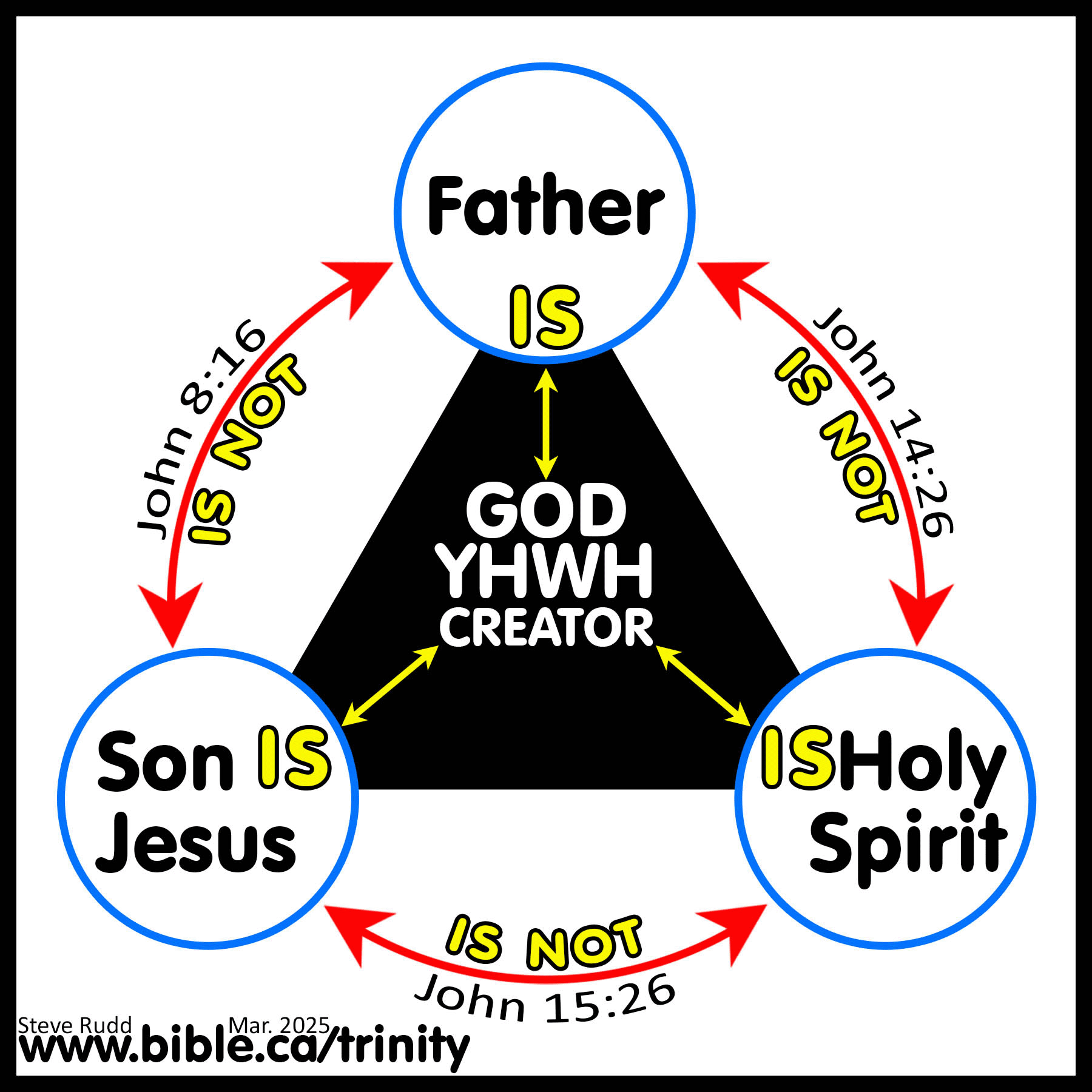
Genesis 1:26
Then God said, "Let US make man in OUR image, according to Our likeness"
I. Plural pronouns used of God proving the trinity:
Click here for detailed study of plural references to God
A. Two plural pronouns, (Us, Our) used 6 different times in four different passages. Remember the word God (elohim) is also plural every time it is used in the Old Testament. Gen 11:7 also includes a plural verb (confuse) which even further, through grammar reinforces the plural "elohim" and the plural pronoun US.
1. "Our" Gen 1:26
2. "Us" Gen 1:26; 3:22; 11:7; Isa 6:8
B. These are the four passages where God speaks for Himself and uses plural pronouns:
1. "Then God [plural elohim] said, "Let Us [plural pronoun] make man in Our [plural pronoun] image, according to Our [plural pronoun] likeness" Genesis 1:26
2. "Then Yahweh God [plural elohim] said, "Behold, the man has become like one of Us [plural pronoun], knowing good and evil" Genesis 3:22
3. "Come, let Us [plural pronoun] go down and there confuse [plural form of balal] their language, so that they will not understand one another's speech." Genesis 11:7
4. "Then I heard the voice of the Lord [plural elohim], saying, "Whom shall I send, and who will go for Us [plural pronoun]?"" Isaiah 6:8
II. Christ is the identical image of God, angels are not
A. Jesus Christ is our co-creator who is the exact image of God.
1. "see the light of the gospel of the glory of Christ, who is the image of God. " 2 Corinthians 4:4
2. "He is the image of the invisible God, the firstborn of all creation. " Colossians 1:15
3. "And He is the radiance of His glory and the exact representation of His nature, and upholds all things by the word of His power. When He had made purification of sins, He sat down at the right hand of the Majesty on high, " Hebrews 1:3
B. There is no reason to suggest the plural pronoun is the "plural of Majesty", since both Jesus and the Father are described as having the same image.
Click here for a full discussion of "plural of Majesty"
III. Angels are not included in "Us" and "Our":
A. Anti-Trinitarians claim that when God said, "Let US make man in OUR image". (Gen 1:26) he was speaking to angels.
1. Angels are not created in the image of God, only man.
2. If angels are included in "Let US make", then angels AND God are equally our creator.
3. Jehovah's Witnesses actually get this one right: The US includes (at least) the Father and Jesus in this creation. Jesus, being God, is the creator of all things: "All things came into being through Him, and apart from Him nothing came into being that has come into being. " John 1:3
IV. Christ cannot be the angel Michael the arch-angel:
V. The apostolic Fathers unanimously taught that the "Us" in Gen 1:26, refers to the trinity:
- Jehovah's Witnesses are taught through their Watchtower, that Jesus is the created arch-angel named Michael. This is false doctrine and heresy.
- Hebrews 1:5 proves Jehovah's Witnesses false teachers when they say Jesus is an angel: "For to which of the angels did He ever say, "You are My Son, Today I have begotten You"? And again, "I will be a Father to Him And He shall be a Son to Me"? " (Hebrews 1:5) Of course the answer is rhetorical: God never said to any angels "Today I have begotten You". But he did say this to Jesus. Therefore Jesus cannot be an angel, but we begotten at his resurrection as Acts 13:33 says, thereby fulfilling Ps 2:7.
- The self contradictory doctrine of the Watchtower has Jesus the creature, functioning as our co-creator (Jn 1:3; Col 1:16). But this violates Rom 1:25: "worshiped and served the creature rather than the Creator". This passage teaches that if Jesus is the creator, as the Bible says he is, then he cannot be a creature. Jesus cannot be creator and creature at the same time!
More trinity quotes from the apostolic Fathers
- 74 AD Epistle of Barnabas: "For the Scripture says concerning us, while He speaks to the Son, "Let Us make man after Our image, and after Our likeness" (Epistle of Barnabas, Chapter VI.—The Sufferings of Christ, and the New Covenant, Were Announced by the Prophets.)
- 150 AD Justin Martyr: Speaking of Jewish theologians Justin calls the Jewish teaching that God spoke to angels a hersey: "In saying, therefore, 'as one of us, '[Moses] has declared that [there is a certain] number of persons associated with one another, and that they are at least two. For I would not say that the dogma of that heresy which is said to be among you (The Jews had their own heresies which supplied many things to the Christian heresies) is true, or that the teachers of it can prove that [God] spoke to angels, or that the human frame was the workmanship of angels. But this Offspring, which was truly brought forth from the Father, was with the Father before all the creatures." (Dialogue of Justin Martyr, with Trypho, a Jew: Chapter LXII.—The Words "Let Us Make Man")
- 180 AD Irenaeus "It was not angels, therefore, who made us, nor who formed us, neither had angels power to make an image of God, nor any one else, except the Word of the Lord, nor any Power remotely distant from the Father of all things. For God did not stand in need of these [beings], in order to the accomplishing of what He had Himself determined with Himself beforehand should be done, as if He did not possess His own hands. For with Him were always present the Word and Wisdom, the Son and the Spirit, by whom and in whom, freely and spontaneously, He made all things, to whom also He speaks, saying, "Let Us make man after Our image and likeness; " [Gen. 1:26]" (Against Heresies 4:20:1).
- 200 AD Tertullian: "If the number of the Trinity also offends you, as if it were not connected in the simple Unity, I ask you how it is possible for a Being who is merely and absolutely One and Singular, to speak in plural phrase, saying, "Let us make man in our own image, and after our own likeness; " whereas He ought to have said, "Let me make man in my own image, and after my own likeness," as being a unique and singular Being? In the following passage, however, "Behold the man is become as one of us," He is either deceiving or amusing us in speaking plurally, if He is One only and singular. Or was it to the angels that He spoke, as the Jews interpret the passage, because these also acknowledge not the Son? Or was it because He was at once the Father, the Son, and the Spirit, that He spoke to Himself in plural terms, making Himself plural on that very account? Nay, it was because He had already His Son close at His side, as a second Person, His own Word, and a third Person also, the Spirit in the Word, that He purposely adopted the plural phrase, "Let us make; "and, "in our image; "and, "become as one of us." (Tertullian, Against Praxeas, Chapter XII. Other Quotations from Holy Scripture Adduced in Proof of the Plurality of Persons in the Godhead.)
- 200 AD Tertullian: Tertullian rejects the idea that God was speaking to Angels because our head is the creator, not a creature: "Since then he is the image of the Creator (for He, when looking on Christ His Word, who was to become man, said, "Let us make man in our own image, after our likeness"), how can I possibly have another head but Him whose image I am? For if I am the image of the Creator there is no room in me for another head" (Tertullian, Book V, Elucidations, Chapter VIII.—Man the Image of the Creator, and Christ the Head of the Man.)
- 200 AD Tertullian: "In the first place, because all things were made by the Word of God, and without Him was nothing made. Now the flesh, too, had its existence from the Word of God, because of the principle, that here should be nothing without that Word. "Let us make man," said He, before He created him, and added, "with our hand," for the sake of his pre-eminence, that so he might not be compared with the rest of creation." (Tertullian: On the Resurrection of the Flesh, Elucidations, Chapter V.—Some Considerations in Reply Eulogistic of the Flesh. It Was Created by God.)
- 250 AD Ignatius "For Moses, the faithful servant of God, when he said, "The Lord thy God is one Lord," and thus proclaimed that there was only one God, did yet forthwith confess also our Lord [Jesus] when he said, "The Lord [Jesus] rained upon Sodom and Gomorrah fire and brimstone from the Lord." And again [he confessed a second time our Lord Jesus by saying], "And God said, Let Us make man after our image: and so God made man, after the image of God made He him."" (The Epistle of Ignatius to the Antiochians, Chapter II.—The True Doctrine Respecting God and Christ.)
- Origen: "it was to Him that God said regarding the creation of man, "Let Us make man in Our image, after Our likeness." (Origen Against Celsus, Book V, Chapter XXXVII)
- Novatian: "For who does not acknowledge that the person of the Son is second after the Father, when he reads that it was said by the Father, consequently to the Son, "Let us make man in our image and our likeness; " and that after this it was related, "And God made man, in the image of God made He him? "Or when he holds in his hands: "The Lord rained upon Sodom and Gomorrah fire and brimstone from the Lord from heaven? " (A Treatise of Novatian Concerning the Trinity, Chapter XXVI. Argument.—Moreover, Against the Sabellians He Proves that the Father is One, the Son Another.)
- Constitutions of the Holy Apostles: "the divine Scripture testifies that God said to Christ, His only-begotten, "Let us make man after our image, and after our likeness. And God made man: after the image of God made He him; male and female made He them."(Constitutions of the Holy Apostles, Book V., VII)
By Steve Rudd
C. The plural nouns and pro-nouns applied to God, like US, OUR, Elohim, Adonai are powerful evidence of the Trinity hidden in the Old Testament, to be discovered after the coming of Christ. The almost exclusive use of the plural elohim for God and adonai for Lord, make a strong case that any honest seeker could see. This extensive pattern is irrefutable.
By Steve Rudd
contact the author
Nomina sacra (Latin: sacred names) are abbreviations that are used for proper names, especially ones that refer to God.
You can also see this with God's other name in the Old Testament. YaHWeH is frequently shortened to YH or IH. This is especially true within names. Jerem-IaH. Hezek-IaH.
The same is true for EL. Isra-EL. Ezeki-EL.
There are also nomina sacra in the New Testament. The oldest manuscripts frequently shorten Jesus (Iesous) to IS or IHS, and Christ (Xristos) to XR.

FreeInChrist
Active Member
Thank you, It is always good to hear from those with the knowledge that you have in addition to the posted things that one finds when they search.EL is not the singular form of Elohim. EL is a nomina sacra.
Nomina sacra (Latin: sacred names) are abbreviations that are used for proper names, especially ones that refer to God.
You can also see this with God's other name in the Old Testament. YaHWeH is frequently shortened to YH or IH. This is especially true within names. Jerem-IaH. Hezek-IaH.
The same is true for EL. Isra-EL. Ezeki-EL.
There are also nomina sacra in the New Testament. The oldest manuscripts frequently shorten Jesus (Iesous) to IS or IHS, and Christ (Xristos) to XR.
It helps top broaden our thoughts and expand what we do read within the four corners of the Holy Bible.
Wick Stick
Active Member
EL should still be read as Elohim, which is plural.Thank you, It is always good to hear from those with the knowledge that you have in addition to the posted things that one finds when they search.
It helps top broaden our thoughts and expand what we do read within the four corners of the Holy Bible.
The singular form is אֱלוֹהַּ (Elowah). It's in the Bible about 50 times, but most of them are in Job.

Runningman
Active Member
You may become a partaker of the divine nature (right now) if you have escaped the corruption in the world caused by evil desires. This is about being on earth, right now, in this life time. Not a future event after the resurrection. (2 Peter 1:4)Yes, in the future, as over-comers and in God, we will become partakers of the divine nature, being renewed in the image of God, and having communion with them, so as to dwell in God and God in you.
The Word as God, in same way the father is also, and became human flesh as JesusIn the beginning at creation it was God's powerful creative word that spoke creation into being NOT a consciously active person.
There is too much scripture testifying against the concept of a Triune God. There is too much scripture testifying that Jesus was a man, a genuine human being - not a god man - not a 100%God 100%man hybrid, not a dual natured being.
Jesus did not have a physical role in creation nor a symbolic role.
It is the Trinitarian doctrine which denigrates not only our Lord Jesus Christ, the Messiah, the Son of God but also denigrates God by making him a human clothed in flesh. No Unitarian I know denied that Jesus is Lord - both Lord and Christ.
The Holy Spirit indwels each redeemed, but Jesus very nature is deity and human both, while we are still just humanYou may become a partaker of the divine nature (right now) if you have escaped the corruption in the world caused by evil desires. This is about being on earth, right now, in this life time. Not a future event after the resurrection. (2 Peter 1:4)
Runningman
Active Member
Following the Biblical timeline, Jesus didn't receive the Holy Spirit until after he was taken to heaven and commanded to take a seat beside God. The Holy Spirit Jesus received is an empowerment, the empowering event the disciples experienced in the upper room on Pentecost, not God himself, but an empowerment to perform spiritual gifts.The Holy Spirit indwels each redeemed, but Jesus very nature is deity and human both, while we are still just human
Acts 2
33Exalted, then, to the right hand of God, He has received from the Father the promised Holy Spirit and has poured out what you now see and hear.
amazing grace
Active Member
The Father became a human being? You aren't Trinitarian are you because they do not believe the Father became a human being. The Father stayed in heaven while the Son came to earth ---- I know, I would be confused too!The Word as God, in same way the father is also, and became human flesh as Jesus
Yes, the Word (God) is the speech/logos. Agree?Yes, all things were made through him, and without him was not any thing made that was made = by God's speech.
If not, to be Biblical find me a text that state, the Father defined as the speech.
You make Jesus made a mistake, when He said, neither heard the Father voice anytime, and that "anytime" includes us.Yes, God's word was with him just as your word is with you.....your word is not with someone else.
Unless you will confirm that you yourself heard the voice of the Father. (John 5:37)
Again, you make Jesus made a mistake, when He said, neither heard the Father voice anytime, and that "anytime" includes us.You just said that logos is defined as SPEECH - God spoke HIS WORD which was WITH HIM ----
AND THE WORD God's speech is qualitative of who God is ---- just as your speech, what you say reveals your qualities.
Or else you can confirm that you yourself heard the voice of the Father. (John 5:37)
Yes, the predicate "God" describe the subject "the Word" as God.Yes, it functions as a predicate in the nominative case.
Yes, the definite article is used before 'word' not before 'God'.
Yes, as the bloodless Word that is God cannot die, He need became flesh to be put to death, and shed blood to offer salvation to all mankind in faith.Jesus died and was raised from the dead and if Jesus did not die, shed his blood then you are still in your sins.
Yes, stated by the later Byzantine text type manuscripts, but that does mean in contradiction of what the Father Himself said in Heb 1:2,10)The one you previously quoted: Ephesians 3:9 at Post #101
(KJV+) Eph 3:9 AndG2532 to make all men seeG5461 G3956 whatG5101 is theG3588 fellowshipG2842 of theG3588 mystery,G3466 which fromG575 theG3588 beginning of the worldG165 hath been hidG613 inG1722 God,G2316 who createdG2936 all thingsG3956 byG1223 JesusG2424 Christ:G5547
(Greek NT Byzantine) Eph 3:9 καιG2532 CONJ φωτισαιG5461 V-AAN πανταςG3956 A-APM τιςG5101 I-NSF ηG3588 T-NSF οικονομιαG3622 N-NSF τουG3588 T-GSN μυστηριουG3466 N-GSN τουG3588 T-GSN αποκεκρυμμενουG613 V-RPP-GSN αποG575 PREP τωνG3588 T-GPM αιωνωνG165 N-GPM ενG1722 PREP τωG3588 T-DSM θεωG2316 N-DSM τωG3588 T-DSM ταG3588 T-APN πανταG3956 A-APN κτισαντιG2936 V-AAP-DSM διαG1223 PREP ιησουG2424 N-GSM χριστουG5547 N-GSM
May we know what Bible translations are that?Research in the arena of 'textual criticism' is an ongoing pursuit among many scholars --- there are new discoveries continually within theological circles.
So, the blueprints hands made the habitable house?God has the blueprint ...... He created according to that blueprint with His Son and the redemption of mankind foremost in His mind sending out agents to accomplish His purposes. Peter made a blueprint and gave the blueprint to his architect and builders --- the building was carried out by Peter's agents yet it was Peter's blueprint that made the house.
I understand that "adjective" God describes the subject the Word.NO, NO I am stressing the fact that without the definite article before 'God' in John 1:1c - places 'God' here in the nominative case and not the vocative case. The nominative case points to 'God' being qualitative (as an adjective).
If 'God' HAD the definite article - the vocative case would point to equality.
As the Greek "καὶ θεὸς ἦν ὁ λόγος" translated as "and God was the Word," we will know that “the Word” is the subject because it has the definite article, and was translated accordingly, “and the Word was God.” Two questions, both of theological import, should come to mind: (1) why was θεός thrown forward? and (2) why does it lack the article?
In brief, its emphatic position stresses its essence or quality: “What God was, the Word was” is how one translation brings out this force. Its lack of a definite article keeps us from identifying the person of the Word, with the person of “God” (the Father). That is to say, the word order tells us that the Word has all the divine attributes that the Father has, the lack of the article tells us that the Word is not the Father.
That is what I mean a revision of John 1:1c, as to imply the speech was of the Father, it should have stated as "and the Word was the God," but that is not stated in the Bible. Clearly "and the Word was God." The speech/logos was God.The Gospel of John is deeply poetic and topical in structure, thematically and not strictly chronological.
Let me say --- I have studied this for a long time. I know the definition of logos fairly well which is why I believe the word that became flesh wasn't God Himself but God's sayings, God's precepts, God's character, God's word became flesh ----
That's why when the Word became flesh, He was identified by literal word for word Bible translations that abide in the process of "textual criticism" as the "only begotten God." (John 1:18)
Our flesh will die, the divine nature will not.You may become a partaker of the divine nature (right now) if you have escaped the corruption in the world caused by evil desires. This is about being on earth, right now, in this life time. Not a future event after the resurrection. (2 Peter 1:4)
Aren't we still in flesh? or not?
In the New Jerusalem there be no longer death and etc as for these things have passed away.
Nothing unclean, no unrighteousness, but only those whose names are written in the Lamb's book of life.
Rev 21:4 and He will wipe away every tear from their eyes; and there will no longer be any death; there will no longer be any mourning, or crying, or pain; the first things have passed away."
Rev 21:27 and nothing unclean, and no one who practices abomination and lying, shall ever come into it, but only those whose names are written in the Lamb's book of life.
amazing grace
Active Member
This has been addressed.Yes, the Word (God) is the speech/logos. Agree?
If not, to be Biblical find me a text that state, the Father defined as the speech
No, Jesus is speaking to a specific audience at John 5:37 - these Jews Jesus was speaking to were ones who were making accusations against him; ones who did not believe he was the Messiah - IOW unbelievers. Unbelievers do not hear the voice of God.You make Jesus made a mistake, when He said, neither heard the Father voice anytime, and that "anytime" includes us.
Unless you will confirm that you yourself heard the voice of the Father. (John 5:37)
Again, you make Jesus made a mistake, when He said, neither heard the Father voice anytime, and that "anytime" includes us.
Or else you can confirm that you yourself heard the voice of the Father. (John 5:37)
God gave his Son to die for our sins - a human being, a man born of a woman.Yes, the predicate "God" describe the subject "the Word" as God.
Yes, as the bloodless Word that is God cannot die, He need became flesh to be put to death, and shed blood to offer salvation to all mankind in faith.
But now the righteousness of God has been manifested apart from the law, although the Law and the Prophets bear witness to it— the righteousness of God through faith in Jesus Christ for all who believe.........and are justified by his grace as a gift, through the redemption that is in Christ Jesus, whom God put forward as a propitiation by his blood, to be received by faith. ...... [Romans 3:21,22,24.25] Jesus Christ DIED for your sins and mine - for the sins of the world.
Yes, the Byzantine Manuscripts came LATER which is when the ending of Eph. 3:9 appeared. I didn't say that any scripture contradicts another.Yes, stated by the later Byzantine text type manuscripts, but that does mean in contradiction of what the Father Himself said in Heb 1:2,10)
(KJV+) Eph 3:9 AndG2532 to make all men seeG5461 G3956 whatG5101 is theG3588 fellowshipG2842 of theG3588 mystery,G3466 which fromG575 theG3588 beginning of the worldG165 hath been hidG613 inG1722 God,G2316 who createdG2936 all thingsG3956 byG1223 JesusG2424 Christ:G5547
(Greek NT Byzantine) Eph 3:9 καιG2532 CONJ φωτισαιG5461 V-AAN πανταςG3956 A-APM τιςG5101 I-NSF ηG3588 T-NSF οικονομιαG3622 N-NSF τουG3588 T-GSN μυστηριουG3466 N-GSN τουG3588 T-GSN αποκεκρυμμενουG613 V-RPP-GSN αποG575 PREP τωνG3588 T-GPM αιωνωνG165 N-GPM ενG1722 PREP τωG3588 T-DSM θεωG2316 N-DSM τωG3588 T-DSM ταG3588 T-APN πανταG3956 A-APN κτισαντιG2936 V-AAP-DSM διαG1223 PREP ιησουG2424 N-GSM χριστουG5547 N-GSM
May we know what Bible translations are that?
Textual critics compare ALL text, all found manuscripts - it is not just certain Bible translations.
As for the above subject ...... I will probably not respond again because it is just getting VERY repetitive.
amazing grace
Active Member
The carpenters, the brick layers, the sheet rock people ----- the "agents" used in building the house brought the plan Peter had in mind, in his foreknowledge written out as a blueprint into a reality.So, the blueprints hands made the habitable house?
Yes, it is not a direct address, it is not calling the word GOD but is stressing the quality of "what God was, the word was".I understand that "adjective" God describes the subject the Word.
As the Greek "καὶ θεὸς ἦν ὁ λόγος" translated as "and God was the Word," we will know that “the Word” is the subject because it has the definite article, and was translated accordingly, “and the Word was God.” Two questions, both of theological import, should come to mind: (1) why was θεός thrown forward? and (2) why does it lack the article?
In brief, its emphatic position stresses its essence or quality: “What God was, the Word was” is how one translation brings out this force. Its lack of a definite article keeps us from identifying the person of the Word, with the person of “God” (the Father). That is to say, the word order tells us that the Word has all the divine attributes that the Father has, the lack of the article tells us that the Word is not the Father.
That is what I mean a revision of John 1:1c, as to imply the speech was of the Father, it should have stated as "and the Word was the God," but that is not stated in the Bible. Clearly "and the Word was God." The speech/logos was God.
Who made a revision to John 1:1c? Correct, you just explained that the emphatic position stresses its quality - 'God' is used in a qualitative sense. Also stated above which I bolded: 'the lack of the article tells us that the Word is not the Father, aka God ---- Remember the Father is the only true God.
That paragraph seems to be trying to separate 'God' from the 'Father' so that John 1:14 doesn't have the 'Father' becoming flesh! Any trick will help right!
Which is why John 1:18 is ambiguous as evidenced in the different translations. If God is an immortal eternal being - HE WAS NOT BEGOTTEN. ---- brought into existence ---- HE HAS ALWAYS BEEN!That's why when the Word became flesh, He was identified by literal word for word Bible translations that abide in the process of "textual criticism" as the "only begotten God." (John 1:18)

synergy
Active Member
The nature that everyone thinks about when conversing about human nature. How many human natures do humans have?I guess you just cannot give me your definition of nature?
You just contradicted RM who claimed that Jesus has "the nature of God". Well done.If you mean by the 'the nature of God' the characteristics of God - Jesus does share these characteristics but if you mean by 'the nature of God', the innate inherent attributes of God - Jesus does not have.


