Your Views on The Trinity

Scripture teaches the Word is a thing in 1 John 1:1-3. Yet you all say the word is God. God isn't a thing, therefore the word is not God. Pretty easy to understand that God's words aren't Himself. They can have attributes of God, but something with God's attributes aren't God. This is what is called godly.
again you fail in two immediately noticed aspects. You take a word in one context to determine its meaning in another context. Also you miss the use of metonymy and have not argued against the probably of metonymy in John 1. Maybe you can try some argument with a little more substance to it.
You have come no where close to wiping 1 John 1:1-3 out of the Bible. It's still there. More accurately, your argument is that you disagree with Scripture. You're in full blown damage control at this point.
That is stupid to say. 1 john 1 speaks on the topic of life, not on the person of Jesus and not on the topic of John 1.
Understand John 1 in light of the Old Testament and 1 John 1:1-3. The Word is never referred to as God in the Old Testament. It's spoken of as a thing that comes out of God's mouth.
You are not dealing with the differences of the writing and again are generalizing the use of "word" That is why it is considered such a bad analysis being proposed by you.
Isaiah 55
11So will My word be which goes forth from My mouth;
It will not return to Me empty,

Without accomplishing what I desire,
And without succeeding in the matter for which I sent it.
Oh wow. You quote an Isaiah text that has no relevance
Some of the trinitarians have rightly identified the word as a thing. Study more and you'll understand what they are talking about.
Funny how you still try to pick out phrases and say that those speak against the Trinitarian context they form.
Not what the Bible says.
I'm sorry that your Bible is missing key verses.
Scripture makes a better argument than you and @TomL do. You all seem to think you can quote John 1:1 and call it a day, but the testimony of Scripture from cover to cover contradicts your opinions.
As long as there is no counter argument to TomL and my demonstration of the text, there is no reason to be dissuaded from the divinity of Christ found in scripture.
In other words, Logos theology was developed over time. You are what I would consider a logos theologian which is an extremely weak philosophy to uphold since it is directly contradicted by the entire OT and 1 John 1:1-3.
You do not know the nature of God's eventual revelation of more and more details. I will count that as ignorance of both the OT and NT.
 
1 John 1:1-3 calls the Word of life eternal life. So it's a thing. Also, the Word is called a that, which, this, what and an it, not a he, him, who, etc. John spoke of the word as an immaterial thing. That isn't going anywhere so cease your arguments trying to change what the Bible says. The buck stops here, you can't gaslight me into changing my mind about it.

So since we know that the Word is a thing, we know that the Word in John 1:1 is not God. John was a Jew and familiar with the holy writ Scriptures. John was speaking of the word in line with Hebrew poetry.
You did not address this

Sorry but you are repeating an absurdity for which you failed to address the rebuttal below


1 John 1:1–3 (NASB95) — 1 What was from the beginning, what we have heard, what we have seen with our eyes, what we have looked at and touched with our hands, concerning the Word of Life— 2 and the life was manifested, and we have seen and testify and proclaim to you the eternal life, which was with the Father and was manifested to us— 3 what we have seen and heard we proclaim to you also, so that you too may have fellowship with us; and indeed our fellowship is with the Father, and with His Son Jesus Christ.

It concerns the person Jesus who was heard and seen and touched

Are you going to claim they did not see and hear a person?

You did not answer

That they had fellowship with a thing that was not personal?

You did not answer

The person spoken of throughout the New Testament really did not personally exist?

As I stated previously and you have not addressed Your claim is absurd - totally

Now for your silly claim

"calls the Word of life eternal life means christ is a thing"

.1 John 5:20And we know that the Son of God has come, and has given us understanding so that we may know Him who is true; and we are in Him who is true, in His Son Jesus Christ. This is the true God and eternal life.

Who is the true God here?

The one you believe?

According to your logic, he must be a thing because he is called eternal life.

And if you deny it is God the Father, then Jesus is the true God

Either way, your argument stands refuted.


The Logos-idea developed out of the Old Testament (especially the creation via divine word in Genesis) and then is influenced by Hellenistic philosophy. Many trinitarians agree with this.

Meyer's NT Commentary agree that the Word (Logos) is a thing and not God:
The investigation of the Logos idea can only lead to a true result when pursued by the path of history. But here, above all, history points us to the O. T.,[64] and most directly to Genesis 1, where the act of creation is effected by God speaking. The reality contained in this representation, anthropomorphic as to its form, of the revelation of Himself made in creation by God, who is in His own nature hidden, became the root of the Logos idea. The Word as creative, and embodying generally the divine will, is personified in Hebrew poetry (Psalm 33:6; Psalm 107:20; Psalm 147:15; Isaiah 55:10-11); and consequent upon this concrete and independent representation, divine attributes are predicated of it (Psalm 34:4; Isaiah 40:8; Psalm 119:105), so far as it was at the same time the continuous revelation of God in law and prophecy. A way was thus paved for the hypostatizing of the λόγος as a further step in the knowledge of the relations in the divine essence; but this advance took place gradually, and only after the captivity, so that probably the oriental doctrine of emanations, and subsequently the Pythagorean-platonic philosophy, were not without influence upon what was already given in germ in Genesis 1.
https://biblehub.com/commentaries/meyer/john/1.htm

“Logos is broadly defined as the Word of God, or principle of divine reason and creative order … In Greek philosophy, it related to a universal, divine reason or the mind of God.”
https://www.christianity.com/wiki/c...in-the-bible-definition-and-significance.html

“The idea of God, who is in his own nature hidden, revealing himself in creation, is the root of the Logos-idea …”

“This idea develops itself in the Old Testament on three lines: (1) The Word, as embodying the divine will, is personified in Hebrew poetry… (2) The personified wisdom … (3) …”
https://www.bible-researcher.com/logos.html

This academic study declares that the term “λόγος” has roots in OT prophecy, in Hellenistic Jewish literature (Philo) and in Greek philosophy"
https://digitalcommons.liberty.edu/masters/76/

I did some homework for you. The Word is a thing, something that Jews have been putting into personification for thousands of years. It's hilarious you think you can come along and unseat that. Scripture and the Christian community refutes you completely.
 
John 17:5Now, Father, glorify Me together with Yourself, with the glory which I had with You before the world was.

Loved of the father before the world was

John 17:24Father, I desire that they also, whom You have given Me, be with Me where I am, so that they may see My glory which You have given Me, for You loved Me before the foundation of the world.
Paul taught that God loved others before the foundation of the world too.

Ephesians 1
4For He chose us in Him before the foundation of the world to be holy and blameless in His presence. In love 5He predestined us for adoption as His sons through Jesus Christ, according to the good pleasure of His will,
Where he was in the form of God

Philippians 2:5–7 (NASB 95) — 5 Have this attitude in yourselves which was also in Christ Jesus, 6 who, although He existed in the form of God, did not regard equality with God a thing to be grasped, 7 but emptied Himself, taking the form of a bond-servant, and being made in the likeness of men.
Another one of my go to verses that prove that Jesus isn't God. Paul was teaching them to have the mind of Jesus, not teach them to believe they are God.

This is a more literal word-for-word version of Philippians 2:6 where Paul taught Jesus isn't equal to God:

Philippians 2
6Who, existing in the form of God,
did not consider equality with God
something to be grasped,

Later in the context, Paul taught them that Jesus isn't the God who receives glory.

Philippians 2
11and every tongue confess that Jesus Christ is Lord,
to the glory of God the Father.
The radiance of God and the exact representation of his nature

Heb 1:1–3God, after He spoke long ago to the fathers in the prophets in many portions and in many ways, in these last days has spoken to us in His Son, whom He appointed heir of all things, through whom also He made the world. And He is the radiance of His glory and the exact representation of His nature, and upholds all things by the word of His power. When He had made purification of sins, He sat down at the right hand of the Majesty on high,
I also quote this verse. Right off the bat we can see that God didn't speak through the Son in the past when He was creating, but rather only spoke through the Son "in these last days" which is after creation.

Tell me, do you know when "these last days" are?
You addressed basically nothing.

And were you to interpret all uses of the Greek word theos without an article as godly you would be making quite a mess of scripture for many examples exist

And for the record Theos (God) is a noun in John 1:1 not an adjective (godly)

The actual greek is

καὶ θεὸς ἦν ὁ λόγος

And God was the word

And btw your interpretation of 1 John was totally refuted

Sorry but you are repeating an absurdity for which you failed to address the rebuttal below
The Greek grammar of John 1:1 is where Unitarians win this argument. Provided that the Word as god lacks a definite article, it is not The God, meaning it is either indefinitely (a god) or qualitative (describing the nature of something.) We know that the Word is not God because the Bible explicitly defines the Word as a thing in the entire Old Testament and 1 John 1:1-3. We also know the Father is the only true God. We also know that the Word isn't a god since there are no examples of that in the OT. Therefore, the only rational conclusion is that the word is qualitative. That's why Biblical Unitarians translate John 1:1 this way:

John 1:1 REV
In the beginning was the word, and the word was with God, and what God was the word was.

This translation is fully supported by the Greek and context of the Bible.
1 John 1:1–3 (NASB95) — 1 What was from the beginning, what we have heard, what we have seen with our eyes, what we have looked at and touched with our hands, concerning the Word of Life— 2 and the life was manifested, and we have seen and testify and proclaim to you the eternal life, which was with the Father and was manifested to us— 3 what we have seen and heard we proclaim to you also, so that you too may have fellowship with us; and indeed our fellowship is with the Father, and with His Son Jesus Christ.

It concerns the person Jesus who was heard and seen and touched

Are you going to claim they did not see and hear a person?

That they had fellowship with a thing that was not personal?

The person spoken of throughout the New Testament really did not personally exist?

As I stated previously and you have not addressed Your claim is absurd - totally
The word of God is spoken of as a thing that can be handled, seen, and even tasted in Scripture. It's no problem for John to say that the word is something that touched with their hands.

Hebrews 6
5who have tasted the goodness of the word of God and the powers of the coming age—

2 Timothy 2
15Make every effort to present yourself approved to God, an unashamed workman who accurately handles the word of truth.

1 John 1:1-3 is completely in line with the Word being a thing they could touch based on very basic exegesis. These are things you should know, but seem to have either never read or forgot about in your religious tunnel vision. This is why John is explicitly identifying the Word as a thing. John didn't believe the Word is God. If you don't understand Jewish literature and personification, and you are completely detached from their culture, it's easy to misunderstand this. This is why Scripture study is more than just reading verses, but actually knowing how the people who wrote what they wrote intended them to be received by their audience.

So yeah, the Word is definitely a thing, Scripture says so reputedly.
 
Lol this was scripture and you ignored it

As previously noted First you ignore John 1

John 1:1–18 (NASB95) — 1 In the beginning was the Word, and the Word was with God, and the Word was God. 2 He was in the beginning with God. 3 All things came into being through Him, and apart from Him nothing came into being that has come into being. 4 In Him was life, and the life was the Light of men. 5 The Light shines in the darkness, and the darkness did not comprehend it. 6 There came a man sent from God, whose name was John. 7 He came as a witness, to testify about the Light, so that all might believe through him. 8 He was not the Light, but he came to testify about the Light. 9 There was the true Light which, coming into the world, enlightens every man. 10 He was in the world, and the world was made through Him, and the world did not know Him. 11 He came to His own, and those who were His own did not receive Him. 12 But as many as received Him, to them He gave the right to become children of God, even to those who believe in His name, 13 who were born, not of blood nor of the will of the flesh nor of the will of man, but of God. 14 And the Word became flesh, and dwelt among us, and we saw His glory, glory as of the only begotten from the Father, full of grace and truth. 15 John testified about Him and cried out, saying, “This was He of whom I said, ‘He who comes after me has a higher rank than I, for He existed before me.’ ” 16 For of His fullness we have all received, and grace upon grace. 17 For the Law was given through Moses; grace and truth were realized through Jesus Christ. 18 No one has seen God at any time; the only begotten God who is in the bosom of the Father, He has explained Him.

He is defined personally with the masculine pronoun he. He is defined as the source of all things. He made the world

And as the source of all things. He therefore is not a thing as he cannot be the source making himself

Confirmed by God as creator

Heb 1:10And, “You, Lord, in the beginning laid the foundation of the earth, And the heavens are the works of Your hands;

And He claims personal existence

John 8:58 Jesus said to them, “Truly, truly, I say to you, before Abraham was born, I am.

Glory with God before the world was
We should understand Jesus by what he explicitly stated. We know that Jesus denied equality with God in John 14:28 saying, "The Father is greater than I." So we can reasonably conclude that Jesus wasn't suggesting that he is equal with God elsewhere.

The full context of John 8, leading up to the "I am" statement in John 8:58, is not in line with Jesus making a claim to deity. Jesus stated in John 8:28, "the Father has taught me." So here we have an example of Jesus not being omniscient about what God knows because Jesus needed to be "taught" by the Father. Jesus had to learn, he had to be taught something he didn't already know.

Next, Jesus explicitly identified himself as a man in John 8:40 "you are trying to kill me, a man who has told you the truth that I heard from God." Similar to what Jesus had previously stated about being taught by the Father, Jesus said he is telling them the truth he heard from God. Here Jesus equates God with being the Father. Any time Jesus mentions God, he is speaking of the Father only in every context, but never a trinity. Jesus defines God as the Father, that's why we do too.

So John 8:58 is not a claim to deity. We know based on the context that Jesus demonstrated himself to be a man who received teachings from God, so it would be pretty unusual for Jesus to make a claim to deity, abruptly, without precedent, in contradiction to his denials of being deity just before this.

If it helps, you can look at Exodus 3:14,15 where the I AM is the God of Abraham, Isaac, and Jacob. These are titles never given to Jesus in the whole Bible. In Acts 3:13, Jesus is entirely distinct from the God of Abraham, Isaac, and Jacob. So Jesus was not claiming to be God.
 
You did not address this

Sorry but you are repeating an absurdity for which you failed to address the rebuttal below


1 John 1:1–3 (NASB95) — 1 What was from the beginning, what we have heard, what we have seen with our eyes, what we have looked at and touched with our hands, concerning the Word of Life— 2 and the life was manifested, and we have seen and testify and proclaim to you the eternal life, which was with the Father and was manifested to us— 3 what we have seen and heard we proclaim to you also, so that you too may have fellowship with us; and indeed our fellowship is with the Father, and with His Son Jesus Christ.

It concerns the person Jesus who was heard and seen and touched

Are you going to claim they did not see and hear a person?

You did not answer

That they had fellowship with a thing that was not personal?

You did not answer

The person spoken of throughout the New Testament really did not personally exist?

As I stated previously and you have not addressed Your claim is absurd - totally

Now for your silly claim

"calls the Word of life eternal life means christ is a thing"

.1 John 5:20And we know that the Son of God has come, and has given us understanding so that we may know Him who is true; and we are in Him who is true, in His Son Jesus Christ. This is the true God and eternal life.

Who is the true God here?

The one you believe?

According to your logic, he must be a thing because he is called eternal life.

And if you deny it is God the Father, then Jesus is the true God

Either way, your argument stands refuted.
Address this right now and stop running away.

1 John 1:1-3 calls the Word of life eternal life. So it's a thing. Also, the Word is called a that, which, this, what and an it, not a he, him, who, etc. John spoke of the word as an immaterial thing. That isn't going anywhere so cease your arguments trying to change what the Bible says. The buck stops here, you can't gaslight me into changing my mind about it.

So since we know that the Word is a thing, we know that the Word in John 1:1 is not God. John was a Jew and familiar with the holy writ Scriptures. John was speaking of the word in line with Hebrew poetry.

The Logos-idea developed out of the Old Testament (especially the creation via divine word in Genesis) and then is influenced by Hellenistic philosophy. Many trinitarians agree with this.

Meyer's NT Commentary agree that the Word (Logos) is a thing and not God:
The investigation of the Logos idea can only lead to a true result when pursued by the path of history. But here, above all, history points us to the O. T.,[64] and most directly to Genesis 1, where the act of creation is effected by God speaking. The reality contained in this representation, anthropomorphic as to its form, of the revelation of Himself made in creation by God, who is in His own nature hidden, became the root of the Logos idea. The Word as creative, and embodying generally the divine will, is personified in Hebrew poetry (Psalm 33:6; Psalm 107:20; Psalm 147:15; Isaiah 55:10-11); and consequent upon this concrete and independent representation, divine attributes are predicated of it (Psalm 34:4; Isaiah 40:8; Psalm 119:105), so far as it was at the same time the continuous revelation of God in law and prophecy. A way was thus paved for the hypostatizing of the λόγος as a further step in the knowledge of the relations in the divine essence; but this advance took place gradually, and only after the captivity, so that probably the oriental doctrine of emanations, and subsequently the Pythagorean-platonic philosophy, were not without influence upon what was already given in germ in Genesis 1.
https://biblehub.com/commentaries/meyer/john/1.htm

“Logos is broadly defined as the Word of God, or principle of divine reason and creative order … In Greek philosophy, it related to a universal, divine reason or the mind of God.”
https://www.christianity.com/wiki/c...in-the-bible-definition-and-significance.html

“The idea of God, who is in his own nature hidden, revealing himself in creation, is the root of the Logos-idea …”

“This idea develops itself in the Old Testament on three lines: (1) The Word, as embodying the divine will, is personified in Hebrew poetry… (2) The personified wisdom … (3) …”
https://www.bible-researcher.com/logos.html

This academic study declares that the term “λόγος” has roots in OT prophecy, in Hellenistic Jewish literature (Philo) and in Greek philosophy"
https://digitalcommons.liberty.edu/masters/76/

I did some homework for you. The Word is a thing, something that Jews have been putting into personification for thousands of years. It's hilarious you think you can come along and unseat that. Scripture and the Christian community refutes you completely.
 
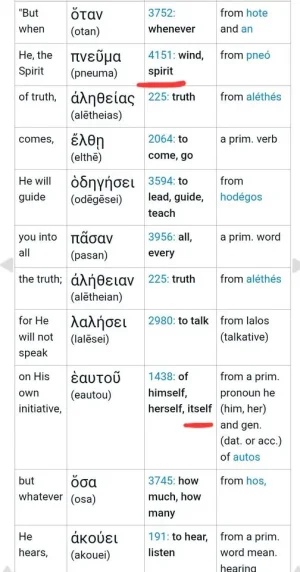
We are dealing with false Trinitarian translation all throughout our modern English Bibles, thank God in these days we are allowed to study the ancient languages for ourselves. Just glancing at this Biblical Lexicon graph down below, this purposeful mistranslation of John 16:13 becomes glaringly obvious! That's a lot of "he and him" that's simply not there.

The Greek word for "spirit" (pneuma) is neuter, so pronouns ("it") should be used, rather than personal ones ("he")


1762626941256.webp
 
While the surgeon general might not say it
Allow me to say it .
It has been deemed
that the love of a harlot is deadly and WILL cause those who embrace her certain death .
Always remember that a harlot will say anything to please to attain one to sit under her and to pay her .
Keep that in mind .
 
@Runningman @Peterlag
Protestants got all of their doctrines from the Catholics.
Christians are neither protestants, not part of Catholicism. We have never protested any truths, not one.

Which sect in the religious sector part of Mystery Babylon, do you and Peter belong to?
 
@Runningman @Peterlag

Christians are neither protestants, not part of Catholicism. We have never protested any truths, not one.
I'm glad to hear you say this.
Which sect in the religious sector part of Mystery Babylon, do you and Peter belong to?
Well, Peter and I are both Christians. I know that word gets thrown around a lot by people who are not Christians, confusing the issue, and somewhat poisoning the well, to the point it's not even clear what a Christian is. If you define Christianity by what Jesus taught then what being a Christian is is clear. You are free to compare your beliefs to what Jesus taught about. Kindly note, Jesus always defined God as the Father. Do you fault people for defining God the way Jesus consistently does?
 
While the surgeon general might not say it
Allow me to say it .
It has been deemed
that the love of a harlot is deadly and WILL cause those who embrace her certain death .
Always remember that a harlot will say anything to please to attain one to sit under her and to pay her .
Keep that in mind .
Sit under a harlot...I pity the fool:eek:
 
We are dealing with false Trinitarian translation all throughout our modern English Bibles, thank God in these days we are allowed to study the ancient languages for ourselves. Just glancing at this Biblical Lexicon graph down below, this purposeful mistranslation of John 16:13 becomes glaringly obvious! That's a lot of "he and him" that's simply not there.

The Greek word for "spirit" (pneuma) is neuter, so pronouns ("it") should be used, rather than personal ones ("he")


View attachment 2544
Yes, it's no secret that trinitarians translate the Bible philosophically rather than Scripturally. It took them roughly 400 years to really make it official in their religion that they believe the Holy Spirit is a third person.

Probably the best place to begin with understanding what the Spirit (sometimes spirit) is is by just starting in Genesis 1. The Spirit in Genesis 1:2 is actually a feminine noun, but the word "spirit" isn't gendered in English. That doesn't mean that God is a she. A literal translation following the way trinitarians seem to do things would be like "and she was hovering over the face of the waters..." but they never seem to do that often, showing that they have awareness of how grammatical gender doesn't necessarily imply personal gender or personhood, because since spirit is neuter in Greek, a consistent rendering would make it "it" rather than "he." Several passages such as Romans 8:16, Romans 8:26, and John 14:17 use neuter pronouns for the Spirit, literally reading "the Spirit itself" or "it," not "he." This shows that in Hebrew and Greek that Spirit is not portrayed as a distinct male person, but is actually God's active power and presence. This is all in line with how God isn't a trinity.
 
Last edited:
Yes, it's no secret that trinitarians translate the Bible philosophically rather than Scripturally. It took them roughly 400 years to really make it official in their religion that they believe the Holy Spirit is a third person.

Probably the best place to begin with understanding what the Spirit (sometimes spirit) is is by just starting in Genesis 1. The Spirit in Genesis 1:2 is actually a feminine noun, but the word "spirit" isn't gendered in English. That doesn't mean that God is a she. A literal translation following the way trinitarians seem to do things would be like "and she was hovering over the face of the waters..." but they never seem to do that often, showing that they have awareness of how grammatical gender doesn't necessarily imply personal gender or personhood, because since spirit is neuter in Greek, a consistent rendering would make it "it" rather than "he." Several passages such as Romans 8:16, Romans 8:26, and John 14:17 use neuter pronouns for the Spirit, literally reading "the Spirit itself" or "it," not "he." This shows that in Hebrew and Greek that Spirit is not portrayed as a distinct male person, but is actually God's active power and presence. This is all in line with how God isn't a trinity.

This does nothing to discount the Trinity.

Obviously there are differences in where Spirit and spirit occur.

God indwells the believer with the Holy Spirit.. is that millions of Holy Spirits?

Jesus says in Matthew 18..He will be 'in the midst ' of believers gathered together as a local church. In the Matthew 18 case as resolving sin issues with a sinning brother.

Is that many many Jesus's?

And actually it is Jesus as the Holy Spirit doing this!

The point being.. if you have a problem with the 3-ness of God.. think about the fact He is in millions if He indwells every believer with His Spirit.

So..He obviously isn't millions..He is one. But He still indwells every believer with His Spirit.

So this fact..and yet who have issue with God being triune.

Unitarianism always wants it both ways. Jesus as Saviour.. Lord ..but not THE Lord.

God as a Spirit, but not the Holy Spirit as another expression of Himself.

Im done with you.
 
@Runningman God is a Trinity;)

Who else but the one true God could say:

“For My own sake, for My own sake, I will act; For how can My name be profaned? And My glory I will not give to another.” (Isa. 48:11)

No one should have the slightest difficulty in identifying the speaker as God. The context of the passage and the grammar of the text are both very clear. But prejudiced anti-Trinitarians must object because the God who is speaking says that He, along with the Holy Spirit, are sent by God.

“Come near to Me, listen to this: From the first I have not spoken in secret, from the time it took place, I was there. And now the Lord GOD has sent Me, and His Spirit.” (Isa. 48:16)

If the passage is interpreted in its natural and normal meaning, there are three persons in this passage who are all God! But how can God be sent by God unless there are several Persons within the Godhead? Since the Father sent the Son and the Spirit in Trinitarian theology, this is exactly the kind of passage which we expect to find.

How can non-Trinitarians handle a passage like this? They can’t. So they deny that the speaker is God and claim that it is actually Isaiah who is speaking in either verse 16b or the whole of verse 16!
The attempt to interject Isaiah into verse 16 falls before the following questions:

1. Is there anything in the Hebrew text to indicate a break in the speech of Jehovah? No.
2. Does Isaiah elsewhere in his book dare to interrupt the Almighty and to insert himself? No.
3. Is there any evidence whatsoever in the text to indicate that anyone else besides God is speaking? No.
4. Has any translation ever separated verse 16 from the rest of Jehovah’s speech? No.
5. Does the Septuagint make a break in verse 16? No.
6. Do the Targums? No.

This passage is clear proof that the authors of the Bible believed that God was multi-personal. A Trinitarian would not have the least hesitation to write the text as it stands. But Unitarians, Arians, Modalists, and Muslims could never do so.

If I as the first person promise to do something for you as the second person through a third person, am I not implying that I am not the same as the third person? If grammar means anything, the answer is, “Yes.”

Robert A. Morey, The Trinity

 
This does nothing to discount the Trinity.

Obviously there are differences in where Spirit and spirit occur.

God indwells the believer with the Holy Spirit.. is that millions of Holy Spirits?

Jesus says in Matthew 18..He will be 'in the midst ' of believers gathered together as a local church. In the Matthew 18 case as resolving sin issues with a sinning brother.

Is that many many Jesus's?

And actually it is Jesus as the Holy Spirit doing this!

The point being.. if you have a problem with the 3-ness of God.. think about the fact He is in millions if He indwells every believer with His Spirit.

So..He obviously isn't millions..He is one. But He still indwells every believer with His Spirit.

So this fact..and yet who have issue with God being triune.

Unitarianism always wants it both ways. Jesus as Saviour.. Lord ..but not THE Lord.

God as a Spirit, but not the Holy Spirit as another expression of Himself.

Im done with you.
It's encouraging that you know that there is the Spirit and spirit. Do you believe the Father is the Holy Spirit?

Trinitarianism always wants it both ways, Jesus as fully God and yet somehow not the same God as the Father, and yet fully human. You can't have it both ways.
 
@Runningman God is a Trinity;)

Who else but the one true God could say:

“For My own sake, for My own sake, I will act; For how can My name be profaned? And My glory I will not give to another.” (Isa. 48:11)

No one should have the slightest difficulty in identifying the speaker as God. The context of the passage and the grammar of the text are both very clear. But prejudiced anti-Trinitarians must object because the God who is speaking says that He, along with the Holy Spirit, are sent by God.

“Come near to Me, listen to this: From the first I have not spoken in secret, from the time it took place, I was there. And now the Lord GOD has sent Me, and His Spirit.” (Isa. 48:16)

If the passage is interpreted in its natural and normal meaning, there are three persons in this passage who are all God! But how can God be sent by God unless there are several Persons within the Godhead? Since the Father sent the Son and the Spirit in Trinitarian theology, this is exactly the kind of passage which we expect to find.

How can non-Trinitarians handle a passage like this? They can’t. So they deny that the speaker is God and claim that it is actually Isaiah who is speaking in either verse 16b or the whole of verse 16!
The attempt to interject Isaiah into verse 16 falls before the following questions:

1. Is there anything in the Hebrew text to indicate a break in the speech of Jehovah? No.
2. Does Isaiah elsewhere in his book dare to interrupt the Almighty and to insert himself? No.
3. Is there any evidence whatsoever in the text to indicate that anyone else besides God is speaking? No.
4. Has any translation ever separated verse 16 from the rest of Jehovah’s speech? No.
5. Does the Septuagint make a break in verse 16? No.
6. Do the Targums? No.

This passage is clear proof that the authors of the Bible believed that God was multi-personal. A Trinitarian would not have the least hesitation to write the text as it stands. But Unitarians, Arians, Modalists, and Muslims could never do so.

If I as the first person promise to do something for you as the second person through a third person, am I not implying that I am not the same as the third person? If grammar means anything, the answer is, “Yes.”

Robert A. Morey, The Trinity
In Isaiah 48:16, it isn't explicitly clear who the speaker is because it shifts perspective and says "And now the Lord GOD has sent me, accompanied by His Spirit." Sometimes prophets alternate between speaking God's words and their own without a clear transition.

If you'll read more of the context until chapter 61, you'll see that Isaiah is identifying himself with what he wrote in Isaiah 48:16:

We know Isaiah 61:1,2 is a microcosm of Isaiah's entire mission. He was referring to what he would do because that's what he spent the entire book of Isaiah doing. Isaiah was anointed and a preacher. He wrote all about him doing that.

Isaiah 61
1The Spirit of the Sovereign Lord is on me,
because the Lord has anointed me
to proclaim good news to the poor.
He has sent me to bind up the brokenhearted,
to proclaim freedom for the captives
and release from darkness for the prisoners,
2to proclaim the year of the Lord’s favor
and the day of vengeance of our God,
to comfort all who mourn,

There is no reason to conclude God is multi-person here based on what you presented because Isaiah explicitly connected himself with Isaiah 48:16. God is consistently referred to as a He, Him, I throughout the Bible by God and everyone else so the idea of God being more than one person isn't being conveyed here. If you had any examples of God being referred to with plural pronouns, you would have a great point. Otherwise, not convincing.
 
Last edited:
@Runningman @Peterlag

Christians are neither protestants, not part of Catholicism. We have never protested any truths, not one.

Which sect in the religious sector part of Mystery Babylon, do you and Peter belong to?
Much of the Roman Catholic doctrine was assimilated into Protestantism and is still being passed along as Christian groups continue to split off from one another. In a nutshell that is why even the independent church in your neighborhood today most probably believes that there is a trinity, dead people are alive, God is in control of everything that happens, the four gospels are written to Christians, and water baptism is relevant. And then there's everything that you know about our sin nature was taught to you by them.
 
@Runningman
Do you fault people for defining God the way Jesus consistently does?
Of course not, for concerning Jesus' humanity, God was his Father, that's not even debatable. God is a Spirit, Jesus was both a man and God in human flesh. Jesus was a complex person, fully man, fully God, the mystery of godliness, which no Christian would never deny. If one denies this truth then they do not know neither the Father or the Son. He that confesses both, has both the Father and the Son abiding within them.

2nd John 1:9​

“Whosoever transgresseth, and abideth not in the doctrine of Christ, hath not God. He that abideth in the doctrine of Christ, he hath both the Father and the Son.”

@Runningman, I do not find fault with the prophet Isaiah, who said:

Isaiah 9:6​

“For unto us a child is born, unto us a son is given: and the government shall be upon his shoulder: and his name shall be called Wonderful, Counsellor, The mighty God, The everlasting Father, The Prince of Peace.”

Do you find fault with the prophet calling the son THE everlasting Father? In what sense is this true? Jesus was the God of Genesis 1:1 in his eternal deity as God. Just as John wrote:

Revelation 1:8​

“I am Alpha and Omega, the beginning and the ending, saith the Lord, which is, and which was, and which is to come, the Almighty.”

1st John 1:1​

“That which was from the beginning, which we have heard, which we have seen with our eyes, which we have looked upon, and our hands have handled, of the Word of life;”
 
@Peterlag @FreeInChrist @brightfame52 @civic @Runningman @dwight92070 @Jim @Victoria
Much of the Roman Catholic doctrine was assimilated into Protestantism
Peter, I would not deny this for it is quite evident that this is so, yet I and other believers have never been part of either group. Protestantism is a word coined by the whore from Rome, making folks believe that if you are not of them then you by the law of deduction, are one that is guilty of protesting truth by the Mother church. We do not sleep with whores, we have been espoused to one husband and are faithful to him!

2nd Corinthians 11:2​

“For I am jealous over you with godly jealousy: for I have espoused you to one husband, that I may present you as a chaste virgin to Christ.”
In a nutshell that is why even the independent church in your neighborhood today most probably believes that there is a trinity
Peter, you are preaching to the choir, I know well that there are false cults on every street corner in Mystery Babylon, and yours without question being one of them. I would not judge them totally on their understanding of the Godhead, more so by the love of the truth and godly living, and the gospel that they preached, either a system of works or one of free grace. There are believers who believe in Jesus' deity as God manifest in flesh, yet hold to the eternal sonship of Jesus, with is an error, yet, a much less corruption of the truth than your total denial of Jesus being God manifest in the flesh, yours is a blatant antichrist teaching.
And then there's everything that you know about our sin nature was taught to you by them.
Well, I came out of them many years ago, back in the seventies, and for the most part have worship in very small home groups and other small groups of public worship with selected believers. Most of mine understanding came directly from personal studies and a few other saints personal searching for the truth.
 
In Isaiah 48:16, it isn't explicitly clear who the speaker is because it shifts perspective and says "And now the Lord GOD has sent me, accompanied by His Spirit." Sometimes prophets alternate between speaking God's words and their own without a clear transition.

If you'll read more of the context until chapter 61, you'll see that Isaiah is identifying himself with what he wrote in Isaiah 48:16:

We know Isaiah 61:1,2 is a microcosm of Isaiah's entire mission. He was referring to what he would do because that's what he spent the entire book of Isaiah doing. Isaiah was anointed and a preacher. He wrote all about him doing that.

Isaiah 61
1The Spirit of the Sovereign Lord is on me,
because the Lord has anointed me
to proclaim good news to the poor.
He has sent me to bind up the brokenhearted,
to proclaim freedom for the captives
and release from darkness for the prisoners,
2to proclaim the year of the Lord’s favor
and the day of vengeance of our God,
to comfort all who mourn,

There is no reason to conclude God is multi-person here based on what you presented because Isaiah explicitly connected himself with Isaiah 48:16. God is consistently referred to as a He, Him, I throughout the Bible by God and everyone else so the idea of God being more than one person isn't being conveyed here. If you had any examples of God being referred to with plural pronouns, you would have a great point. Otherwise, not convincing.
Thats the best way to persent you View:love: Nice and Clear!
 
I'm glad to hear you say this.

Well, Peter and I are both Christians. I know that word gets thrown around a lot by people who are not Christians, confusing the issue, and somewhat poisoning the well, to the point it's not even clear what a Christian is. If you define Christianity by what Jesus taught then what being a Christian is is clear. You are free to compare your beliefs to what Jesus taught about. Kindly note, Jesus always defined God as the Father. Do you fault people for defining God the way Jesus consistently does?
Well , JESUS and the apostels made it real clear
that those who Believe NOT HE Is Christ will surely perish .
There are no broad all inclusive ecumenical roads WITH the TRUE JESUS .
Its beleive in HIM or perish . Let us keep that in mind .
Because if we believe in another gospel
say like OH I BELEIVE but its not necessary to beleive , THEN WE beleive only IN UNBELIEF .
no more kissing korans and budda statues and acting like
all religoins serve the same GOD we do . Nor can we even dare keep company
with those who preach this other so called gospel and its finding common ground .
 
Back
Top Bottom