Ummm,
IF the elect are foreordained to salvation before their birth into earthly lives and
IF this foreordination was not unconditional but due to some reason found in them to be acceptable to GOD for HIM to treat them in this way,
THEN this acceptability to GOD can easily be called a merit.
What was their merit?
Romans 8:29 - For whom HE did foreknow, HE also did predestinate to be conformed to the image of HIS Son. From this verse we can see that the predestination of the elect is based on
the foreknowledge of GOD. Now everyone admits that in this verse, the word
fore means
before life. Therefore, they think that it also means before creation as if our earthly life was the same as our created spirit life. I wonder if this is a valid and reasonable link to make?
GOD obviously does not
before life know everybody since not everyone will become like Jesus, as
Rom 8:29 just said predestination means and as per
Matthew 7:21, 23 Then I will tell them plainly, I never knew you. Away from me, you evildoers! which tells us what
knowing means, emphasising the idea that
loving is knowing and
knowing about has no love.
James 2:19 You believe that there is one God. Good! Even the demons believe that--and shudder. Jesus obviously
knew about the demons and
knew about the miracle workers but this knowing contained no love as it is plain; He
never knew them.
Revelation 20:15, And whosoever was not found written in the book of life was cast into the lake of fire. This means that foreknow must carry the idea of approval. As one commentator stated it,
Whom HE foreknew is virtually equivalent to
whom HE foreloved.
Now this question comes to mind:
if it is true that no one had been created at the time of this foreknowledge, on what basis does GOD "before life" love some and not the rest?
1. Merit based Election before Creation!
The basis can not be, as some have suggested, some merit in the creatures, first because no one exists yet; second, because the ones HE foreloves will be just as defiled in life as any other; and third, because the Scriptures say election is not on the basis of the creature's works or choices in life, but rather on HIS unmerited favour:
Romans 9:11 For the children being not yet born, neither having done any good or evil, that the purpose of GOD according to election might stand, not of works, but of HIM that calleth... Romans 9:16 So then it is not of him that willeth, nor of him that runneth, but of GOD that sheweth mercy.
Therefore, we can surmise that GOD does
not "before life" love some because HE has divined that they will have some merit in their life.
2. Election to Damnation before Creation Serves HIS Purpose?
Others have suggested that GOD
"before life" loved only some because this is more beneficial for HIS purposes than if HE before life loved everyone. The explanation goes something like this: The loved ones' eternal joy is directly proportional to their knowledge - appreciation of GOD and the wonderfulness of their salvation. Therefore an increase of good comes forth from the eternal damnation of some persons for by their damnation, that is, the outcome of Adam's decision to sin, and HIS
"before life" decision not to love these persons, two types of eternal blessings supposedly occur for the rest.
First, a fuller appreciation of several of God's attributes is made possible, which opportunity wouldn't be possible if all lived forever, that is, if HE
"before life" loved them all. These attributes are usually said to be HIS justness (retribution - wrath) holiness and omnipotence.
Secondly, the truth regarding the elect's end apart from Christ's salvation is made fully known, which full knowledge makes possible the fuller appreciation of HIS salvation, for this salvation (hence, HIS mercy too) would not be so fully appreciated without the graphic depiction of both ends.
Third, Others even go so far as to say that their damnation is absolutely necessary in order that the purpose of GOD be able to be fulfilled by HIS elect, and they offer this explanation: In order to live in eternity with GOD, we must live fully in the truth, which necessity necessitates having a perfect appreciation of GOD's attributes and HIS salvation, and that this perfect appreciation by HIS elect creatures is made possible first, only through witnessing HIS triumph over and judgement upon HIS enemies, and second, only when HIS perfection and our life in Christ are contrasted with the complete imperfections of the damned and the end we would have had, had HE not saved us.
Now, these are very hard positions to hold, for they fail on many accounts.
First, they both fail to answer or give a reasonable basis for why HE chose the particular ones HE did and why HE did not choose the rest. In other words, they both deny the faithful and unselfish character of GOD's love, in that they limit it without just cause and look on it as somewhat capricious.
Secondly, they both necessitate the unproven presupposition that it is impossible for GOD to perfect HIS creatures HIMSELF, that HE needs the presence of evil in order to bring HIS creation to its highest potential.
In other words we must accept, for example, that in GODS world one has to first be sick in order to be healthy, or sinful in order to be faultless [and the more sinful (or sick) the better].
Third, they both fail to satisfactorily answer the question of how the damnation of millions makes us more appreciative / perfect than would be the damnation of but one, since it is the moral depravity of those in hell that is supposed to make for the increased appreciation / perfection and not the quantity of persons therein.
Fourthly, they both put a very small value on the worth of the individual creature in the eyes of GOD.
Well, since the reason for GOD's foreknowledge / forelove does not include everyone can not be found in HIS divination of merit in some creatures and since a reasonable answer has not been put forward for why GOD does it particularly, we are left with but two conclusions: We must either look for the answer elsewhere, in some area we have not looked before, or we must put the basis of HIS foreknowledge down to unreasonable chance.
This would mean that there is no reason for HIS particular
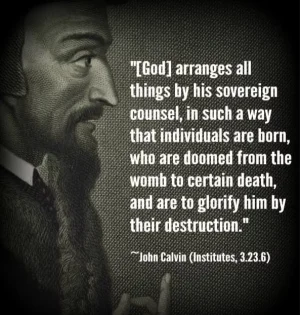
"before life" love. [Aside: as I understand it, this is Calvin's failure to understand this doctrine correctly.] GOD's election / foreknowing is thus based on eenie, meenie, minie, mo, but how can you put your faith in a GOD like that? How much better to admit that we should start looking in some area we have not looked yet, and since we cannot find any of those, why not finally admit that we need a revelation from GOD to give us an infinitely loving answer to this problem?
Now, according to pre-conception theology, the
"before life" love (foreknowledge) of GOD, that is, HIS pre-life approval of some and rejection of the rest is based on the prior uncoerced choice of the creature (in Sheol, before physical creation) and on HIS infinite love, which means that HE will never stop loving anyone who can possibly ever come to glorify HIM. Therein is the reason why HE loved some
"before this life" and why HE did not love the rest.
Some had chosen to eternally defile themselves and some had not. Some had decided to never ever fulfil HIS purpose and some were still able to fulfil HIS purpose, some willingly, (angels) and others only if HE was infallibly gracious (election) to them (His fallen church, the sinful good seed). Yes, and He predestined these to be conformed to the image of HIS Son, and HE predestined the other evil ones for the Day of Judgement and established them for the correction of the fallen elect, as is fulfilled in
Jn 3:18 Whoever (sinner) believes in Him (elect) is not condemned, but whoever (sinner) does not believe (the self chosen reprobate) has already been condemned, because he has not believed in the name of God’s one and only Son. Berean Standard Bible
Now, I ask you, which doctrine is the more scriptural and reasonable and compatible with the attributes of GOD?
2 Timothy 1:9 - Who hath saved us, and called us with an holy calling, not according to our works, but according to HIS own purpose and grace, which was given us in Christ Jesus before the world began. This Scripture does not prove that we existed before our conception. The reason I am including it is that I believe that it does not invalidate pre-conception existence theology, and I am sure a lot of people will think that it and others like it do. May I submit that when the Scriptures speak of works in relation to our election, they are referring to only our works after we're born, ie, no one was elected on account of any works they would do as sinners
in this life.
Now, if there is anyone who would like to disagree with me on this and would like to debate whether Paul intended that our pre-life works were also to be included in the works that were excluded as part of the basis of GOD's election, I would be very interested in seeing your argument. I suppose this isn't necessary, but I would like to (first) point out that any such argument must admit to our pre-earthly existence.
The second thing I would like to point out is that we were called according to HIS purpose. This must mean
so that we could fulfil HIS purpose for us. But if this is so, then there must be an uncoerced choice on our part if we are ever to have the possibility of glorifying GOD. His purpose for us necessitates a free will choice to join that purpose or it is a tape recorder type of agreement and meaningless. Therefore I say that being
called according to HIS purpose and grace is almost exactly the same as saying,
being called in accord with our uncoerced choice and HIS covenant, and
if making that choice is a work, since earthly works are out, then it is the same as saying,
Being called in accord with a pre-conception work and HIS gracious covenant to those who performed that work.
The third thing I would like to point out is that the angels are elected too.
1 Timothy 5:21 I charge thee before GOD and the Lord Jesus Christ, and the elect angels... Angels are a lot different than men (at least, that is what many believe), ie, they do not have what is usually called racial solidarity. This means that they have to make all their own choices. No one else can make them for them and they can not be held accountable for someone else's evil choices. In other words, Adam's choices do not affect them at all (supposedly). Perhaps you would like to tell me
on what basis GOD elected only some of them?
If HIS choice was
not on the basis of their individual choices, then they had to be elected before the satanic rebellion, at least. But if GOD's election of some took place before the satanic rebellion, would this not lead us into the pretty incredulous situation of some unblemished creatures being unjustly
un-predestined to remain in heaven, (which in fact implies the are
predestined for Hell)? And what reasonable basis can we put forward for this situation other than HE simply did not want them to be with HIM forever? This situation does not look too good, does it?
Well then, what if no one was elected before the rebellion, that is, what if GOD's election took place after the rebellion?
Then GOD's election took place after they all had made an eternal choice, and presumably that choice would be taken into account when GOD was doing HIS electing. It would have to be if HE was holy and just. Now, the main thing I am trying to bring out with all of this is that when we just begin to consider the election of angels, we run into some pretty unreasonable implications if we leave out their choice as being a part of the basis of their election, and the only other real alternative necessitates that we accept that their eternal choice was at least a part of the basis of their election.
Well, if you are willing to accept the possibility of their choice, works, being a part of the basis of their election, why can that not be a part of the basis of ours too?




 …
…  …
…  …
…  …
…