Defining the authority of the "church"....

Sam Shamoun is a former Protestant that in recent years (several years now) begun to embrace Roman Catholicism. I include him here that he might "weigh in" here on this topic. I've tried to engage Sam from "time to time" recently with no success. Not that he has to respond to me. He doesn't.

So I will begin this argument that I don't believe most people understand..... Please join in... (Anyone and everyone)

If you're going to appeal to Polycarp, Eusebius, Justin Martyr, Augustine, Jerome and etc..... then you must deal with the "authority" of their positions in the Church. (The Church Universal/Catholic)

I'll begin to define authority as seen in the practice of Christianity in the "early church" assembly and relative teachings.

My position is that the apostle Paul left the keeping of the "church" to Timothy and Titus. We do not know what happened to Timothy and Titus. They basically "disappeared" in the surviving narrative of the early church assembly. There is a reason for this.

The Church at Jerusalem was destroyed when the Temple was destroyed in the conclusion of the 70 weeks of Daniel before 100 AD. In that destruction, there as very wide impact to Christianity that was centered in Jerusalem. It is why we have so few primary sources of information from that very time period.

It took over 200 years after these events to even begin to find primary sources of information now being used by "Roman Catholics/Protestants" alike to defend their positions. Even though I'm "Prima Scriptura" in my position, none of you have ever seen me appeal to these sources as evidence. I don't appeal to them as evidence because I don't believe they're authoritative.

So how do YOU establish the authority by which you teach, preach and etc to others?

Please detail. Thanks
The Hebrew Scripture.

Saul was a rabbi and Pharisee. When he became born-again, he remained a rabbi and Pharisee. Nothing changed. He remained obedient to the Hebrew Scripture. But after he met the Lord and he was baptized by the Holy Spirit into the body of Christ (something he did not know as such at the time) he says in his letter that he left Damascus and went into Arabia. He went to other places and then after three years he went back to Jerusalem. Looking into his narrative we find out Saul "disappeared" for 14-17 years. I'm sure he was very inspired to understand what happened to him and what was taking place among Jewry with this Jesus whom others called "Messiah/Christ", rabbi, teacher, prophet, and even king of Israel. He was married to his "books" of scrolls, parchments, and other rabbinical literature and the Hebrew Scripture which he was learned having been discipled by Gamaliel, a very prominent Jew in Judaism. So, Saul spent time studying Scripture because of his experiences with the Lord and something called the Holy Spirit of Promise. Everything he wrote about later in his letters to the various Jewish Churches in various places in the Roman Empire was this great desire to understand the New Covenant era he participated in specifically and what was happening in Israel in general. Everything he wrote about was clearly the result of his studying the Hebrew Scripture for everything about the New Covenant was found in its pages (scrolls.)

He wrote over fourteen letters to churches and various individuals. Being a rabbi his letters take the approach of rabbinical instruction from the debates he has with himself to debates he had with others about the New Covenant era Israel found itself in. His letters reflect this. Peter, James, John, Andrew, and the other disciples were not among the religious leaders in Israel, but they were taught the Hebrew Scripture by Jesus and having direct contact with the actual Author of those very same Hebrew Scripture they became learned in many things pertaining to the covenants. They were on the outside looking in and Saul was on the inside looking out and all the letters are that Saul wrote were his understanding under the anointing of the Holy Spirit. For Saul his authority was Scripture as was Jesus'. As a whole, what later became the New Testament was not a New Testament, but a New Covenant based upon the Hebrew Scripture. In short, Saul was not just a born-again rabbi and Pharisee, or a Jewish Christian, he was a Biblical Christian. His authority to the things he wrote about in his letters came from studying and understanding the New Covenant era Israel found itself in by reading and studying the Hebrew Scripture. Saul never wrote about biblical/Scriptural instruction to others unless he could prove his statements and theological positions unless he could prove those things by the Hebrew Scripture. THAT is the authority that every true-planted church should base their teachings on. As has been said before, if it's not chapter and verse then it is chatter or worse.
 
the only important, now ,
is the 144k sons.

not the vatican.
not the baal vatican-created baptism concept.
not protestantism.
not evangelicalism.
not years or decades or centuries of 'theology'.
not the corrupt kjv.
not the failed protestant reformation.
 
The Hebrew Scripture.

Saul was a rabbi and Pharisee. When he became born-again, he remained a rabbi and Pharisee. Nothing changed. He remained obedient to the Hebrew Scripture. But after he met the Lord and he was baptized by the Holy Spirit into the body of Christ (something he did not know as such at the time) he says in his letter that he left Damascus and went into Arabia. He went to other places and then after three years he went back to Jerusalem. Looking into his narrative we find out Saul "disappeared" for 14-17 years. I'm sure he was very inspired to understand what happened to him and what was taking place among Jewry with this Jesus whom others called "Messiah/Christ", rabbi, teacher, prophet, and even king of Israel. He was married to his "books" of scrolls, parchments, and other rabbinical literature and the Hebrew Scripture which he was learned having been discipled by Gamaliel, a very prominent Jew in Judaism. So, Saul spent time studying Scripture because of his experiences with the Lord and something called the Holy Spirit of Promise. Everything he wrote about later in his letters to the various Jewish Churches in various places in the Roman Empire was this great desire to understand the New Covenant era he participated in specifically and what was happening in Israel in general. Everything he wrote about was clearly the result of his studying the Hebrew Scripture for everything about the New Covenant was found in its pages (scrolls.)

He wrote over fourteen letters to churches and various individuals. Being a rabbi his letters take the approach of rabbinical instruction from the debates he has with himself to debates he had with others about the New Covenant era Israel found itself in. His letters reflect this. Peter, James, John, Andrew, and the other disciples were not among the religious leaders in Israel, but they were taught the Hebrew Scripture by Jesus and having direct contact with the actual Author of those very same Hebrew Scripture they became learned in many things pertaining to the covenants. They were on the outside looking in and Saul was on the inside looking out and all the letters are that Saul wrote were his understanding under the anointing of the Holy Spirit. For Saul his authority was Scripture as was Jesus'. As a whole, what later became the New Testament was not a New Testament, but a New Covenant based upon the Hebrew Scripture. In short, Saul was not just a born-again rabbi and Pharisee, or a Jewish Christian, he was a Biblical Christian. His authority to the things he wrote about in his letters came from studying and understanding the New Covenant era Israel found itself in by reading and studying the Hebrew Scripture. Saul never wrote about biblical/Scriptural instruction to others unless he could prove his statements and theological positions unless he could prove those things by the Hebrew Scripture. THAT is the authority that every true-planted church should base their teachings on. As has been said before, if it's not chapter and verse then it is chatter or worse.
paul is far from perfect. that said
he is a soul of ieue.

the problem now -
his letters were edited
by esau type corrupt souls

his covenant received from God
was the return of eden.

whatever the NT says now
is not entirely what paul said.
 
the OT is so important
for learning what God really said to Us
is so important...
yet
after marcion
and the vatican divided the texts

suddenly it was made into dusty history
...

sad

well and add to that corruptions, additions, deletions going on since evil septuagint
 
Last edited:
title of thread, response..

the preachers are in a precarious situation
.. because the kjv is not His... nor septuagint.
nor modern Christianity.

not His.
 
the best for preachers is to praise
and love Him and -
avoid modern theology or
training anyone in it.
 
Sam Shamoun is a former Protestant that in recent years (several years now) begun to embrace Roman Catholicism. I include him here that he might "weigh in" here on this topic. I've tried to engage Sam from "time to time" recently with no success. Not that he has to respond to me. He doesn't.

So I will begin this argument that I don't believe most people understand..... Please join in... (Anyone and everyone)

If you're going to appeal to Polycarp, Eusebius, Justin Martyr, Augustine, Jerome and etc..... then you must deal with the "authority" of their positions in the Church. (The Church Universal/Catholic)

I'll begin to define authority as seen in the practice of Christianity in the "early church" assembly and relative teachings.

My position is that the apostle Paul left the keeping of the "church" to Timothy and Titus. We do not know what happened to Timothy and Titus. They basically "disappeared" in the surviving narrative of the early church assembly. There is a reason for this.

The Church at Jerusalem was destroyed when the Temple was destroyed in the conclusion of the 70 weeks of Daniel before 100 AD. In that destruction, there as very wide impact to Christianity that was centered in Jerusalem. It is why we have so few primary sources of information from that very time period.

It took over 200 years after these events to even begin to find primary sources of information now being used by "Roman Catholics/Protestants" alike to defend their positions. Even though I'm "Prima Scriptura" in my position, none of you have ever seen me appeal to these sources as evidence. I don't appeal to them as evidence because I don't believe they're authoritative.

So how do YOU establish the authority by which you teach, preach and etc to others?

Please detail. Thanks


to distinguish the institution or pharisees from those following it is important..
greater jacob, be that a catholic or evangelical or any other sect,
does not know what is what. and the protestant reformation did not reform the problems.
there are things each sect gets right or wrong, as but a branch of catholicism, albeit sensing a problem.
no one here can establish authority. Only HE can.

the problem is the corrupted text, septuagint and kjv...
that has brought ALL of modern christianity to a state Daniel
describes as the sealed vision.
 
yes. the kjv and septuagint are intentionally corrupted.
Read the aristeas letter. I have posted the relevant section here..
if you search.

and that is the tip of the iceberg of what satan has done.

its horrible yes.
The Greek OT wasn't intentionally corrupted. Jerome lead the early church away from the Greek OT.

The supposed "Hebrew OT" is actually the problem. It is a late 9th century reconstruction by people that hate Jesus Christ. It is no wonder they prefer people believe that Christ was separated from God.

What particular issue do you have? The KJV does retain some LXX readings. Maybe more so than others.
 
The Greek OT wasn't intentionally corrupted. Jerome lead the early church away from the Greek OT.

The supposed "Hebrew OT" is actually the problem. It is a late 9th century reconstruction by people that hate Jesus Christ. It is no wonder they prefer people believe that Christ was separated from God.

What particular issue do you have? The KJV does retain some LXX readings. Maybe more so than others.

i disagree with the first sentence. the corruption of the what God said starts before Christ our deity came here.
 
i disagree with the first sentence. the corruption of the what God said starts before Christ our deity came here.

I what way. What historical event or process establishes this for you?

There is no doubt that Hebrew of Moses isn't found "as is" in any single surviving manuscript today. Not one.
 
I what way. What historical event or process establishes this for you?

There is no doubt that Hebrew of Moses isn't found "as is" in any single surviving manuscript today. Not one.
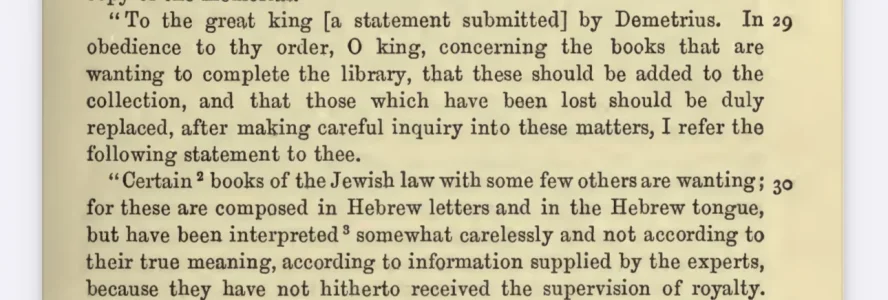
correct and that's on purpose. By God's enemy, Egypt. The king referred to here in the letter is Ptolemy II, a pagan who commissioned and oversaw the Septuagint corrupt text, and later King James, with His sorcerer friend John Dee, loved by Nasa today as a saint, produced the KJV.
 

Attachments

  • IMG_1611.webp
    IMG_1611.webp
    75.2 KB · Views: 1
correct and that's on purpose. By God's enemy, Egypt. The king referred to here in the letter is Ptolemy II, a pagan who commissioned and oversaw the Septuagint corrupt text, and later King James, with His sorcerer friend John Dee, loved by Nasa today as a saint, produced the KJV.

Abraham lived in Egypt. Right? God preserved Abraham and his children in Egypt and brought them out with His mighty hand......

This guilty by associate argument you're presenting doesn't equal much to me.

The LXX was translated by Jews from a different stream of texts than what has survived for Jerome to bring his hybrid work to you today. Jerome mixed the LXX sources into the Vulgate. He didn't have the Hebrew manuscripts to reproduce the Psalms or much of Proverbs and several other books he never completed. Which ultimately made their way into surviving English derivatives.

I don't care what some king said about anything. Whether it is King James or someone else. I have access to the evidence itself. I can discern what is fact and what isn't fact.

Which is why I asked about details of your issue. I appreciate you sharing but I still don't see anything that gives you any reason to reject anything from the Greek OT. The Scriptures were much better "served" through the Greek language than what has partially survived in the reconstructed language of the 9th century MT.

Any particular reference in the LXX tradition you don't prefer?
 
Abraham lived in Egypt. Right? God preserved Abraham and his children in Egypt and brought them out with His mighty hand......

This guilty by associate argument you're presenting doesn't equal much to me.

The LXX was translated by Jews from a different stream of texts than what has survived for Jerome to bring his hybrid work to you today. Jerome mixed the LXX sources into the Vulgate. He didn't have the Hebrew manuscripts to reproduce the Psalms or much of Proverbs and several other books he never completed. Which ultimately made their way into surviving English derivatives.

I don't care what some king said about anything. Whether it is King James or someone else. I have access to the evidence itself. I can discern what is fact and what isn't fact.

Which is why I asked about details of your issue. I appreciate you sharing but I still don't see anything that gives you any reason to reject anything from the Greek OT. The Scriptures were much better "served" through the Greek language than what has partially survived in the reconstructed language of the 9th century MT.

Any particular reference in the LXX tradition you don't prefer?
the quote from aristeas, was just to show Egypt's intent to corrupt, and that they did not mean well in producing the septuagint, given that they viewed their own 'version' superior to God's and planned to change the words to suit their own higher (in their opinion) language. The texts are indeed corrupted and this letter showed that it was intended to do. Bibles were affected by septuagint given that for a long time it was the only reference. and traditions took over from there. I never said God's words were not His words. Only that as men passed these down, there was corruption in those passed down interpretations, which was evident in what you said, quote, "There is no doubt that Hebrew of Moses isn't found "as is" in any single surviving manuscript today. Not one."
 
the quote from aristeas, was just to show Egypt's intent to corrupt, and that they did not mean well in producing the septuagint, given that they viewed their own 'version' superior to God's and planned to change the words to suit their own higher (in their opinion) language. The texts are indeed corrupted and this letter showed that it was intended to do. Bibles were affected by septuagint given that for a long time it was the only reference. and traditions took over from there. I never said God's words were not His words. Only that as men passed these down, there was corruption in those passed down interpretations, which was evident in what you said, quote, "There is no doubt that Hebrew of Moses isn't found "as is" in any single surviving manuscript today. Not one."
So give me an example of the corruption found in the LXX. The intent of the Jews who produced the MT was to diminish the necessity of offering of Jesus Christ.... once for all.
 
Back
Top Bottom