"Works Salvation"

@Studyman
So, if the law was added, till the true lamb of God came, did it truly have power to put away sins? Please consider and answer if you can:

The law and its sacrifices "were" types, shadows, and symbols of the future sacrifice of Christ. While they were means of expiation by which the patriarchs testified faith, only the blood of Christ had the actual efficacy to wash away sin.
  • Weakness of the Jews' temporary religion: It is so clear that animal blood cannot cleanse consciences or remove the guilt of sin. If they could, they would have ceased to be offered.
  • Symbolic Value: The sacrifices under the law were not worthless; they were valid "symbols" or "types" through which believers could "truly" (sacramentally) receive pardon.
  • Retrospective Merit: The power of Christ's one sacrifice on the cross extends backward to the beginning of the world and forward to the end, making it the only true sacrifice. The Old Testament believers were by Christ faith and obedience justified as we are, not by the efficacy of animal blood itself.
Men of God from 1450-1800 (through the blessing of the printing press invention) all taught:
  • Temporary and Typical: They explains that sacrifices under the law only took away sin typically (representing something else), not really (or literally). They served as a "figure" or "shadow" for the time being, pointing forward to the true, ultimate sacrifice of Christ.
  • A "Remembrance" of Sin: Rather than removing sin, They all preached that the yearly repetition of these sacrifices actually served as a "remembrance of sins" afresh.
  • The Inefficacy of Law: They all with one voice maintains that the legal sacrifices could not perfect the worshippers, nor could they cleanse or purge the conscience from the guilt of sin.
  • Contrast with Christ's Sacrifice: In contrast, they all argues that by his one offering, Christ has actually put away sin, removed our sins from the sight of God, and secured a complete atonement that gives to of God's elect total peace in their conscience that their sin are removed from them as far as the east is from the west, never to be remember again, never.
 
Last edited:
And once again we see the false doctrine of Total Depravity not the true doctrine of the Holy Scriptures as the basis for that analysis.

The idea that Jesus would make being born of the flesh a condition for being born again is ludicrous, if not side-splittingly stupid. Who would be precluded by such a requirement? Answer absolutely none.

Wrong. Jesus was contrasting two different kinds of birth, not giving two saving conditions.

“That which is born of the flesh is flesh, and that which is born of the Spirit is spirit.” Gospel of John Jesus Himself explains the meaning in the very next verse. Natural birth produces natural life. Spiritual birth produces spiritual life.

His point was that being physically born into Israel, having Abraham as ancestor, or possessing natural life is not enough. A person must also be born from above by the Spirit.

So the reference to water is not “inert” at all. It distinguishes physical birth from spiritual rebirth. Jesus was correcting Nicodemus’ earthly thinking with a heavenly truth.

The irrational view is not Christ’s words, but assuming every mention of water must mean baptism.
So why would Christ establish such an inert requirement? Answer, He wouldn't. The very idea makes Jesus out to be more than a little short on rational thinking.
 
@Jim

Jim, the Lord Jesus never made flesh "a condition for" being born again, never! But, those born of the flesh, (through natural means of Adam's generation, from one person to the next, one generation to the next, etc., must be born of the Spirit, if ever conceived through the first Adam's posterity ~ "before" they can ever see, and do spiritual acts pleasing to God ~ spiritual acts, meaning, the fruits of the Spirit as mentioned in Galatians 5: 22,23...including, but, not limited to them thereunto mentioned.
Verse 5 of John 3 explains verse 3. That is to be born again is to be born of water and Spirit. If born of water is to be born of flesh, then Jesus is definitely saying that being born of the flesh is a condition for being born again. But of course, that makes no sense at all. Thus born of flesh has nothing to do with it and Jesus would never have explained "born again" as born of flesh. So clearly born of water must mean something else.
 
Wrong. Jesus was contrasting two different kinds of birth, not giving two saving conditions.
No, Jesus wasn't speaking about physical birth at all. He was explaining what He meant by being "born again".
“That which is born of the flesh is flesh, and that which is born of the Spirit is spirit.” Gospel of John Jesus Himself explains the meaning in the very next verse. Natural birth produces natural life. Spiritual birth produces spiritual life.

His point was that being physically born into Israel, having Abraham as ancestor, or possessing natural life is not enough. A person must also be born from above by the Spirit.

So the reference to water is not “inert” at all. It distinguishes physical birth from spiritual rebirth. Jesus was correcting Nicodemus’ earthly thinking with a heavenly truth.

The irrational view is not Christ’s words, but assuming every mention of water must mean baptism.
Clearly Jesus is describing to Nicodemus what he meant by being born again. He said that being born again (v.3) is being born of water and Spirit (v.5). The phrase born of water and Spirit describes the phrase born again. So, whatever Jesus meant by water cannot have anything to do with flesh - period. So if you don't like water being the water of baptism, you need fo come up with something else because obviously Jesus is not saying that born again has anything to do with physical birth.
 
@Doug Brents

Wishful thinking on your part Doug. Prove where I have failed ~ you saying that has zero value, you must prove it.
No, @Red Baker, You said,
@brightfame52 @Doug Brents @Seabass @Jim @Studyman

The whole of the word of God proves that salvation from sin and condemnation is without water baptism.
You made a statement. That statement is not found anywhere in the word of God. That is your statement; is it not found in the word of God. Therefore, it is up to you to prove that it is true. You must prove it. And of course, you can't.
 
Both the thief and Cornelius prove salvation is without water baptism Even the Ethiopian eunech professed Faith in the Son of God b4 he was baptized Acts 8:35-38

35 Then Philip opened his mouth, and began at the same scripture, and preached unto him Jesus.

36 And as they went on their way, they came unto a certain water: and the eunuch said, See, here is water; what doth hinder me to be baptized?

37 And Philip said, If thou believest with all thine heart, thou mayest. And he answered and said, I believe that Jesus Christ is the Son of God.

38 And he commanded the chariot to stand still: and they went down both into the water, both Philip and the eunuch; and he baptized him.

Now according to Apostolic Testimony, when one confesses and believes in the Son of God, they have been born of God 1 Jn 5:1,5

Whosoever believeth that Jesus is the Christ is born of God: and every one that loveth him that begat loveth him also that is begotten of him.

5 Who is he that overcometh the world, but he that believeth that Jesus is the Son of God?

The Eunech was an overcome and born of God b4 a drop of water on him !

You have been deceived friend
 
No, Jesus wasn't speaking about physical birth at all. He was explaining what He meant by being "born again".

Clearly Jesus is describing to Nicodemus what he meant by being born again. He said that being born again (v.3) is being born of water and Spirit (v.5). The phrase born of water and Spirit describes the phrase born again. So, whatever Jesus meant by water cannot have anything to do with flesh - period. So if you don't like water being the water of baptism, you need fo come up with something else because obviously Jesus is not saying that born again has anything to do with physical birth.
He said verse 6 FLESH and that refers to physical birth.

Vs 5 unless one is born of water and the Spirit .

Vs. 6 born of the flesh is flesh, and that which is born of the Spirit is spirit.

The water here is not baptism.
 
So @FreeInChrist. do you think you understand?

John 3:3​

“Jesus answered and said unto him, Verily, verily, I say unto thee, Except a man be born again, he cannot see the kingdom of God.”
I have been teaching the Nick thing for a very long time.... Starting with way back in GC....

I had posted this....on GC way back

I have been cleaning out some old book marks when I came across one that should have a conversation regarding which IS right and why.

To me, original statements should be observed , as in this case accepting either/or give 2 entirely different meanings.

This is a copy from my online Greek interlinear that is my rapid go to as needed.

https://biblehub.com/interlinear/john/3.htm

QuoteJohn 3:3 Answered Jesus and said to him Truly truly I say to you if not anyone be born from above not he is able to see the kingdom - of God

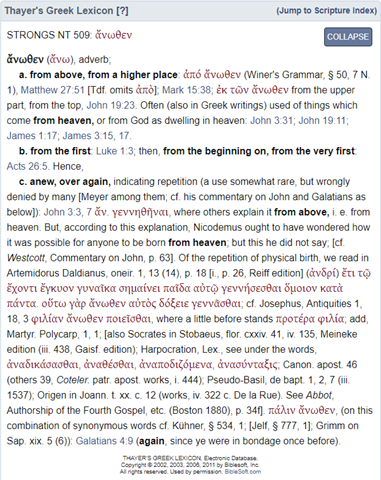
From above is ἄνωθεν

If I might interject my own side question at this point before going on....

Nicodemus had come to Jesus and said to him

vs 2. He came to Him by night and said to Him Rabbi we know that from God you have come a teacher no one for is able these - signs to do that You do if not should be - God with Him

It was immediately after this that Jesus did not confirm or deny what Nick was saying but went in an entirely different direction
in vs3 by telling him about being born from above.

Why? Was this because Jesus knew what Nick was seeking and just jumped into it?

The verses in this entire exchange... while being perfectly clear do not answer any of Nicodemus' questions directly.

To the reason for this particular thread.

A question from another forum I had saved was

From https://hermeneutics.stackexchange....sv-translates-be-born-from-above-to-is-born-a

Quote

Why is it that in John 3:3 the ESV translates "be born from above" to "is born again"?

I was told that ESV uses the oldest Greek manuscripts to translate the scripture literally from Greek into English.

So why is it that in John 3:3 the ESV translates "be born from above" to "is born again" in John 3:3?

Is it "born again" in the oldest manuscripts?

If we check the interlinear bible { John 3:3 interlinear } and the Greek we never find Jesus using the words "born again".

John 3:3 interlinear

Which transcript is the interliner bible using?

ANSWER NUMBER 1 of 2)

QuoteThe matter in dispute here is NOT the Greek text but the translation of a single word, ἄνωθεν (anōthen). This is a simple preposition for which BDAG provides four basic uses:

1. in extension from a source that is above, from above, eg, Mark 15:38, Matt 27:51, John 19:23, 3:31, 1:17, 19:11,
James 3:15, 17.
2. from a point in time marking the beginning of something, from the beginning, eg, Luke 1:3, Acts 26:5.
3. for a relatively long period in the past, for a long time, eg, Acts 26:5
4. At a subsequent point in time involving repetition, again, eg, Gal 4:9, John 3:3.

In the above extract from BDAG I have only included the Bible references and have not included BDAG's numerous extra Biblical sources and examples.

The problem in John 3:3 is should ἄνωθεν (anōthen) be translated "from above", or "again"? In this case, both are theologically correct (see also John 3:31). My personal view is that, probably, both are intended: converts need to be born again (= anew) but NOT as Nicodemus suggested from earthly origins, but "from above". Indeed, as the foot notes in the ESV explicitly point out,


QuoteOr, from above, the Greek is purposely ambiguous and can mean both again and from above, also verse 7.
Ellicott notes (in part):


Quote Except a man be born again, he cannot see the kingdom of God.--Our translators have followed the ancient expositors in
giving the alternative renderings "born again" and "born from above" (margin). Chrysostom notes the two currents of
interpretation in his day; and in our own day the opinions of scholars, whether we count them or weigh them, may be
equally claimed for either view. There can be no doubt that the Greek word (ἄνωθεν) is found with both meanings. It is
equally certain that St. John elsewhere uses it in the local sense "from above" only (John 3:31; John 19:11; John 19:23);
but these instances are not sufficient to establish an usus loquendi, and the sense here, and in John 3:7, must be taken in
connection with the meaning of the verb. (Comp. the same word in Luke 1:3, "from the very first," and Galatians 4:9,
"again.") What has not, perhaps, been sufficiently noted is, that the Greek word is not the true key to the difficulty, and
that its double sense has led men to seek the meaning in a wrong direction.
The Pulpit commentary makes extensive remarks about this as well - too many to be repeated here.

[/size]

ANSWER #2

Quote2
As the notes in the ESV state, the Greek is ambiguous: (I have got to ask.... who determines anything to be ambiguous.
Someone who cannot compute why a word would mean something
said in a certain way?)

Jesus answered him, "Truly, truly, I say to you, unless one is born again he cannot see the kingdom of God." (John 3:3) [ESV]

John 3:3 Or from above; the Greek is purposely ambiguous and can mean both again and from above; also verse 7

ἄνωθεν can mean from above, from the first, or anew, over again:

9Vc9s border=0

The ESV chose "again" because that is the meaning which best fits the immediate context: (WHO? Who says it does. )


Quote Nicodemus said to him, "How can a man be born when he is old? Can he enter a second time into his
mother's womb and be born?" (John 3:4)
Nicodemus took what Jesus said as "again." If the translator chose "born from above," Nicodemus' reaction makes little sense. The Interlinear translation chooses "above" because as the discussion progresses it becomes clear that is the meaning which best fits everything Jesus says (John 3:7-9). However, that choice only "works" if the one verse is viewed in isolation.

In actuality the ambiguity of the Greek is accurate as the only way a person may be born again is as a work of God. So if one is born again, it was an act of God (from above):

QuoteBut to all who did receive him, who believed in his name, he gave the right to become children of God, who were born, not of blood nor of the will of the flesh nor of the will of man, but of God. (John 1:12-13)
[/size]

Like you seem to be pointing out in your last sentence, there is a way around the Nicodemus dilemma. This is, that to be "born from above" could be regarded as a second birth and be called "to be born again", if "to be born from below" was the label applied to the first birth. – Constantthin Jul 27, 2019 at 7:28

And guess what I have found you saying in my historic searches.......

Quote from: grams on Thu Oct 19, 2017 - 16:01:239 Not of works, lest any man should boast.
Dear Grams, that verse does not cancel out water baptism as a channel of a salvation that believers enjoy in being baptized into the religion of Jesus Christ, per Jesus' own teaching from Mark 16:16. If you believe that water baptism is not necessary, or something that one can take OR leave, then you by your own confession show lack of faith, and without question, lack of biblical knowledge. There IS a sense that water baptism DOES indeed bring "a salvation" to an understanding heart, that those who have never been baptized CANNOT enjoy, IMPOSSIBLE~or Mark 16:16 spoken of by Jesus Christ should be penknife from the holy scriptures. Peter DID NOT suggest that Cornelius and his household should consider baptism, BUT he COMMANDED them to be so! Every believer post Calvary, who are baptized in the name of Jesus Christ enjoy a glorious salvation that even Abraham DID NOT enjoy, impossible dear soul.
No, Jesus wasn't speaking about physical birth at all. He was explaining what He meant by being "born again".

Clearly Jesus is describing to Nicodemus what he meant by being born again. He said that being born again (v.3) is being born of water and Spirit (v.5). The phrase born of water and Spirit describes the phrase born again. So, whatever Jesus meant by water cannot have anything to do with flesh - period. So if you don't like water being the water of baptism, you need fo come up with something else because obviously Jesus is not saying that born again has anything to do with physical birth.
He said verse 6 FLESH and that refers to physical birth.

Vs 5 unless one is born of water and the Spirit .

Vs. 6 born of the flesh is flesh, and that which is born of the Spirit is spirit.
 
Back
Top Bottom