Is the Background of God's Word Greek or Jewish?

No is not a Baptist thing. The Baptist IS a denomination with different flavors like Baskin Robbins.
ex. American Baptist, Southern Baptist, Independent Baptist, Regular Baptist and etc. I like to think
of the Baptist's has a corrupt anti-semitic denomination with it's varying vices. I wonder how many
missionaries they send to Israel? I already know the answer to that. They are more concerned with
racial justice in the black community then the anti-semitism in the Jewish community,
Below is a statement from the Cooperative Baptist Fellowship that Southern Baptists support
from their website. CBF are pro homosexual an abomination against God.

Cultivating Belonging in LGBTQ+ Affirming Churches of CBF
Join pastors of affirming CBF congregations as they share stories of their journeys of inclusion and witness how a wider welcome for LGBTQ+ folks leads to broader belonging for all. Participants will hear about tangible steps to extend distinct hospitality to members of the LGBTQ+ community and encouragement for the road ahead.

Preston Clegg is pastor of Second Baptist Church, Downtown Little Rock, Ark.
Jason Edwards is senior pastor of Second Baptist Church, Liberty, Mo.
Emily Hull McGee has served as pastor of First Baptist Church on Fifth in Winston-Salem, N.C., since 2015.
Carol McEntyre is senior minister of First Baptist Greenville, S.C., and a former moderator of CBF.
Garrett Vickrey is senior pastor of Woodland Church in San Antonio, Texas.


Shabbat Shalom
 
Sorry to crap all over your Messianic Judaism thread, but you really need a quick lesson on what it means to be a BAPTIST:

Baptist distinctives are core beliefs setting Baptists apart, emphasizing Biblical Authority, the Autonomy of the Local Church, the Priesthood of Believers (direct access to God), Regenerate/Believer's Baptism (immersion after conversion), and Soul Liberty (individual freedom in faith), along with two ordinances (Baptism, Lord's Supper) and the importance of separating church and state, all centered on a personal faith in Jesus Christ.

Here are the key Baptist distinctives:
  1. Biblical Authority: The Bible (Scripture) is the inspired, infallible, and final rule for all Christian faith and practice, not creeds or human traditions.
  2. Autonomy of the Local Church: Each local church is self-governing, independent, and accountable only to Christ, not to a hierarchical denominational body.
  3. Priesthood of the Believer: Every believer has direct access to God through Jesus Christ, without needing a human mediator like a priest.
  4. Regenerate Church Membership: Church membership is for those who have personally experienced salvation (been "born again") and can give a credible testimony of faith in Christ.
  5. Believers' Baptism by Immersion: Baptism is an ordinance (symbolic act) performed only for believers after conversion, by fully immersing them in water to symbolize their identification with Christ's death, burial, and resurrection.
  6. Soul Liberty (or Freedom of Conscience): Every individual has the right and responsibility to choose their own religious beliefs, free from coercion by government or other people.
  7. Two Ordinances: Baptists observe two main church ordinances commanded by Christ: Baptism and the Lord's Supper (Communion).
  8. Separation of Church and State: A historical commitment to the principle that religious institutions and government should remain separate, ensuring religious freedom for all.
 
I must have hit a raw nerve. I know everything I need to know about the Baptist religion and their free get out of Hell card. Lol
I and others have experienced antisemitism in the Baptist Church. I worship on Shabbat with down streaming from a Messianic service.
I make a cameo appearance at the Baptist church about once a month to connect with friends I have helped. I never stay for morning service. Maimonides would turn over in his Rabbinical grave if I did that! Lol
The Baptist church like other protestant denominations are basically social clubs masquerading as a so called Christian Church.
Shabbat Shalom
 
My response came from reliable sources not from hear say or somebody's lopsided opinion. You want to go down the road with Martin Luther and see what he was all about with the Jewish people? I didn't think so.
If you admire these early Church Fathers then that speaks volumes about you. God help us.
Shabbat Shalom
So now the Council of Jerusalem (Acts 15:1-29) is "somebody's lopsided opinion". Stop running away from the truths of the Greek NT Bible.
 
Your the one that has your running shoes on!
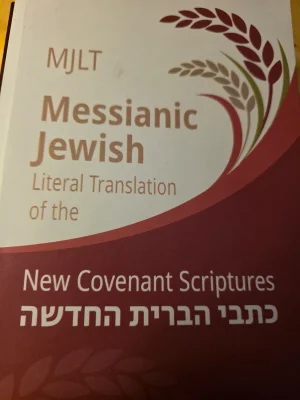
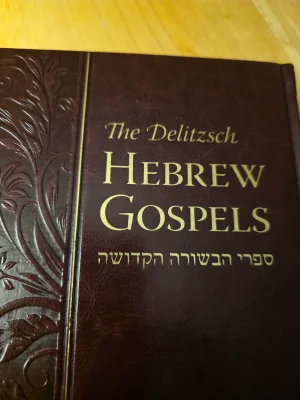
I prefer the Hebrew New Covenant Scriptures.
 

Attachments

  • 20260117_191806.webp
    20260117_191806.webp
    252.1 KB · Views: 1
  • 20260117_191754.webp
    20260117_191754.webp
    468.1 KB · Views: 1
So now the Council of Jerusalem (Acts 15:1-29) is "somebody's lopsided opinion". Stop running away from the truths of the Greek NT Bible.

The Hebrew v. Greek World View

Pilate: "So you are a king?"
Yeshua: "Yes. For this purpose I was born and for this purpose I have come into the world -- to bear witness to the truth. Everyone who is of the truth listens to my voice."
Pilate: "What is truth?"
Yeshua: (silence)
When Pilate asked the question, Yeshua answers his question from the Hebrew mindset. Pilate then asks a question from his Greek mindset. The two do not mix, and Yeshua answers with silence.
The two-fold problem trying to understand the “Greek Mindset”

  1. It is so all-pervasive that it lies below the threshold of our daily assumptions.
  2. The very attempt to define it is a function of the Greek mindset itself.
There is a very basic foundation that must be laid to understand Spiritual Authority. It is the Hebrew – Greek Mindset. We live in a Greek Culture and it is this culture that must be understood. It helps create the disrespect to authority for the Believer
Let’s make some comparisons:
Hebrew thinking and Greek thinking are not the same, yet it is the Greek thinking that influences today’s society and impacts many of our English translations of the Bible.
The Greek concept of truth can be divided into 2 parts:

  • In the Hebrew world, reality is the Word.
  • For the Greek reality is the Thing.
Allow me to explain this with the Hebrew word “Sh’ma.” The Hebrew word sh’ma, which is interpreted in the Greek as “listen”, “hear”, and/or “obey,” actually means both and much more.
Hebrew thought and language sees things differently than English or Greek thought and language. Hebrew sees a thing not just as it appears in the moment you are looking at it, but from its tiniest seed form all the way through to when it reaches full maturity. This is a critical distinction. You are looking and seeing things from God’s eternal perspective vs. man’s temporal perspective.
Hebraic thought is different from Western thought as a snapshot of you is different from a full-length movie of your life – even from the moment of your conception to your death.
The Western viewpoint has a snapshot mentality; He looks at the moment, and whatever appears before his eyes or catches the attention of his ears at that specific moment, it takes a “snapshot” and considers it to be reality.
This Greek “snapshot” is why:

  • The English word “listen” means only “pay attention."
  • The English word ‘hear’ means only to recognize words.
  • The English word ‘’ means only do what you are told.
However, the Hebrew word sh’ma does not just mean ‘listen’, ‘hear’, or ‘obey’. The Hebrew sh’ma lifestyle involves having an “ear to hear”

  • It means to “listen, and pay full attention, as if your life depended on it, and, once you paid attention, and heard what is said,begin immediately to incorporate what has been said into your life, and adapt every aspect of your thought life, speech, and conduct to what you have heard, and begin to memorize and teach it to your children and demonstrate it to the world, until you, and the world around you, is transformed into the image of the words you hear.” It means doing whatever He says, and not doing whatever He instructs against,and doing this not to “win His favor” but out of a mixture of awe and passionate love of Him and in full faith and trust that what He says is good.
Use of Senses
The most important senses in Hebrew is hearing and feeling creating a dynamic, intensity and a mood or feeling. This is what we expect when we read the Hebrew Scriptures. For the Greek it is sight. This creates visible things, static, or images. These images have form and objectivity
How it relates to God
In the Hebrew Culture, there is only one God, one source, one measuring stick, creating a foundation for moral behavior – producing a clear right or wrong. In the Greek culture, they have many gods. This makes right and wrong unclear. It is called “relativism” today. In the Hebrew thinking God does not change and works in cycles.
How it relates to the Nature of Man
To the Hebrew, man has three parts – it is a unity of spirit, soul, and body. He tries to be righteous, redeemed, and sanctified. The Hebrew will search God’s word to find out how to live the righteous life. What a man trusts and follows determines what he does. He searches for instructions for the heart, guidance for his soul, and directions for his body.
His #1 question is “HOW DO I…?”
In Greek thinking the gods are always changing. Because of this, life in their view is seen as linear. To the Greek, man has two parts, the flesh and the soul. The soul is considered eternal.
It is knowledge and what the Greek believes that is the most important reflection of how he is.

  • Knowledge and right thinkingor doctrine feeds the soul.
  • Morals and ethics are concepts that are for the soul.
This is why the commandments and laws from scripture, which deal with the physical man, are irrelevant to the spiritual man.
His # 1 question is “WHAT DO I…?
Concrete Thought:

Concrete thought expresses concepts and ideas in ways that can be seen, touched, smelled, tasted, or heard. All five of these senses are used when speaking, hearing, writing, and reading the Hebrew language. In Psalm 1:3, it reads: “He is like a tree planted by streams of water, which yields its fruit in season, and whose leaf does not wither.” The writer is expressing his thoughts in concrete terms such as: tree, streams of water, fruit, and leaf
Abstract Thought:
Abstract thought expresses concepts and ideas that cannot be seen, touched, smelled, tasted, of heard. In Psalm 103:8, it reads: “The LORD is compassionate, and gracious, slow to anger, abounding in love.” The words compassion, grace, anger, and love are abstract words that cannot be experienced by the senses. This forces a question: Why are there abstract words in a passage of concrete thinking Hebrews?
These are English words used to translate original Hebrew concrete words. If the translators used the original Hebrew words, it would make no sense when translated into English. Example: Anger(alp): literally means “nose”, a concrete word. When a person is very angry, he begins to breathe hard and the nostrils begin to flare. A Hebrew sees anger as “the flaring of the nos (nostrils).” If a translator literally translated the above passage, it would read “slow to nose”. The English reader would not understand this
Function verses Appearance:
Hebrew thought describes objects in the relation to its functions, using verbs and nouns (Dynamic). Greek thought describes objects in the relation to its appearance, using adjectives (Static). Remember the Hebrew word “Sh’ma” explained earlier?
Another example would be a pencil. Hebrew thought would say “I write words with it.” Greek thought would say “it is yellow and about 8 inches long”
Congregating a Verb:
Greek(English)
I Am …. You Are … He is ….
Hebrew
He is … You are …. I Am ….
The "Greek" mindset imagines a tattoo or something similar on the thigh of Y'shua (Jesus) when he returns as "King of Kings, and Lord of Lords" (Revelation 19:11-13,16). They do not connect this with Leviticus 19:28 which reads “Ye shall not make any cuttings in your flesh for the dead, nor print any marks upon you: I am the LORD”
The Hebrew mindset sees something more realistic: The tzit-tzits (braid/knots/tassels) of Yeshua's tallit (prayer shawl) falling across his thighs when He returns to earth atop a white horse! Each letter of the Hebrew alphabet has a numerical value. The knots of the tassels on the four corners of a tallit spell out words.

  • The Sephardics tie the knots in windings of 10, 5, 6, 5 which spells out the numeric values of "YHWH"
  • The Ashkenazics use windings of 7, 8, 11, 13 which, adds up to 39, which is the numerical equivalent of Deuteronomy 6:4 which cites the Shema
Calculating Time:
Greek –

  • Day - “Midnight to Midnight”
  • Week – named after Pagan Gods
Hebrew–

  • Day– “Sunset to Sunset” (Genesis 1:5)
  • Week– “first day”. “second day”, “third day”, “fourth day”, “fifth day”, “sixth day”. “The Sabbath”.
This Chart gives a good explanation between the Greek and Hebrew structures:
Greek (Western) Approach Hebrew Approach

Life analyzed in precise categories.Everything blurs into everything else.
A split between natural & supernaturalSupernatural affects everything.
Linear logicContextual or "block" logic
"Rugged Individualism"Importance of being part of group
Equality of personsValue comes from place in hierarchies
Freedom orientationSecurity orientation
Competition is goodCompetition is evil (cooperation better)
Man-centered universeGod/tribe/family-centered universe
Worth of person based on money/material possessions/powerWorth derived from family relationships
Biological life sacredSocial life supremely important
Chance + cause & effect limit what can happenGod causes everything in his universe
Man rules nature through understanding and applying laws of scienceGod rules everything, so relationship with God determines how things turn out
Power over others achieved through business, politics and human organizationsPower over others is structured by social patterns ordained by God.
All that exists is the materialThe universe is filled with powerful spirit beings
Linear time divided into neat segments. Each event is newCyclical or spiraling time. Similar events constantly reoccur.
Oriented to the near futureOriented to lessons of history
History is recording facts objectively and chronologically.History is an attempt to preserve significant truths in meaningful or memorable ways whether or not details are objective facts.
Change is good = progressChange is bad = destruction of traditions
Universe evolved by chanceUniverse created by God
Universe dominated and controlled by science and technologyGod gave man stewardship over his earthly creation. Accountability to God.
Material goods = measure of personal achievementMaterial goods = measure of God’s blessing
Blind faithKnowledge-based faith
Time as points on straight line ("at this point in time…"Time determined by content ("In the day that the Lord did…")
What Do I …“How Do I…
Summary:
The distinction comes from the difference between doing and knowing.

  • The Hebrew is concerned with practice, the Greek with knowledge.
  • Right conduct is the ultimate concern of the Hebrew, Right thinking that of theGreek.
  • Duty and strictness of conscience are the paramount things in life for the Hebrew;
For the Greek, the spontaneous and luminous play of the intelligence.

  • The Hebrew extols the moral virtues as the substance and meaning of life; TheGreek subordinates them to the intellectual virtues
The contrast is between practice and theory, between the moral man and the theoretical or intellectual man.
History of Greek Influence:
Plato (428-348): His University became the model of the modern University
- To the Greek world, “Truth” is understood as “justified true belief.”
- The everyday world of particulars is always in a state of flux.
- Inferences regarding its objects are really opinions based on sensations.
- If there's truth about the physical world, that world exists, then it is truth about the ideal world, which also exists. This led to a dualism in both nature and in man -- there is the real and the ideal; the "is" and the "ought,"
Aristotle (384-322 BC): He ‘redirected” the thinking of Plato teaching the forms and ideas are not found in some abstract realm, but in the particulars things themselves.
- By “abstracting” from the particulars (ideas) you form a general understanding of the thing’s nature
- The mind understood things in terms of their (static) generalized essences.
- This increased the use of Logic
Aristotle created systems of logical argument. He taught that truth was discovered by systematic arguments based on "premise to conclusion" concepts. You first begin with a premise and then sets down a system of steps to come to an ultimate conclusion.

  • Problem #1 - It still relied on human reasoning which was limited by human experience
  • Problem #2 - The block logic of Hebrew was considerably different than this type of thinking, and it was Hebrew logic that the Scriptures were written in, not Greek(this includes the Brit Hadashah(New Testament)
He was the teacher to Alexander the Great, who spread this thinking over the then known world. Alexander’s strategy was for Greece to dominate the world by conforming the world to Greek thinking. This could only be accomplished by language.
He knew that if you change a people's language, you change their whole view of life.

  • Language shapes, molds, and defines a culture.
  • Hate can turn into loyalty if you can change the meaning and purpose of words and traditions.
  • Fate was responsible for everything that happened, denying “Free Will.”
What did Alexander do?

  • He educated his future leaders in Greek letters and weaponry.
  • He established schools throughout his conquered regions.
  • He organized traditional Greek festivals to honor the gods in the most lavish fashion.
  • He trained his successors in the Greek language.
  • He taught that the deities made their wishes known through natural phenomena, through omens and oracles, which were interpreted through great speakers in the theaters and arenas. This is why Paul and Barnabas were called Jupiter (Zeus) and Mercury (Hermes). These were the Roman names for the Greek gods.
Although Rome conquered Greece, they took upon the same system of philosophy, only the names were changed.
Consider this: Most of western thought -- including ideas about language and logic,natural science, mathematics, mathematics, ethics, jurisprudence, politics,aesthetics, and theology,draws from this tradition. Much has been subconsciously adopted into the educational technologies of the west for thousands of years.
POINT: Since the early Roman church was led by orators and others schooled in classical Greek thought (i.e., Hellenism), many of the basic assumptions of the Greeks were implicitly integrated into the earliest forms of Christian theology.
Two of the greatest theologians of the Christian world - Augustine and Thomas Aquinas - attempting to synthesizeGreek philosophy with the Scriptures

  • Augustine followed Plato.
  • Aquinas followed Aristotle.
The Hebrew Mindset:
It is not concerned with these abstract ideas of the ancient Greeks. WHY? Because of the direct revelation of YHVH, reality was regarded in terms of divine encounter, dialog, antinomy, paradox, and mystery. Hebrew thinking is more dynamic, more poetic, more dramatic, more based on appearances, and more impassioned than that of the ancient Greeks.
They do not ask "What is time?" To the Hebrew mind, time is rooted in historical experiences such as the Exodus from Egypt and other "appointed events" (moedim). Time is linked not so much to chronology as it is to spiritual significance.
Time in Greek and Hebrew:

  • Greek - a substance or medium or "dimension,“
  • Hebrew– The events are the focus, not the supposed bedrock for these events.
Since the Hebrews dealt with the Divine revelation that was eventually committed to writing (i.e., the Torah), hermeneutics and interpretation became important in their overall perspective. The study of narrative, the layered sense of meanings, the focus on action (rather than static), the application Divine law to particular cases, etc., were the result of interpreting the divine within everyday life.
Jewish Theology has been conditioned by debate, discussion, and dialog -- all within a shared sense of communal tradition. To the Hebrew mind, reality is the handiwork of a single all-knowing, all-powerful, and Supreme Creator who has personally revealed Himself to key individuals in human history. Reality is intensely, overwhelmingly, and personal. Truth therefore is a matter of trust -- not abstract knowledge.
“Knowledge" is primarily about practical ethics, moral obligation, and cult practices (i.e., Temple worship). Truth is more connected to moral fidelity than it is to a propositional correspondence; It is a matter of the heart than of the head.
From its earliest days in Rome, the Greek mindset has been hugely influential in shaping the vision of the "church" -- its structure, mission, "theology," and its ways of doing business. The roles of the earliest "Church fathers" and apologists is a study of Greek oratory and dialectic, not Hebrew structure
Though the "Reformation" of the church in the 16th century tried to restore a primitive Christian expression, it failed because it went back to ancient Greek humanism rather than to the Hebrew Jewish roots of the Christian faith. The Sabbath still remained on Sunday (Council of Trent – 1545 – 1563). The ideal of Zion as a real, physical future continued to be allegorized, just as the Church continued to mistakenly regard itself as "Israel." The greatest exegetical fallacy was the respect of absolutist forms of theology -- a Greek legacy that comes more from the Academy of Plato than it does from Moses.
This is the hub of "Greek philosophical theology" and explains why the various disagreements among Christian "denominations" still persist to this day. Hellenization affected the Jews as much as other people groups. Example: Hellenistic Judaism, sought to syncretize Hebraic-Jewish religious tradition with the culture and language of the Greeks.
The major literary product of the contact of Judaism and Hellenistic culture was the Septuagint (LXX).

  • The Jewish theologian Philo of Alexandria() attempted to synthesize Plato with Moses.
  • Maimonides (1135-1204) later attempted to synthesize Aristotle with traditional Jewish dogma.
When Pilate asked "What is truth?" Yeshua replied with silence. Yeshua did not come to speculate like Socrates and to dialog about abstractions... He came to reveal the Face of God. But, when Yeshua spoke to His disciples - just before his impending death as the Passover Lamb of God - he said, "I am the way, the truth, the life..."
He did not mean this in the Greek sense, since that would have been absurd, but he presupposed a Jewish mindset regarding His identity and the salvation purposes of God (i.e., Zion). The way to God is the way of faith... Since truth is based on faithfulness, trusting in Yeshua's sacrificial death is the only way to God -- He (alone) is our intercessor, High Priest, Mediator and Savior. Yeshua is derech ha-chaim- the way of life.The truth of God is revealed in the Person and sacrifice of Yeshua. The sacrifice of the Messiah is the truth of God --- it perfectly reveals both God's love and justice, His faithfulness and holiness.
The execution stake demonstrates the truth of our depravity and our need for salvation. The words "Sanctify them in the truth; your word is truth" = the Word of the LORD which is truth incarnate. The truth he embodied was God's passionate love for us.
Yeshua is the life. He is both the one who sustains all things and mediates all things through His infinite glory. For those who trust in him, he offers abundant life, eternal life, inexpressible joy, unsurpassed peace, love that passes understanding, and a glorious future in the world to come.
The Close:
“Has not God made foolish the wisdom of the world? For Jews demand signs and Greeks seek wisdom, but we preach the Messiah crucified, a stumbling block to Jews and folly to Gentiles, but to those who are called, both Jews and Greeks, the Messiah the power of God and the wisdom of God.’
Shalom

 
I must have hit a raw nerve.
Not so much a “raw nerve” as I just find your ignorance of the Baptist Distinctives (as you pontificate falsely on Baptist Churches) to be offensive enough that I am compelled to correct your ignorance less some reader mistakenly think that the drivel you spout about the “Southern Baptist Denomination” might be true.

I suspect that it may not be “antisemitism”, but they just don’t like YOU personally. ;)
 
Why should I be concerned with man made Baptist distinctives? There is nothing distinct about them. They have asked me to join their church and be a deacon and teach adult Sunday School class. I declined. I'm not ignorant about the Southern Baptists. I fully vetted them. They are the lesser of the two evils in my view. They thumb their nose at God and expected to be blessed. I told them I would join their church if they would defund the Cooperative Baptist Fellowship which is liberal and is in the business of affirming the LGBTQ people, and if I could teach adult Sunday School from a Messianic Jewish ✡️ perspective. They declined my offer, which didn't surprise me. The church is in the middle of a crisis anyway with their declining membership and attendance. They couldn't meet their budget last year so the cut their funding to the Southern Baptist cooperative program by 50% and gave all their staff generous raises of 10%. This church will collapse from within in a few years in my view.
Shalom
 

The Hebrew v. Greek World View

Pilate: "So you are a king?"
Yeshua: "Yes. For this purpose I was born and for this purpose I have come into the world -- to bear witness to the truth. Everyone who is of the truth listens to my voice."
Pilate: "What is truth?"
Yeshua: (silence)
When Pilate asked the question, Yeshua answers his question from the Hebrew mindset. Pilate then asks a question from his Greek mindset. The two do not mix, and Yeshua answers with silence.
The two-fold problem trying to understand the “Greek Mindset”


  1. It is so all-pervasive that it lies below the threshold of our daily assumptions.
  2. The very attempt to define it is a function of the Greek mindset itself.
There is a very basic foundation that must be laid to understand Spiritual Authority. It is the Hebrew – Greek Mindset. We live in a Greek Culture and it is this culture that must be understood. It helps create the disrespect to authority for the Believer
Let’s make some comparisons:
Hebrew thinking and Greek thinking are not the same, yet it is the Greek thinking that influences today’s society and impacts many of our English translations of the Bible.
The Greek concept of truth can be divided into 2 parts:


  • In the Hebrew world, reality is the Word.
  • For the Greek reality is the Thing.
Allow me to explain this with the Hebrew word “Sh’ma.” The Hebrew word sh’ma, which is interpreted in the Greek as “listen”, “hear”, and/or “obey,” actually means both and much more.
Hebrew thought and language sees things differently than English or Greek thought and language. Hebrew sees a thing not just as it appears in the moment you are looking at it, but from its tiniest seed form all the way through to when it reaches full maturity. This is a critical distinction. You are looking and seeing things from God’s eternal perspective vs. man’s temporal perspective.
Hebraic thought is different from Western thought as a snapshot of you is different from a full-length movie of your life – even from the moment of your conception to your death.
The Western viewpoint has a snapshot mentality; He looks at the moment, and whatever appears before his eyes or catches the attention of his ears at that specific moment, it takes a “snapshot” and considers it to be reality.
This Greek “snapshot” is why:


  • The English word “listen” means only “pay attention."
  • The English word ‘hear’ means only to recognize words.
  • The English word ‘’ means only do what you are told.
However, the Hebrew word sh’ma does not just mean ‘listen’, ‘hear’, or ‘obey’. The Hebrew sh’ma lifestyle involves having an “ear to hear”

  • It means to “listen, and pay full attention, as if your life depended on it, and, once you paid attention, and heard what is said,begin immediately to incorporate what has been said into your life, and adapt every aspect of your thought life, speech, and conduct to what you have heard, and begin to memorize and teach it to your children and demonstrate it to the world, until you, and the world around you, is transformed into the image of the words you hear.” It means doing whatever He says, and not doing whatever He instructs against,and doing this not to “win His favor” but out of a mixture of awe and passionate love of Him and in full faith and trust that what He says is good.
Use of Senses
The most important senses in Hebrew is hearing and feeling creating a dynamic, intensity and a mood or feeling. This is what we expect when we read the Hebrew Scriptures. For the Greek it is sight. This creates visible things, static, or images. These images have form and objectivity
How it relates to God
In the Hebrew Culture, there is only one God, one source, one measuring stick, creating a foundation for moral behavior – producing a clear right or wrong. In the Greek culture, they have many gods. This makes right and wrong unclear. It is called “relativism” today. In the Hebrew thinking God does not change and works in cycles.
How it relates to the Nature of Man
To the Hebrew, man has three parts – it is a unity of spirit, soul, and body. He tries to be righteous, redeemed, and sanctified. The Hebrew will search God’s word to find out how to live the righteous life. What a man trusts and follows determines what he does. He searches for instructions for the heart, guidance for his soul, and directions for his body.
His #1 question is “HOW DO I…?”
In Greek thinking the gods are always changing. Because of this, life in their view is seen as linear. To the Greek, man has two parts, the flesh and the soul. The soul is considered eternal.
It is knowledge and what the Greek believes that is the most important reflection of how he is.


  • Knowledge and right thinkingor doctrine feeds the soul.
  • Morals and ethics are concepts that are for the soul.
This is why the commandments and laws from scripture, which deal with the physical man, are irrelevant to the spiritual man.
His # 1 question is “WHAT DO I…?
Concrete Thought:

Concrete thought expresses concepts and ideas in ways that can be seen, touched, smelled, tasted, or heard. All five of these senses are used when speaking, hearing, writing, and reading the Hebrew language. In Psalm 1:3, it reads: “He is like a tree planted by streams of water, which yields its fruit in season, and whose leaf does not wither.” The writer is expressing his thoughts in concrete terms such as: tree, streams of water, fruit, and leaf
Abstract Thought:
Abstract thought expresses concepts and ideas that cannot be seen, touched, smelled, tasted, of heard. In Psalm 103:8, it reads: “The LORD is compassionate, and gracious, slow to anger, abounding in love.” The words compassion, grace, anger, and love are abstract words that cannot be experienced by the senses. This forces a question: Why are there abstract words in a passage of concrete thinking Hebrews?
These are English words used to translate original Hebrew concrete words. If the translators used the original Hebrew words, it would make no sense when translated into English. Example: Anger(alp): literally means “nose”, a concrete word. When a person is very angry, he begins to breathe hard and the nostrils begin to flare. A Hebrew sees anger as “the flaring of the nos (nostrils).” If a translator literally translated the above passage, it would read “slow to nose”. The English reader would not understand this
Function verses Appearance:
Hebrew thought describes objects in the relation to its functions, using verbs and nouns (Dynamic). Greek thought describes objects in the relation to its appearance, using adjectives (Static). Remember the Hebrew word “Sh’ma” explained earlier?
Another example would be a pencil. Hebrew thought would say “I write words with it.” Greek thought would say “it is yellow and about 8 inches long”
Congregating a Verb:
Greek(English)
I Am …. You Are … He is ….
Hebrew
He is … You are …. I Am ….
The "Greek" mindset imagines a tattoo or something similar on the thigh of Y'shua (Jesus) when he returns as "King of Kings, and Lord of Lords" (Revelation 19:11-13,16). They do not connect this with Leviticus 19:28 which reads “Ye shall not make any cuttings in your flesh for the dead, nor print any marks upon you: I am the LORD”
The Hebrew mindset sees something more realistic: The tzit-tzits (braid/knots/tassels) of Yeshua's tallit (prayer shawl) falling across his thighs when He returns to earth atop a white horse! Each letter of the Hebrew alphabet has a numerical value. The knots of the tassels on the four corners of a tallit spell out words.


  • The Sephardics tie the knots in windings of 10, 5, 6, 5 which spells out the numeric values of "YHWH"
  • The Ashkenazics use windings of 7, 8, 11, 13 which, adds up to 39, which is the numerical equivalent of Deuteronomy 6:4 which cites the Shema
Calculating Time:
Greek –

  • Day - “Midnight to Midnight”
  • Week – named after Pagan Gods
Hebrew–

  • Day– “Sunset to Sunset” (Genesis 1:5)
  • Week– “first day”. “second day”, “third day”, “fourth day”, “fifth day”, “sixth day”. “The Sabbath”.
This Chart gives a good explanation between the Greek and Hebrew structures:
Greek (Western) Approach Hebrew Approach

Life analyzed in precise categories.Everything blurs into everything else.
A split between natural & supernaturalSupernatural affects everything.
Linear logicContextual or "block" logic
"Rugged Individualism"Importance of being part of group
Equality of personsValue comes from place in hierarchies
Freedom orientationSecurity orientation
Competition is goodCompetition is evil (cooperation better)
Man-centered universeGod/tribe/family-centered universe
Worth of person based on money/material possessions/powerWorth derived from family relationships
Biological life sacredSocial life supremely important
Chance + cause & effect limit what can happenGod causes everything in his universe
Man rules nature through understanding and applying laws of scienceGod rules everything, so relationship with God determines how things turn out
Power over others achieved through business, politics and human organizationsPower over others is structured by social patterns ordained by God.
All that exists is the materialThe universe is filled with powerful spirit beings
Linear time divided into neat segments. Each event is newCyclical or spiraling time. Similar events constantly reoccur.
Oriented to the near futureOriented to lessons of history
History is recording facts objectively and chronologically.History is an attempt to preserve significant truths in meaningful or memorable ways whether or not details are objective facts.
Change is good = progressChange is bad = destruction of traditions
Universe evolved by chanceUniverse created by God
Universe dominated and controlled by science and technologyGod gave man stewardship over his earthly creation. Accountability to God.
Material goods = measure of personal achievementMaterial goods = measure of God’s blessing
Blind faithKnowledge-based faith
Time as points on straight line ("at this point in time…"Time determined by content ("In the day that the Lord did…")
What Do I …“How Do I…
Summary:
The distinction comes from the difference between doing and knowing.

  • The Hebrew is concerned with practice, the Greek with knowledge.
  • Right conduct is the ultimate concern of the Hebrew, Right thinking that of theGreek.
  • Duty and strictness of conscience are the paramount things in life for the Hebrew;
For the Greek, the spontaneous and luminous play of the intelligence.

  • The Hebrew extols the moral virtues as the substance and meaning of life; TheGreek subordinates them to the intellectual virtues
The contrast is between practice and theory, between the moral man and the theoretical or intellectual man.
History of Greek Influence:
Plato (428-348): His University became the model of the modern University
- To the Greek world, “Truth” is understood as “justified true belief.”
- The everyday world of particulars is always in a state of flux.
- Inferences regarding its objects are really opinions based on sensations.
- If there's truth about the physical world, that world exists, then it is truth about the ideal world, which also exists. This led to a dualism in both nature and in man -- there is the real and the ideal; the "is" and the "ought,"
Aristotle (384-322 BC): He ‘redirected” the thinking of Plato teaching the forms and ideas are not found in some abstract realm, but in the particulars things themselves.
- By “abstracting” from the particulars (ideas) you form a general understanding of the thing’s nature
- The mind understood things in terms of their (static) generalized essences.
- This increased the use of Logic
Aristotle created systems of logical argument. He taught that truth was discovered by systematic arguments based on "premise to conclusion" concepts. You first begin with a premise and then sets down a system of steps to come to an ultimate conclusion.


  • Problem #1 - It still relied on human reasoning which was limited by human experience
  • Problem #2 - The block logic of Hebrew was considerably different than this type of thinking, and it was Hebrew logic that the Scriptures were written in, not Greek(this includes the Brit Hadashah(New Testament)
He was the teacher to Alexander the Great, who spread this thinking over the then known world. Alexander’s strategy was for Greece to dominate the world by conforming the world to Greek thinking. This could only be accomplished by language.
He knew that if you change a people's language, you change their whole view of life.

  • Language shapes, molds, and defines a culture.
  • Hate can turn into loyalty if you can change the meaning and purpose of words and traditions.
  • Fate was responsible for everything that happened, denying “Free Will.”
What did Alexander do?

  • He educated his future leaders in Greek letters and weaponry.
  • He established schools throughout his conquered regions.
  • He organized traditional Greek festivals to honor the gods in the most lavish fashion.
  • He trained his successors in the Greek language.
  • He taught that the deities made their wishes known through natural phenomena, through omens and oracles, which were interpreted through great speakers in the theaters and arenas. This is why Paul and Barnabas were called Jupiter (Zeus) and Mercury (Hermes). These were the Roman names for the Greek gods.
Although Rome conquered Greece, they took upon the same system of philosophy, only the names were changed.
Consider this: Most of western thought -- including ideas about language and logic,natural science, mathematics, mathematics, ethics, jurisprudence, politics,aesthetics, and theology,draws from this tradition. Much has been subconsciously adopted into the educational technologies of the west for thousands of years.
POINT: Since the early Roman church was led by orators and others schooled in classical Greek thought (i.e., Hellenism), many of the basic assumptions of the Greeks were implicitly integrated into the earliest forms of Christian theology.
Two of the greatest theologians of the Christian world - Augustine and Thomas Aquinas - attempting to synthesizeGreek philosophy with the Scriptures


  • Augustine followed Plato.
  • Aquinas followed Aristotle.
The Hebrew Mindset:
It is not concerned with these abstract ideas of the ancient Greeks. WHY? Because of the direct revelation of YHVH, reality was regarded in terms of divine encounter, dialog, antinomy, paradox, and mystery. Hebrew thinking is more dynamic, more poetic, more dramatic, more based on appearances, and more impassioned than that of the ancient Greeks.
They do not ask "What is time?" To the Hebrew mind, time is rooted in historical experiences such as the Exodus from Egypt and other "appointed events" (moedim). Time is linked not so much to chronology as it is to spiritual significance.
Time in Greek and Hebrew:


  • Greek - a substance or medium or "dimension,“
  • Hebrew– The events are the focus, not the supposed bedrock for these events.
Since the Hebrews dealt with the Divine revelation that was eventually committed to writing (i.e., the Torah), hermeneutics and interpretation became important in their overall perspective. The study of narrative, the layered sense of meanings, the focus on action (rather than static), the application Divine law to particular cases, etc., were the result of interpreting the divine within everyday life.
Jewish Theology has been conditioned by debate, discussion, and dialog -- all within a shared sense of communal tradition. To the Hebrew mind, reality is the handiwork of a single all-knowing, all-powerful, and Supreme Creator who has personally revealed Himself to key individuals in human history. Reality is intensely, overwhelmingly, and personal. Truth therefore is a matter of trust -- not abstract knowledge.
“Knowledge" is primarily about practical ethics, moral obligation, and cult practices (i.e., Temple worship). Truth is more connected to moral fidelity than it is to a propositional correspondence; It is a matter of the heart than of the head.
From its earliest days in Rome, the Greek mindset has been hugely influential in shaping the vision of the "church" -- its structure, mission, "theology," and its ways of doing business. The roles of the earliest "Church fathers" and apologists is a study of Greek oratory and dialectic, not Hebrew structure
Though the "Reformation" of the church in the 16th century tried to restore a primitive Christian expression, it failed because it went back to ancient Greek humanism rather than to the Hebrew Jewish roots of the Christian faith. The Sabbath still remained on Sunday (Council of Trent – 1545 – 1563). The ideal of Zion as a real, physical future continued to be allegorized, just as the Church continued to mistakenly regard itself as "Israel." The greatest exegetical fallacy was the respect of absolutist forms of theology -- a Greek legacy that comes more from the Academy of Plato than it does from Moses.
This is the hub of "Greek philosophical theology" and explains why the various disagreements among Christian "denominations" still persist to this day. Hellenization affected the Jews as much as other people groups. Example: Hellenistic Judaism, sought to syncretize Hebraic-Jewish religious tradition with the culture and language of the Greeks.
The major literary product of the contact of Judaism and Hellenistic culture was the Septuagint (LXX).


  • The Jewish theologian Philo of Alexandria() attempted to synthesize Plato with Moses.
  • Maimonides (1135-1204) later attempted to synthesize Aristotle with traditional Jewish dogma.
When Pilate asked "What is truth?" Yeshua replied with silence. Yeshua did not come to speculate like Socrates and to dialog about abstractions... He came to reveal the Face of God. But, when Yeshua spoke to His disciples - just before his impending death as the Passover Lamb of God - he said, "I am the way, the truth, the life..."
He did not mean this in the Greek sense, since that would have been absurd, but he presupposed a Jewish mindset regarding His identity and the salvation purposes of God (i.e., Zion). The way to God is the way of faith... Since truth is based on faithfulness, trusting in Yeshua's sacrificial death is the only way to God -- He (alone) is our intercessor, High Priest, Mediator and Savior. Yeshua is derech ha-chaim- the way of life.The truth of God is revealed in the Person and sacrifice of Yeshua. The sacrifice of the Messiah is the truth of God --- it perfectly reveals both God's love and justice, His faithfulness and holiness.
The execution stake demonstrates the truth of our depravity and our need for salvation. The words "Sanctify them in the truth; your word is truth" = the Word of the LORD which is truth incarnate. The truth he embodied was God's passionate love for us.
Yeshua is the life. He is both the one who sustains all things and mediates all things through His infinite glory. For those who trust in him, he offers abundant life, eternal life, inexpressible joy, unsurpassed peace, love that passes understanding, and a glorious future in the world to come.
The Close:
“Has not God made foolish the wisdom of the world? For Jews demand signs and Greeks seek wisdom, but we preach the Messiah crucified, a stumbling block to Jews and folly to Gentiles, but to those who are called, both Jews and Greeks, the Messiah the power of God and the wisdom of God.’
Shalom
You copy and paste only what you're willing to see. History and Reality is much more vast than what you limited yourself to. You never even once mentioned the 1000 years history of the Christianizing of the Classical Greeks that produced the Byzantine Empire and its Church.

I'm not a Byzantine Empire lover. For one thing I believe in Democracies, not Empires. Nevertheless, the Greeks adopted Christianity and the Byzantine Orthodox Church was formed. The Byzantine Church, which did not invent new doctrines but articulated, in continuity with Scripture, the full implications of the Incarnation. The Gospel entered a Greek culture already shaped by logos (Acts 17:22–23). The Word did not remain abstract: “The Word became flesh and tabernacled among us” (John 1:14). Because God became visible in Christ, matter itself was affirmed and transformed, no dualism. Thus Christ is “the Icon of the invisible God” (Colossians 1:15) and we're predestined to be Icons of Christ (Rom 8:29).

From this Incarnational foundation flow icons, sacramental life, and participation in God’s life itself. Scripture teaches true communion: “The bread that we break, is it not a participation in the body of Christ?” (1 Corinthians 10:16), and “you may become partakers of the divine nature” (2 Peter 1:4). The physical becomes a bearer of divine life because “in Him the whole fullness of deity dwells bodily” (Colossians 2:9). The Greek Biblical view is that God is tabernacled with us and humanity lifted into communion with Him by the reality of the Incarnation itself.

In short, these are just a few of the many Greek NT beliefs that Greeks carried forth into the world: the merging of the spiritual with the physical (Icons), the spiritual transformation of the physical, the partaking of Divine Energies (Eucharist), the Tabernacling of the very Word of God Himself, who was God, apart from God the Father (John 1:1).
 
I thought everyone knew that? He is the only non-Jewish writer. Matthew was writing to a Jewish ✡️ audience, Mark was writing to a Roman audience and Luke was writing to a Greek audience.
Shalom
I did know that and have thought for a long time there should be a discussion on him.
 
Here is the real truth about Justin Martyr (100-165 A.D.)

"The Christians are the true Israeli race." "Tribulation was justly imposed on you for you have murdered the
Just One."

The Church Father Justin Martyr also claimed that the term, the seed of Jacob, in the Bible, when properly
understood, now referred to the Gentile Christians, not to the Jews. This is a very important point because
it signals the beginning of a shift in understanding of the early Church of biblical passages, especially relating
to Israel. What Justin is saying is that now the Gentile Church replaces Israel. This teaching of the spiritualization
of Genesis 25:23, a departure from its literal meaning. He taught that the Gentiles in the Church were now the
true Israeli race; and that the Gentile believers in Jesus were now the seed of Jacob, and the Jews were not
the seed of Jacob. This is the beginning of Replacement Theology. So Replacement Theology actually began
millennia ago and is not a recent development.

Tertullian (155-240 A.D.)
Tertullian of Carthage in North Africa, in the western branch of the Church, wrote some very strong Anti-Semitic
statements against the Jews. Meanwhile in the eastern branch of the Church, there was a very strong anti-Semitic
spirit that was developing against the Jewish people. Christians were call Jews "Christ killers." The Premillennial
view of the Scriptures was believed by the early Jewish Church and Judaism for centuries. Because the Premillennial
view of the Messiah setting up the earthly Messianic Kingdom was taught and believed by Jews, the Church
stigmatized Premillennial teaching as "Jewish" and therefore "heretical." Thus, one irrational anti-Semitic sentiment
spawned even more irrational thinking. As a result, Eastern Church leaders looked at Premillennial as heretical,
renouncing the literal, biblical teaching of the Second Coming of Jesus in the End Times.

Origen (185-254 A.D.)
Origen was a brilliant man who at the age of 18 was made the president of the Alexandrian School of Theology
in Egypt. Origen opposed Premillennialism, calling it a Jewish dream. He developed a whole new way of
interpreting the Scriptures called the Allegorical Method of Interpretation. This he inherited from Philo, who
was born in Alexandria, Egypt (25 B.C.- 50 A.D.)
Origen was a Hellenized Jewish philosopher who used philosophical allegory to attempt to fuse and harmonize
Greek philosophy with Jewish philosophy. In this method, instead of giving the Scriptures a literal meaning,
one can simply spiritualize them, making them mirror whatever meaning is desired for the person's purpose.
According to this approach, when the Bible says "Israel" it does not necessarily mean literal Israel. but could
be interpreted as meaning the Church. The following quote expresses well the idea of allegorical interpretation:

According to Origen, the understanding of Scripture is "the art of arts" and "the science." The words of Scripture
are its body, or the visible element, that hides its spirit, or its invisible element. The spirit is the treasure hidden
in a field: hidden behind every word, every letter and even behind every iota used in the written Word of God.
Thus "everything in the Scripture is mystery," [Bolding my emphasis]

The teaching of mysteries is similar to the Agnostic heresies of ancient times, in which people believed that
knowledge came from reflection, and that knowledge was hidden from most. In error, they proposed the belief
that Jesus was a man who became God by gaining knowledge, which is the theme of many heresies through
the centuries. The Bible teaches that the Gospel message is clear and open to all.

John Chrysostom (347-407 A.D.
Known as the Patriarch of Constantinople, Chrysostom's legacy of anti-Semitism reflected the strongest attacks
on Jews and Judaism by the Church Fathers. His teachings are found in his writings, the Homilies of Chrysostom,
a collection of Antioch sermons. Ironically, he is considered to be among the most beloved and admired in
Church history. His name translates in Greek as "St. John, the Golden Mouthed." His discourses were prompted
by the fact that many Christians were meeting on friendly terms with Jews, visiting Jewish homes, and attending
their synagogues, which he viciously attacked. Understand the tremendous impact that Chrysostom had on the
future generations of priests for centuries to come.

The following are statements made by Chrysostom:
The Synagogue was...a criminal assembly of Jews...a place of meeting for the assassins of Christ.
Jews are the most worthless of all men. They are perfidious murders of Christ.
The Jews sacrifice their children to Satan...they are worse than wild beasts.
The Jews have fallen into a condition lower than the vilest animal.
The synagogue is a brothel, a den of scoundrels, the temple of demons devoted to idolatrous cults.
I hate the Jews because they violate the Law. I hate the synagogue because it has the Law and the Prophets.
It is the duty of all Christians to hate the Jews.

Chrysostom further said that the Jews had become a degenerate race (sounding like Hitler and the Nazis)
because of their "odious assassination of Christ for which there is no expiation possible, no indulgence,
no pardon, and for which they will always be a people without a nation, enduring a servitude without end.

At the hands of the Gentile Church, which was becoming increasingly ant-Semitic, the organized Church was
moving away from its Jewish roots and heritage toward a total and complete Gentile viewpoint. Jewish believers
in Messiah were not accepted by the Church were not accepted by the Church because Jewish believers
understandably wanted to keep their Jewish culture and ethnic heritage. Jewish believers in Messiah were not
accepted by the unbelieving Jewish population because they believed in the "Christian" Messiah, Jesus Christ.
Hence, the Jewish Church was not embraced by the Church nor was it embraced by the Jewish community.
The net result was the death of the Jewish Church because of their perspective of the Jewish background of
Scripture. To the Church, anything -- and I mean anything -- that had a Jewish connection was viewed by the
Gentile Church as Jewish, thus heretical! Next are just a few examples of the rejection of the Jewish background
of Passover, by three Church councils.

Council of Caesarea: 196 A.D.
The resurrection of Yeshua (Jesus) would be celebrated on a Sunday each year during the Feast of Eshtar,
a celebration of the pagan goddess of Egypt. So the resurrection of Jesus was to be celebrated on a pagan,
heathen holiday, not to be connected in any way with the Jewish Passover and the biblical Feast of First Fruits.

Council of Nicea: 325 A.D.
This council declared that Yeshua's resurrection was to be observed on Easter Sunday with no attachment
to the Jewish Passover.

Council of Antioch 341 A.D.
The Council of Antioch decreed that anyone attempting to celebrate the Passover on the 14th of Nissan was
to be excommunicated. Here is the unbiblical extreme that the Church Fathers forced upon the Church.
The Jewish Church disappeared after the Church Fathers laid the groundwork for centuries of Anti-Semitism
in the organized Church.. Because of all the anti-Jewish believers in Jesus, the Jewish Church of believeryou
was pushed out of existence because they did not want to lose their Jewishness, their ethnicity. It does not
mean that there were no Jewish people coming to the Faith, but it does mean that all Jewish believers had
to give up their Jewishness. Despite persecution, there has always been a believing Jewish remnant down
through history.

Shabbat Shalom (שַׁבָּת שָׁלוֹם)
WOW... Thank you, thank you, thank you.

I did know some of this but have learned enough today to be shocked at the Councils.

And shocked even more as the "Christian" if I can call it that, church did not defend everything we know of the Messiah who walked among us that is talked of in the Holy Bible. It is as if they have forgotten who the Chosen originally were, and the importance of Jesus' bloodline back to David which actually traces from both Mary as well as Jesus' stepdad, Joseph.

But Wowzers ...
I have always been appalled that the KJV used “Easter” instead of Passover in Acts 12:4, when every Greek manuscript says πάσχα (pascha) = Passover.


But what is even worse is that the very week of the Crucifixion .....Passover week .....was then further compromised by insisting Jesus died on Friday, when an honest study of Scripture shows the Crucifixion had to be Wednesday to fulfill “three days and three nights.”


This was not accidental. It was part of the church’s effort to distance itself from the Jews and from Passover, replacing biblical fulfillment with Roman tradition.
That is not faith , that is tradition overriding Scripture.

Boy, to be a fly on the wall to explain that to our Heavenly Father on their judgement days.

Thanks again
 
Good stuff guys!

This video illustrates some of the purposeful differences in the Masoretic Manuscripts and the Septuagint. It has some humor, but very well addresses the issue.

Excellent.
 
Here is the real truth about Justin Martyr (100-165 A.D.)

"The Christians are the true Israeli race." "Tribulation was justly imposed on you for you have murdered the
Just One."

The Church Father Justin Martyr also claimed that the term, the seed of Jacob, in the Bible, when properly
understood, now referred to the Gentile Christians, not to the Jews. This is a very important point because
it signals the beginning of a shift in understanding of the early Church of biblical passages, especially relating
to Israel. What Justin is saying is that now the Gentile Church replaces Israel. This teaching of the spiritualization
of Genesis 25:23, a departure from its literal meaning. He taught that the Gentiles in the Church were now the
true Israeli race; and that the Gentile believers in Jesus were now the seed of Jacob, and the Jews were not
the seed of Jacob. This is the beginning of Replacement Theology. So Replacement Theology actually began
millennia ago and is not a recent development.

Tertullian (155-240 A.D.)
Tertullian of Carthage in North Africa, in the western branch of the Church, wrote some very strong Anti-Semitic
statements against the Jews. Meanwhile in the eastern branch of the Church, there was a very strong anti-Semitic
spirit that was developing against the Jewish people. Christians were call Jews "Christ killers." The Premillennial
view of the Scriptures was believed by the early Jewish Church and Judaism for centuries. Because the Premillennial
view of the Messiah setting up the earthly Messianic Kingdom was taught and believed by Jews, the Church
stigmatized Premillennial teaching as "Jewish" and therefore "heretical." Thus, one irrational anti-Semitic sentiment
spawned even more irrational thinking. As a result, Eastern Church leaders looked at Premillennial as heretical,
renouncing the literal, biblical teaching of the Second Coming of Jesus in the End Times.

Origen (185-254 A.D.)
Origen was a brilliant man who at the age of 18 was made the president of the Alexandrian School of Theology
in Egypt. Origen opposed Premillennialism, calling it a Jewish dream. He developed a whole new way of
interpreting the Scriptures called the Allegorical Method of Interpretation. This he inherited from Philo, who
was born in Alexandria, Egypt (25 B.C.- 50 A.D.)
Origen was a Hellenized Jewish philosopher who used philosophical allegory to attempt to fuse and harmonize
Greek philosophy with Jewish philosophy. In this method, instead of giving the Scriptures a literal meaning,
one can simply spiritualize them, making them mirror whatever meaning is desired for the person's purpose.
According to this approach, when the Bible says "Israel" it does not necessarily mean literal Israel. but could
be interpreted as meaning the Church. The following quote expresses well the idea of allegorical interpretation:

According to Origen, the understanding of Scripture is "the art of arts" and "the science." The words of Scripture
are its body, or the visible element, that hides its spirit, or its invisible element. The spirit is the treasure hidden
in a field: hidden behind every word, every letter and even behind every iota used in the written Word of God.
Thus "everything in the Scripture is mystery," [Bolding my emphasis]

The teaching of mysteries is similar to the Agnostic heresies of ancient times, in which people believed that
knowledge came from reflection, and that knowledge was hidden from most. In error, they proposed the belief
that Jesus was a man who became God by gaining knowledge, which is the theme of many heresies through
the centuries. The Bible teaches that the Gospel message is clear and open to all.

John Chrysostom (347-407 A.D.
Known as the Patriarch of Constantinople, Chrysostom's legacy of anti-Semitism reflected the strongest attacks
on Jews and Judaism by the Church Fathers. His teachings are found in his writings, the Homilies of Chrysostom,
a collection of Antioch sermons. Ironically, he is considered to be among the most beloved and admired in
Church history. His name translates in Greek as "St. John, the Golden Mouthed." His discourses were prompted
by the fact that many Christians were meeting on friendly terms with Jews, visiting Jewish homes, and attending
their synagogues, which he viciously attacked. Understand the tremendous impact that Chrysostom had on the
future generations of priests for centuries to come.

The following are statements made by Chrysostom:
The Synagogue was...a criminal assembly of Jews...a place of meeting for the assassins of Christ.
Jews are the most worthless of all men. They are perfidious murders of Christ.
The Jews sacrifice their children to Satan...they are worse than wild beasts.
The Jews have fallen into a condition lower than the vilest animal.
The synagogue is a brothel, a den of scoundrels, the temple of demons devoted to idolatrous cults.
I hate the Jews because they violate the Law. I hate the synagogue because it has the Law and the Prophets.
It is the duty of all Christians to hate the Jews.

Chrysostom further said that the Jews had become a degenerate race (sounding like Hitler and the Nazis)
because of their "odious assassination of Christ for which there is no expiation possible, no indulgence,
no pardon, and for which they will always be a people without a nation, enduring a servitude without end.

At the hands of the Gentile Church, which was becoming increasingly ant-Semitic, the organized Church was
moving away from its Jewish roots and heritage toward a total and complete Gentile viewpoint. Jewish believers
in Messiah were not accepted by the Church were not accepted by the Church because Jewish believers
understandably wanted to keep their Jewish culture and ethnic heritage. Jewish believers in Messiah were not
accepted by the unbelieving Jewish population because they believed in the "Christian" Messiah, Jesus Christ.
Hence, the Jewish Church was not embraced by the Church nor was it embraced by the Jewish community.
The net result was the death of the Jewish Church because of their perspective of the Jewish background of
Scripture. To the Church, anything -- and I mean anything -- that had a Jewish connection was viewed by the
Gentile Church as Jewish, thus heretical! Next are just a few examples of the rejection of the Jewish background
of Passover, by three Church councils.

Council of Caesarea: 196 A.D.
The resurrection of Yeshua (Jesus) would be celebrated on a Sunday each year during the Feast of Eshtar,
a celebration of the pagan goddess of Egypt. So the resurrection of Jesus was to be celebrated on a pagan,
heathen holiday, not to be connected in any way with the Jewish Passover and the biblical Feast of First Fruits.

Council of Nicea: 325 A.D.
This council declared that Yeshua's resurrection was to be observed on Easter Sunday with no attachment
to the Jewish Passover.

Council of Antioch 341 A.D.
The Council of Antioch decreed that anyone attempting to celebrate the Passover on the 14th of Nissan was
to be excommunicated. Here is the unbiblical extreme that the Church Fathers forced upon the Church.
The Jewish Church disappeared after the Church Fathers laid the groundwork for centuries of Anti-Semitism
in the organized Church.. Because of all the anti-Jewish believers in Jesus, the Jewish Church of believeryou
was pushed out of existence because they did not want to lose their Jewishness, their ethnicity. It does not
mean that there were no Jewish people coming to the Faith, but it does mean that all Jewish believers had
to give up their Jewishness. Despite persecution, there has always been a believing Jewish remnant down
through history.

Shabbat Shalom (שַׁבָּת שָׁלוֹם)
WOW... Thank you, thank you, thank you.

I did know some of this but have learned enough to be shocked at the Councils.

And shocked even more as the "Christian" if I can call it that, church did not defend everything we know of the Messiah who walked among us that is talked of in the Holy Bible. It is as if they have forgotten who the Chosen originally were, and the importance of Jesus' bloodline back to David which actually traces from both Mary as well as Jesus Stepdad, Joseph.

But Wowzers when this made total sense of why Jimmy's men used Easter in the 1611 translation rather then Passover
 
Council of Jerusalem (Acts 15:1-29)
The Apostles themselves started the anti-Judaizing movement by eliminating circumcision, as recorded in Acts 15:1–29. Under the guidance of the Holy Spirit, the Christian Church had the "audacity" to declare that all new believers were not required to be circumcised or to keep the Mosaic Law. That was the first break away from the Legalism of Judaism.

Justin Martyr
Justin Martyr did argue forcefully that the Church is the heir of the promises, but it is historically false to claim that he “invented” Replacement Theology or that his position amounts to ethnic erasure of Jews. In Dialogue with Trypho, Justin’s argument is Christological and covenantal, not racial: participation in Israel’s promises is defined by faith in the Messiah, not bloodline which is an argument drawn directly from Paul (Romans 4; Galatians 3). Justin never denied the Jewish origin of Scripture, never rejected the Hebrew Bible, and never claimed Gentiles replaced Jews as an ethnicity. His polemic reflects a second-century Jewish–Christian debate context, not a systematic theology of antisemitism, and to portray him as the architect of later abuses is anachronistic and irresponsible.

Tertullian
Tertullian’s rhetoric against Jews was undeniably harsh, but the claim that the Church rejected premillennialism because it was “Jewish” is historically inaccurate. Early chiliasm (premillennialism) was widely held by Papias, Irenaeus, and Justin himself, and its decline had more to do with exegetical concerns, apocalyptic excesses, and ecclesial stability, not ethnic prejudice. Moreover, Tertullian was not shaping a universal Church consensus—he was a North African polemicist with a combative style toward nearly everyone, including other Christians. To conflate his rhetoric with a coordinated Gentile conspiracy against Jewish thought oversimplifies history.

Origen
While Origen did develop an elaborate allegorical method, he never rejected the literal sense of Scripture. Rather, he insisted on multiple levels of meaning, a practice already present in Jewish interpretation (e.g., midrash, pesher). His critique of crude millennialism was not antisemitic but philosophical and exegetical, aimed at what he saw as overly materialistic readings of eschatology. To equate Origen’s theology with Gnosticism is false: Origen fiercely opposed Gnostics, affirmed the goodness of creation, the incarnation, and bodily resurrection. Allegory was not invented to erase Israel, but to grapple with difficult texts in a Greco-Roman intellectual world.

John Chrysostom
His statements were aimed primarily at Christians attending synagogues, not at Jews as a race, and while this does not excuse his rhetoric, it does matter for historical accuracy. Chrysostom did not advocate genocide, racial theory, or Nazi-style ideology; those comparisons are emotionally charged and historically unsound. His words need to be addressed contextually and not within a Nazi rally.

The Date of Easter
The claim that Easter was deliberately moved to honor a pagan goddess (“Eshtar”) is a popular myth with no serious historical support. The Quartodeciman controversy was about calendar calculation, not hatred of Passover. The Council of Nicaea sought unity of observance, not paganization, and the term “Easter” itself is linguistic (English/Germanic), not theological—the Church universally called the feast Pascha, explicitly rooted in Passover. While later councils wrongly punished Jewish believers who wished to retain Passover observance, it is false to claim the resurrection was intentionally detached from its Jewish roots or replaced with a pagan festival.

Conclusion
Truth does not require romanticizing the Jewish roots of Christianity nor demonizing the Christian Apostolic Fathers. It requires contextual accuracy.
As to the date of the Crucifixion, there is no doubt if you have studied. The don't explain comes why Easter was used in place of Passover... these are the Bibles that had used it.

Tyndale Bible (1526) – “Ester”
Coverdale Bible (1535) – “Easter”
Great Bible (1539) – “Easter”
Bishops’ Bible (1568) – “Easter”
King James Version (1611) – “Easter”

It is notable that the NKJV changed to Passover.

That entire week... crucifixion week ... is down to prefect timing, not guesswork. And contextual accuracy should be based on good research not speculation because a translator gets it wrong.
 
Because today these so called Christians are fake and have reaped horrific sins within the Church. People see that and want no part of it and the real Christians and Messianics have left the Church and want no part of it too. Me included.
I down stream my Messianic teaching on Shabbat. I make a cameo appearance once in awhile at the Southern Baptist church i attend because there is no Messianic synagogue near me. And when I do attend this church I usually have to hold my nose when I am there because of the offensive things I see. The music leader has tattoos up and down both arms. The Church gives to pro LGBTQ causes. They glorify pagan holidays like Christmas and Easter. The deacon there gave me a Christmas card with a picture of Santa Claus on the front of the card. No wonder this particular denomination has paid out millions to settle their sex abuse cases.
This is just one denomination. I'm sure the other denominations are similar.
Adonai Elohim help us.
Shabbat Shalom
Eweeee. Does the music leader work also at McDonalds?
 
No is not a Baptist thing. The Baptist IS a denomination with different flavors like Baskin Robbins.
ex. American Baptist, Southern Baptist, Independent Baptist, Regular Baptist and etc. I like to think
of the Baptist's has a corrupt anti-semitic denomination with it's varying vices. I wonder how many
missionaries they send to Israel? I already know the answer to that. They are more concerned with
racial justice in the black community then the anti-semitism in the Jewish community,
Below is a statement from the Cooperative Baptist Fellowship that Southern Baptists support
from their website. CBF are pro homosexual an abomination against God.

Cultivating Belonging in LGBTQ+ Affirming Churches of CBF
Join pastors of affirming CBF congregations as they share stories of their journeys of inclusion and witness how a wider welcome for LGBTQ+ folks leads to broader belonging for all. Participants will hear about tangible steps to extend distinct hospitality to members of the LGBTQ+ community and encouragement for the road ahead.

Preston Clegg is pastor of Second Baptist Church, Downtown Little Rock, Ark.
Jason Edwards is senior pastor of Second Baptist Church, Liberty, Mo.
Emily Hull McGee has served as pastor of First Baptist Church on Fifth in Winston-Salem, N.C., since 2015.
Carol McEntyre is senior minister of First Baptist Greenville, S.C., and a former moderator of CBF.
Garrett Vickrey is senior pastor of Woodland Church in San Antonio, Texas.


Shabbat Shalom
Ain't just the Baptists... The Presbyterian USA is actually worse.....
 
You copy and paste only what you're willing to see. History and Reality is much more vast than what you limited yourself to. You never even once mentioned the 1000 years history of the Christianizing of the Classical Greeks that produced the Byzantine Empire and its Church.

I'm not a Byzantine Empire lover. For one thing I believe in Democracies, not Empires. Nevertheless, the Greeks adopted Christianity and the Byzantine Orthodox Church was formed. The Byzantine Church, which did not invent new doctrines but articulated, in continuity with Scripture, the full implications of the Incarnation. The Gospel entered a Greek culture already shaped by logos (Acts 17:22–23). The Word did not remain abstract: “The Word became flesh and tabernacled among us” (John 1:14). Because God became visible in Christ, matter itself was affirmed and transformed, no dualism. Thus Christ is “the Icon of the invisible God” (Colossians 1:15) and we're predestined to be Icons of Christ (Rom 8:29).

From this Incarnational foundation flow icons, sacramental life, and participation in God’s life itself. Scripture teaches true communion: “The bread that we break, is it not a participation in the body of Christ?” (1 Corinthians 10:16), and “you may become partakers of the divine nature” (2 Peter 1:4). The physical becomes a bearer of divine life because “in Him the whole fullness of deity dwells bodily” (Colossians 2:9). The Greek Biblical view is that God is tabernacled with us and humanity lifted into communion with Him by the reality of the Incarnation itself.

In short, these are just a few of the many Greek NT beliefs that Greeks carried forth into the world: the merging of the spiritual with the physical (Icons), the spiritual transformation of the physical, the partaking of Divine Energies (Eucharist), the Tabernacling of the very Word of God Himself, who was God, apart from God the Father (John 1:1).
First of all there is no Greek biblical view. There is no Greek culture. However, there were Greek speaking Jews ✡️ communicating the Hebrew mindset, thoughts and the Hebrew Biblical view and culture through the Greek language which was common at the time.
The Greek Orthodox Church is a bankrupt religion like all other similar pagan religions.
King James did his best to strip the Jewishness from the Gospel with his biased translation. The Biblical translation you study will be the theological path you will follow.
Shalom
 
Back
Top Bottom